A live-music city still requires a specific choice
Austin’s musical history can make every venue description sound essential. A workable listener’s guide needs a narrower question: what kind of attention do you want to give the show tonight? Dancing, following a songwriter and hearing an electric band’s interplay are all valid aims, but they may lead to different rooms. This route uses the Broken Spoke, White Horse, Saxon Pub and Continental Club as contrasting starting points. They are not a ranked top four, and none is a guarantee of one genre every night. The official calendar and event details should decide your visit. A room’s historic association can explain why it matters while telling you very little about the performer actually booked next Tuesday.
Broken Spoke: the dance floor is part of the music
The Broken Spoke’s official history makes its long-running Austin dance-hall identity central to the venue. Approach it with the same attention to floor etiquette that you would bring to a community dance outside the city. Watch how couples circulate before stepping into their path, keep drinks off the floor and let the band’s introduction establish the pace. For a newcomer, an officially listed lesson can provide a better entry than attempting to decode every turn during a busy set. Verify the current lesson and show arrangements through the venue. A historic room is still a working business with particular event rules. The musical reward is hearing rhythm as a shared activity: the bass and drums are helping people move together, not merely backing a singer.1
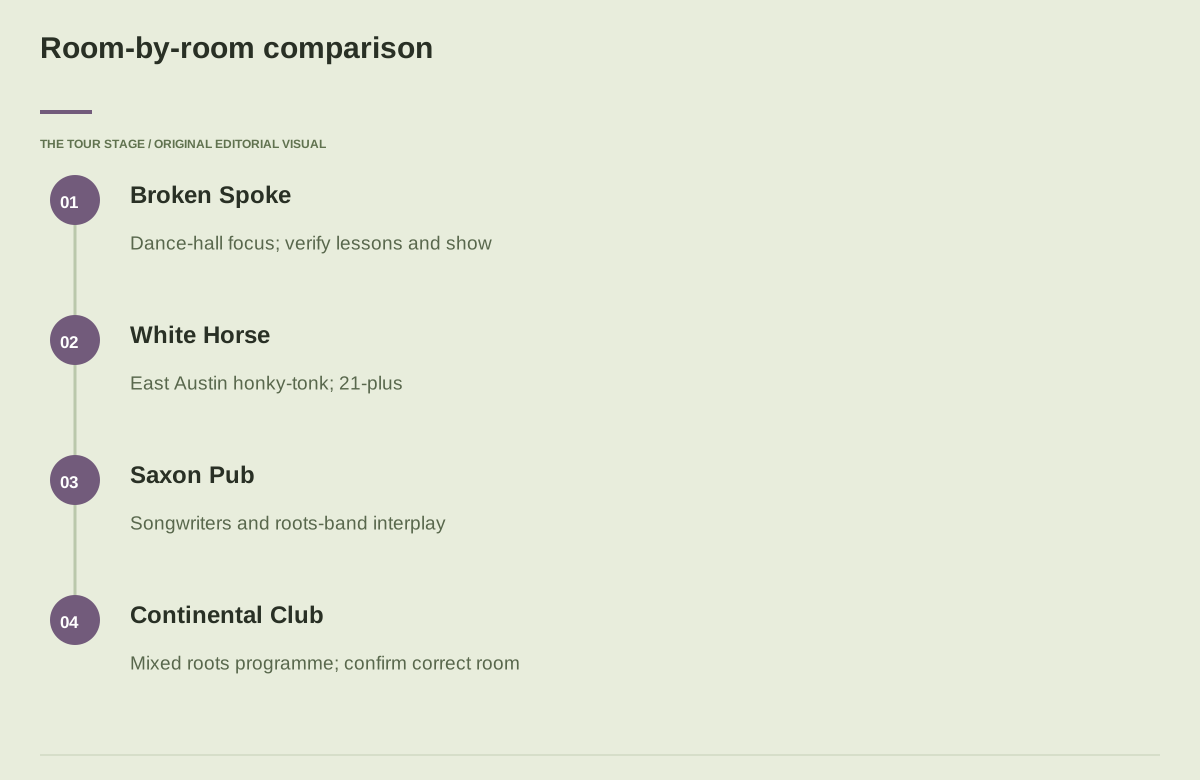
Room-by-room comparison
- Broken SpokeDance-hall focus; verify lessons and show
- White HorseEast Austin honky-tonk; 21-plus
- Saxon PubSongwriters and roots-band interplay
- Continental ClubMixed roots programme; confirm correct room
Read the visual as text
- Broken SpokeDance-hall focus; verify lessons and show
- White HorseEast Austin honky-tonk; 21-plus
- Saxon PubSongwriters and roots-band interplay
- Continental ClubMixed roots programme; confirm correct room
White Horse: an East Austin honky-tonk setting
The White Horse identifies itself as an East Austin honky-tonk and explicitly states that it is a 21-plus bar. That age condition matters when choosing a group outing; do not assume a daytime arrival changes it. Its dancing information and current programme are more useful than an old list of recurring performers. Listen for the interaction between the band’s pulse and the floor, and accept that a lively social room creates a different environment from a seated songwriter concert. If a lyric-led, very quiet performance is your priority, check whether the actual event offers that setting. The point is not that one audience behaves better. Different rooms support different ways of participating, and choosing knowingly makes the evening more satisfying for everyone.2
Saxon Pub: follow the musicians across the bill
The Saxon Pub’s official calendar demonstrates a broad roots and songwriter programme, including regular appearances and individual ticketed shows. In November 2026 it lists acts such as the Resentments and David Grissom, useful evidence of a working musician-centred room rather than a generic country-only label. Treat those as dated examples, not permanent promises. A focused band setting lets you hear how an instrumentalist supports a song over a whole set: a guitar figure can develop, a backing singer can become a lead voice, and a group can change dynamics without relying on a huge stage. Check whether your ticket covers a particular set and how seating works. Several performances listed on the same day do not necessarily constitute one continuous admission.3
Continental Club: a broader roots conversation
The Continental Club’s own programme is the place to distinguish roots rock, country, blues and other bookings, and to identify the correct room. A club with a long history may operate more than one performance space or host several sets, so confirm the event rather than navigating only to a familiar name. The listening appeal is breadth. A country fan may discover that a rockabilly pulse, blues phrasing or a rhythm-and-blues horn part answers the same musical questions they enjoy in country. That overlap does not require every booking to be relabelled country. Listen for the rhythm’s shape and the lead instrument’s role first. A mixed programme can expand a listening habit precisely because it contains genuine differences.4
Prepare with three Austin-connected bands
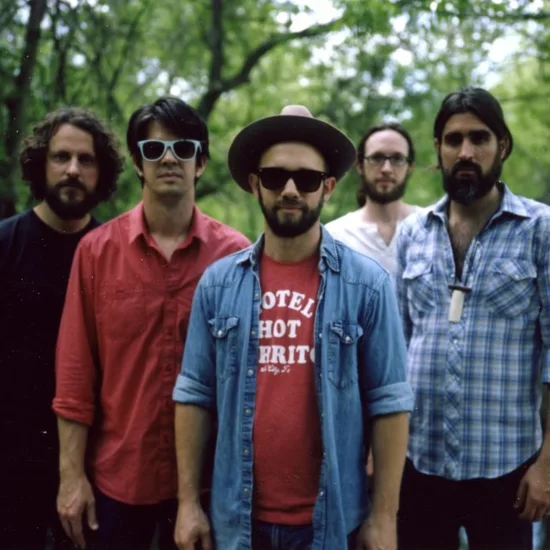
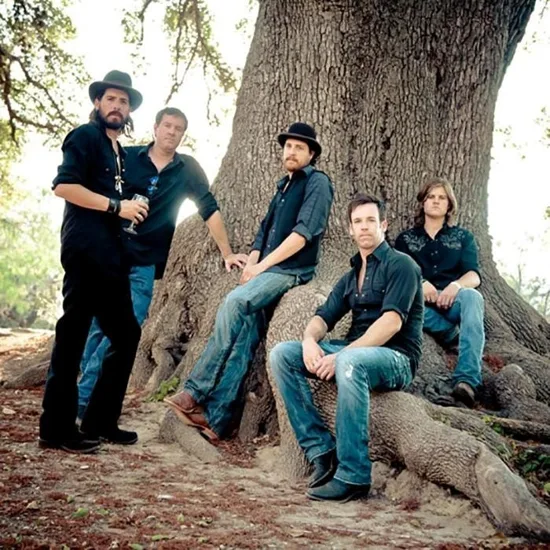
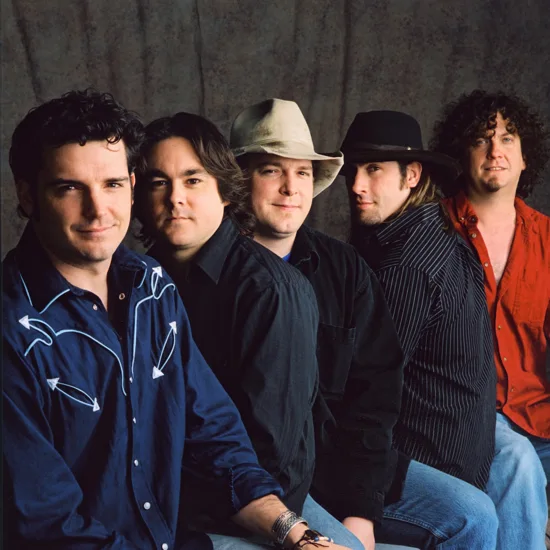
The Band of Heathens, Reckless Kelly and Micky and the Motorcars offer useful record-based preparation for Austin’s roots overlap. Compare the Heathens’ layered vocals and groove, Reckless Kelly’s forceful roots-rock momentum and the Motorcars’ melodic band interplay. These are editorial listening descriptions, not a claim that all three are booked in the rooms above. Pick one full album or a complete official performance from each, then ask which musical feature makes you want a ticket: harmonies, a guitar conversation, the grain of a lead voice or a chorus arriving with force. That answer is more useful than searching for a venue that vaguely looks Texan in photographs.
Choose a route with realistic transfers
Austin’s rooms are not all within a comfortable walk of one another, and a venue-hopping plan can consume the time you hoped to spend listening. Anchor one show, then make another stop optional. Check the venue’s address and the actual return route, including late-night transit or a booked ride. Driving plans need to account for parking and the journey home before drinking begins. For access, ask specific questions about steps, seating, toilets and whether the offered position has a clear view of the performers. A small venue description does not answer those questions. The Texas dance-hall guide extends the route beyond the city; Nashville’s listening rooms offers a useful contrast in audience format.
Listen to what the room changes
After a show, revisit one studio recording from the artist you heard. Did the live version make the rhythm more assertive, leave longer instrumental gaps or bring a backing voice forward? Those are concrete observations that connect place to music. Avoid making a crowded night proof of an artist’s national commercial position or an enthusiastic room proof that every Austin audience wants the same sound. Your experience is local and specific, which is part of its value. Next time, choose one changed variable: a dance rather than a seated set, a trio rather than a full electric band, or a room across town. The small-band listening guide can help identify the ensemble choices you want to follow.
Sources & further reading
- Broken Spoke official websiteOfficial history, music and dance information.
- White Horse official websiteHonky-tonk identity, 21-plus rule and venue information.
- Saxon Pub official calendarCurrent dated programming and ticketed-show distinctions.
- Continental Club official websiteRoom-specific programming and venue details.