A map of connections, not a national ranking
The route here uses birthplace, upbringing or a documented working identity to connect artists to provinces. Those relationships are not identical, and moving to Nashville does not erase a Canadian connection. Nor does every musician from the same province share a style. This is an introductory selection of English-language country and roots recordings, not a complete account of Canadian music or a claim that other languages and Indigenous traditions belong outside country. The Canadian Country Music Association provides one institutional view of the industry, while artist catalogues establish what was actually released. Read the route as an invitation to compare vocal approach, arrangement and storytelling. Its west-to-east order is geographical, not a ladder of importance, popularity or quality.1
British Columbia: Dean Brody and the scale of a story
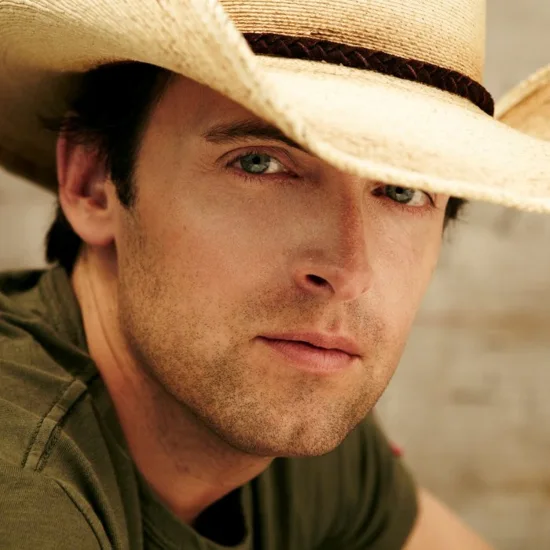
Dean Brody offers a western starting point, with a documented upbringing in Jaffray, British Columbia. Begin with “Brothers,” then widen the frame with Dirt or Crop Circles. A narrative song can establish emotional stakes through what characters do and what they leave unsaid; an energetic song can invite a communal response through a broad refrain. Brody’s catalogue gives you both questions to explore. Listen for how quickly the first verse identifies a relationship and how the later chorus changes your understanding of it. Do not treat a rural image as proof that a song describes the singer’s own biography. Recorded narrators are constructed voices, even when a writer borrows from experience. Official release information helps separate the work from assumptions prompted by a familiar landscape.2
Canada listening map
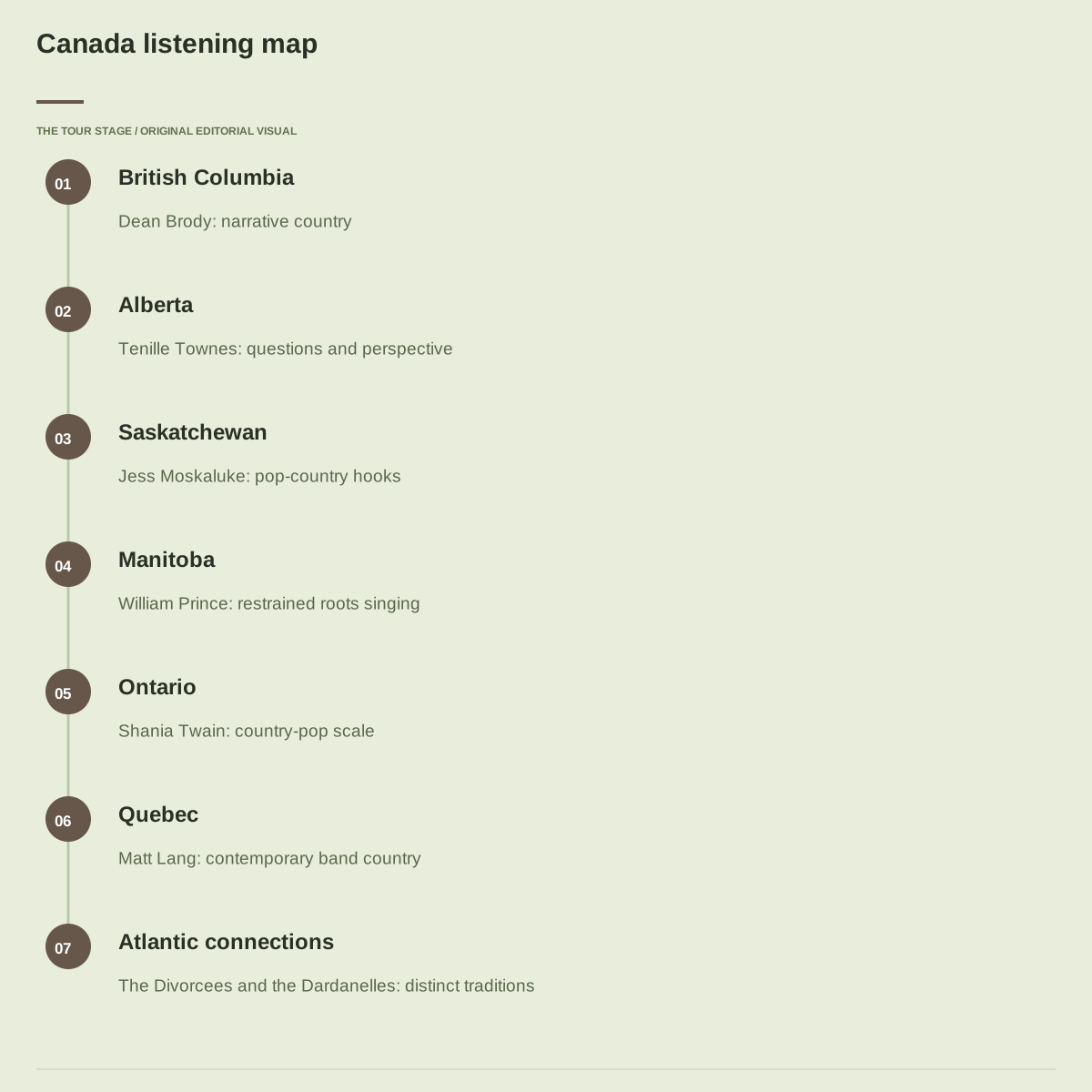
- British ColumbiaDean Brody: narrative country
- AlbertaTenille Townes: questions and perspective
- SaskatchewanJess Moskaluke: pop-country hooks
- ManitobaWilliam Prince: restrained roots singing
- OntarioShania Twain: country-pop scale
- QuebecMatt Lang: contemporary band country
- Atlantic connectionsThe Divorcees and the Dardanelles: distinct traditions
Read the visual as text
- British ColumbiaDean Brody: narrative country
- AlbertaTenille Townes: questions and perspective
- SaskatchewanJess Moskaluke: pop-country hooks
- ManitobaWilliam Prince: restrained roots singing
- OntarioShania Twain: country-pop scale
- QuebecMatt Lang: contemporary band country
- Atlantic connectionsThe Divorcees and the Dardanelles: distinct traditions
Alberta: Tenille Townes and the compassionate question
Grande Prairie, Alberta, is the starting connection for Tenille Townes. Her official biography identifies that upbringing and documents The Lemonade Stand, which includes “Somebody’s Daughter” and “Jersey on the Wall (I’m Just Asking).” Listen to the way a question can organise a country song without receiving a neat answer. A vulnerable vocal does not necessarily require a sparse production; the relationship between the voice and the surrounding instruments determines how close a listener feels. Compare a full studio recording with the Living Room Worktapes versions. The differences are useful because the central writing remains recognisable while the musical frame changes. This is a route into empathy and narrative perspective, rather than evidence that Alberta has one characteristic songwriting temperament.3
Saskatchewan: Jess Moskaluke and a precise pop-country hook
Jess Moskaluke brings the route to Saskatchewan. Her own site connects her with Langenburg and provides the release context for “Mapdot”; “Cheap Wine and Cigarettes” is another established entry point. Compare the sharply shaped chorus with the details that lead into it. Pop-country precision can make an emotion legible quickly, but the interpretation still depends on the singer’s tone and the arrangement’s timing. Ask which phrase you remember after one listen and which detail becomes more interesting after three. Her catalogue also includes alternate mixes and acoustic versions, so identify which recording you are using. A remix can alter the rhythmic surface dramatically while preserving a melody and lyric. That is a production comparison, not a second birthplace or a new regional genre.4
Manitoba: William Prince broadens the listening frame
William Prince, raised in Peguis First Nation in Manitoba, adds a singer-songwriter and roots connection that deserves to be heard on its own terms. His official catalogue includes Earthly Days and Reliever. Begin with “Breathless” and attend to the steadiness of the low vocal and the room around it. The restraint can make a small melodic movement feel consequential. Including Prince does not mean all roots music is simply country under another name. It means an introductory route can show where audiences and musical questions overlap while respecting the artist’s individual work. Compare the emotional effect of a sustained, centred phrase with Townes’ more exposed questioning. Neither approach needs to out-sing the other to communicate depth.5
Ontario: Shania Twain and the possibilities of scale
Timmins is central to Shania Twain’s Ontario story, but the reach of her records cannot be explained by hometown alone. Start with The Woman in Me and Come On Over. Listen to how country instrumentation, emphatic rhythm, backing vocals and highly memorable melodic shapes can work together. The important comparison is not a simplistic country-versus-pop argument. Ask how the production creates a sense of scale around the singer and how a concise lyric invites participation. Then move to Ontario artists such as Tim Hicks or Owen Riegling to hear different balances of guitars, local identity and choruses. The Ontario guide keeps those provincial connections specific rather than making Twain carry the entire history of Canadian country.6
Quebec: Matt Lang and the difference between language and location
Matt Lang provides a Quebec connection in an English-language country route. His official releases, including More, offer an entry into a forceful contemporary country vocal with a strong band setting. Province, language of performance and genre are three different facts; none should be inferred automatically from the others. Listen to the role of the guitar beneath a sustained line and the way a chorus expands from the verse. Then explore Quebec’s wider country programming rather than treating one artist as a comprehensive representative. A useful map leaves room for parallel routes. It can point a listener toward a catalogue without pretending a single selection explains a province’s cultural history, bilingual performance environment or every audience that gathers for country music.7
Atlantic Canada: two different ways to close the journey
New Brunswick’s The Divorcees and Newfoundland and Labrador’s The Dardanelles create a deliberately broad eastern finish. The Divorcees’ official catalogue gives access to a hard-country band approach; the Dardanelles’ records and performances make traditional Newfoundland ensemble music available on its own terms. The latter is a neighbouring tradition in this listening journey, not a claim that every fiddle-led recording is country. Compare rhythm, instrumental roles and how a group carries a melody when a lead singer is not the only point of attention. Atlantic Canada is not one musical region with interchangeable practices, so do not collapse these two acts into a coastal sound. Their inclusion keeps the route honest about both connection and difference, and provides a clear next research question rather than a final national conclusion.89
How to listen across eight stops
Choose one complete recording from each stop, then repeat the session in a different order. The geographical sequence is useful for orientation, but it can accidentally imply an evolution from one style into another. Reordering removes that illusion. Try a quiet vocal followed by a large pop-country chorus, then two band-led records together. Write down what changes: vocal attack, harmonic movement, drum feel, acoustic texture, narrator or song structure. Use specific descriptions rather than national character claims. A fiddle may appear in several stops while performing a different job each time. A writer’s use of a place name may be central to one song and absent from the next. These small distinctions are how an expansive route becomes listening rather than map collecting.
Follow people and credits beyond the map
Artist histories connect Canada with Nashville and many other touring centres, but a cross-border move does not determine the sound of every subsequent record. Check the actual producer and musician credits when you want to understand a recording relationship. Shared management or a festival appearance does not prove collaboration in a studio. Canadian institutions, provincial associations and official artist sites can help you follow those paths without inventing a national league table. For a narrower contemporary session, try four Canadian artist entry points. For a transatlantic comparison, explore the UK live ecosystem. Both routes ask a similar question: how do local audiences and working networks support music that also travels far beyond the place printed in an artist biography?
Sources & further reading
- Canadian Country Music AssociationNational country-industry institution and artist context.
- Dean Brody official websiteOfficial artist and catalogue links.
- Tenille Townes official biographyGrande Prairie upbringing and early releases.
- Jess Moskaluke official newsLangenburg connection and official catalogue.
- William Prince official websiteArtist background and recordings.
- Shania Twain official websiteOfficial catalogue and artist context.
- Matt Lang official websiteQuebec artist and release catalogue.
- The Divorcees official websiteNew Brunswick band and recordings.
- The Dardanelles official websiteNewfoundland traditional ensemble and recordings.