Begin with the sentence, not the high note
A ballad is a performance of a thought unfolding over time. Before deciding whether a singer has a powerful voice, hear where a sentence begins, which word receives its strongest emphasis and whether the ending resolves cleanly or seems to remain in the room. A sustained note can communicate certainty, hesitation or exhaustion depending on what precedes it. Restraint therefore does not simply mean a quiet recording or a small vocal range. It describes the management of emphasis: a performer can reserve a large gesture until the listener understands its significance. These comparisons are listening interpretations, not claims about a singer’s private intentions. Begin with one complete recording at ordinary volume, then return to a verse and chorus. The story-song guide helps identify what the narrator knows before you assess how the singer reveals it.
Vince Gill: hear the approach to the held note
Vince Gill’s official catalogue lists When I Call Your Name, and the label’s anniversary account places the album in its original 1989 context.12 Use the title track to listen for the relationship between a clear vocal line and the feeling of a sentence reaching beyond ordinary speech. Instead of treating its most sustained moments as isolated demonstrations of range, follow the path into them. Hear the consonants that establish the words, the vowel that can carry a pitch and the space left after a phrase. An instrumental reply can continue a feeling without the singer having to repeat it. On a second pass, concentrate on the accompaniment while retaining the vocal in peripheral attention. The question becomes how the arrangement makes a restrained phrase feel exposed, rather than how many notes the singer can deliver.
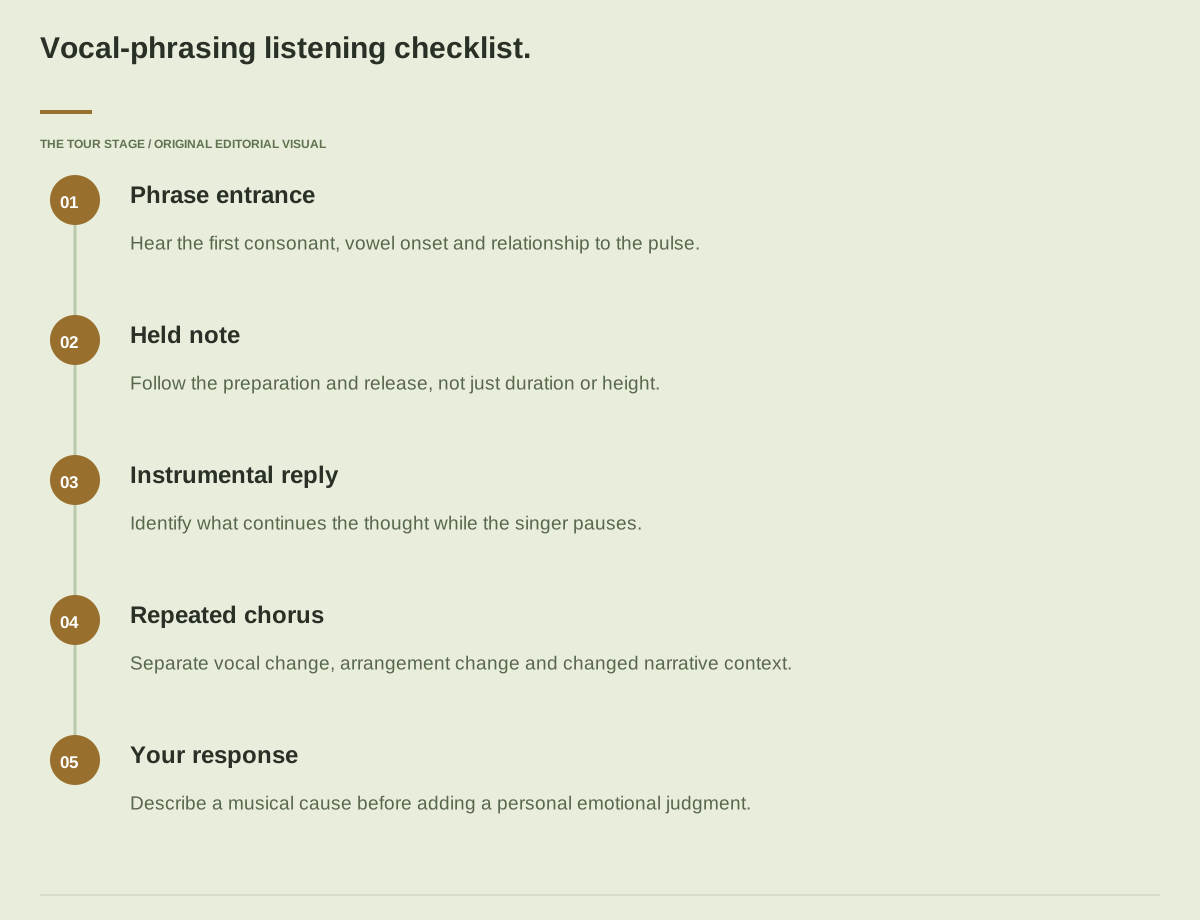
Vocal-phrasing listening checklist.
- Phrase entranceHear the first consonant, vowel onset and relationship to the pulse.
- Held noteFollow the preparation and release, not just duration or height.
- Instrumental replyIdentify what continues the thought while the singer pauses.
- Repeated chorusSeparate vocal change, arrangement change and changed narrative context.
- Your responseDescribe a musical cause before adding a personal emotional judgment.
Read the visual as text
- Phrase entranceHear the first consonant, vowel onset and relationship to the pulse.
- Held noteFollow the preparation and release, not just duration or height.
- Instrumental replyIdentify what continues the thought while the singer pauses.
- Repeated chorusSeparate vocal change, arrangement change and changed narrative context.
- Your responseDescribe a musical cause before adding a personal emotional judgment.
Alison Krauss: intimacy without a miniature emotion
The official Alison Krauss discography dates Lonely Runs Both Ways to November 23, 2004; its recording of “A Living Prayer” provides a contrasting route into vocal concentration.34 Listen for the smooth continuity of the melody and the small differences between starting a note, keeping it present and releasing it. A relatively even surface can make a minor change in weight unusually meaningful. Try listening once without searching for a climactic moment. Follow the stability of the line and the way the surrounding instruments leave it legible. Then hear how the song’s reflective stance is sustained across repeated musical material. This is a useful corrective to equating emotional communication with audible strain. A centred, carefully shaped tone can allow a listener to focus on the thought rather than on the physical effort of producing it.
Gary Allan: texture can supply the tension
Gary Allan’s 1999 Smoke Rings in the Dark offers another approach. His official anniversary account identifies the album and documents its later expanded edition.5 In the title recording, listen to the contrast between the vocal’s grain and the surrounding sense of space. Describe the texture as something you hear, rather than assuming it proves a particular life experience. A rough edge can complicate an otherwise steady phrase; a relatively calm delivery can make the song’s situation feel unresolved. Pay attention to whether a word arrives as a clean onset or with a softer edge, and to how long the arrangement allows an atmosphere to persist after it. Comparing this with Gill or Krauss does not require choosing the most moving singer. It shows that clarity, smoothness and grain are different resources for shaping a ballad.
Follow the room around the voice
The spaces in a ballad are active parts of its arrangement. A guitar response may draw attention toward a phrase’s melodic shape, while a held background texture can keep its emotional colour present. A pause feels different when the pulse continues beneath it. Choose one vocal gap in each recording and identify what occupies it: a distinct answering instrument, a sustained sound, a rhythmic figure or a nearly bare silence. Avoid deciding that more open space automatically means greater sincerity. A full arrangement can protect a fragile vocal line, and an exposed voice can be a highly deliberate production choice. The producer guide explains why recorded intimacy is also a constructed musical perspective. Your listening notes should say what the surrounding parts do, not merely whether the recording seems polished.
Compare timing without turning it into a score
Hear whether the voice seems to settle directly on a beat, lean toward it or allow it to pass before a phrase develops. These impressions can change within one song. You do not need a stopwatch or notation software: tap the underlying pulse gently, then follow one complete sentence. A singer may stretch a word while the rhythm remains steady, creating a small independence between speech and accompaniment. Do not mistake every sustained note for a tempo change. Compare the return of a chorus with its first appearance. Does the same line feel heavier because the arrangement expands, because the voice changes its attack, or because the preceding verse has changed your understanding? Naming the cause keeps a useful comparison from becoming an unsupported claim that one performance is simply more emotional.
A short listening exercise for three ballads
Make three columns headed voice, accompaniment and space. For each recording, enter one precise observation in each column: a gentle onset, a sustained reply, a phrase that ends before the accompaniment settles. Keep judgments such as beautiful or heartbreaking for a separate personal note. Now choose the moment you found most affecting and explain which combination of details produced it. There is no requirement to prefer the most restrained performance. A larger chorus can work because the earlier verse has given it somewhere to go. Repeat the exercise with a second recording by one of the artists, using the official album sequence to keep versions straight. The acoustic comparison guide provides a further experiment in what happens when the surrounding texture changes.
Take the observation into a live room
A ballad in a concert occupies a different frame from the same song through headphones. Crowd sound, the preceding number and the room’s scale all affect attention. Use what you noticed on record as a question rather than a prediction about a future performance. Listen for an instrumental response you previously missed, or for how a singer gives a familiar phrase room to settle. You can enjoy the broad emotional sweep while noticing a small technical choice. That combination is the point of close listening: it adds another way into a song without replacing the first response that made you care about it. Keep the record’s credits and release identity attached to your notes so that a later live version becomes a meaningful comparison, rather than an accidental substitute.
Sources & further reading
- Vince Gill official When I Call Your Name catalogueAlbum identity.
- Universal Music Canada: When I Call Your Name anniversaryOriginal album context and anniversary edition.
- Alison Krauss official music catalogueLonely Runs Both Ways release date.
- Alison Krauss official Bandcamp: A Living PrayerRecording and album identity.
- Gary Allan official Smoke Rings in the Dark anniversary1999 original and later expanded edition.