
Separate admission permission from a suitable family day
Begin with your child’s routine and interests rather than an event’s family-friendly description. How long do they enjoy listening outdoors? What happens when they need quiet, food, a toilet or an early finish? A child who enjoys a recording at home may experience a long crowded day differently. Choose a manageable duration and identify which parts of the programme you would be happy to miss.
Artists such as High Valley, Jess Moskaluke and Josh Turner can be starting points for shared listening, without implying that every performance or festival is suitable for every family. Explore some music together and ask what interests the child. Then assess the event’s practical arrangements independently. The festival-choice guide provides a useful framework for matching an experience to your needs.
Read age rules at the level of the ticket you want
Check the child’s age on the event date, not today, and read any adult-to-child limit. A free admission policy may still require a zero-price ticket or registration. Premium areas, reserved seats and separately ticketed shows can have different conditions. Make a row for every family member, recording the required product and who will accompany them. Keep proof-of-age requirements with the booking information.
The table below records specific organiser policies checked on 8 November 2026. Stagecoach and The Long Road were advertising their 2027 editions; MerleFest’s ticket page had moved to 2027 products. These are edition-context examples, not permanent promises. High Water’s help article was updated on 14 October 2026 but did not identify an edition in its body, so it is labelled by that update rather than silently assigned a festival year.
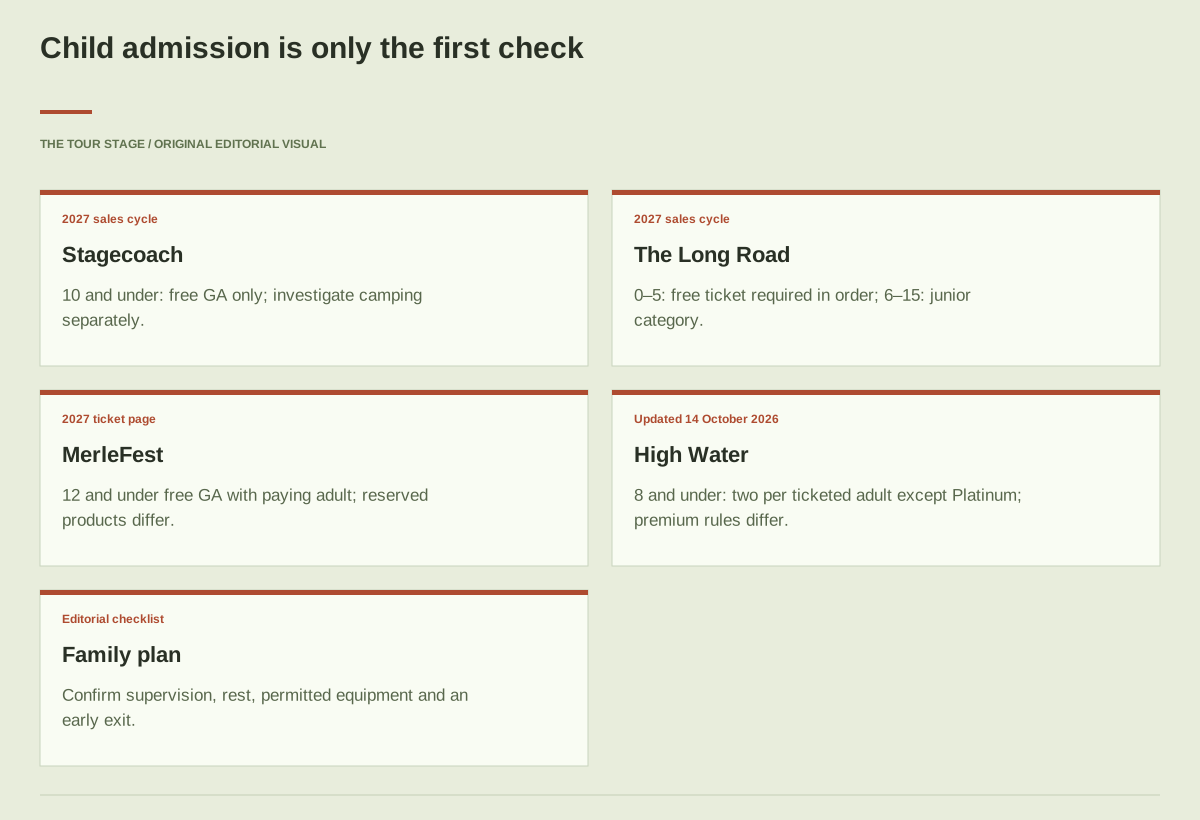
Child admission is only the first check
- 2027 sales cycle · Stagecoach10 and under: free GA only; investigate camping separately.
- 2027 sales cycle · The Long Road0–5: free ticket required in order; 6–15: junior category.
- 2027 ticket page · MerleFest12 and under free GA with paying adult; reserved products differ.
- Updated 14 October 2026 · High Water8 and under: two per ticketed adult except Platinum; premium rules differ.
- Editorial checklist · Family planConfirm supervision, rest, permitted equipment and an early exit.
Read the visual as text
- 2027 sales cycle · Stagecoach10 and under: free GA only; investigate camping separately.
- 2027 sales cycle · The Long Road0–5: free ticket required in order; 6–15: junior category.
- 2027 ticket page · MerleFest12 and under free GA with paying adult; reserved products differ.
- Updated 14 October 2026 · High Water8 and under: two per ticketed adult except Platinum; premium rules differ.
- Editorial checklist · Family planConfirm supervision, rest, permitted equipment and an early exit.
Compare these verified policy details
| Organiser page and context | Published child-admission detail | What to verify for your booking |
|---|---|---|
| Stagecoach, 2027 sales cycle | Children 10 and under free in General Admission only. | Correct access tier and separate camping credentials. |
| The Long Road, 2027 sales cycle | Ages 0–5 use a free child ticket added to the order; ages 6–15 use junior tickets. | Order contains every child and the intended camping category. |
| MerleFest, 2027 ticket page | Ages 12 and under free in GA with paying adult; reserved-seat products require paid tickets for ages 3–12. | Exact reserved product and the stated exemption for ages 2 and under. |
| High Water, policy updated 14 October 2026 | Ages 8 and under free with a ticketed adult, maximum two per adult, except Platinum. | Platinum uses separate age-specific rules, including paid Kids tickets for ages 3–8. |
Read the original pages before purchasing, particularly if a child falls near an age boundary or you are mixing ticket tiers.1234 A free general-admission place does not imply a free seat in every area.
Treat camping as a second permission check
Ask whether children may use your chosen campground, whether they need their own camping credential and whether an accompanying-adult rule applies. Check the maximum occupancy of the pitch or accommodation and count children as the organiser instructs. A festival admission policy does not automatically describe an overnight area. Hotel check-in and occupancy requirements are separate again.
For example, MerleFest’s current ticket page distinguishes its on-campus RV spaces from other camping arrangements and describes restrictions on eligible sleeping vehicles.3 A family carrying a tent should therefore investigate the suitable campground rather than assume every camping product works. Compare the walk, toilets, morning routine and ability to leave early in the camping-versus-hotel worksheet. If a child needs reliable quiet or a particular sleeping setup, make that an essential requirement rather than an optional upgrade.
Map rest, toilets, food and the route out
Choose a few facilities that determine whether the day will be comfortable. Find toilets, drinking water, any family area, a quieter place to pause and the transport pickup point. Identify the route between them and your likely stage. Do not assume shade, indoor rest or a play space will exist simply because children are admitted. Ask the organiser when the map does not resolve an important need.
MerleFest’s published festival information describes family facilities and also warns about uneven ground and hills.5 This is the kind of specific evidence that is more useful than a broad family label. Inspect routes with a pushchair or mobility requirement in mind. Plan rest before everyone is exhausted and choose a shorter programme if the facilities require too much back-and-forth walking.
Check equipment and individual access needs early
Verify pushchairs, wagons, food, bottles, changing supplies, shade equipment and bags against the actual entrance policy. One event’s exception for a child-related item does not create an exception elsewhere. If a necessary item appears restricted, ask the organiser’s access or guest-services team about the procedure and keep the response. Pack essentials in the allowed format so you do not have to reorganise a family’s belongings at security.
Hearing protection should be suitable for the child and comfortable enough to use; plan quieter breaks and ask qualified advice if you need individual guidance. Any medical, sensory or mobility requirement deserves a specific question to the festival rather than a generic accessibility assumption. The packing list helps separate admission-day essentials from overnight belongings, keeping what you need for the child reachable throughout the journey.
Agree supervision and an early-exit plan
Name the adult responsible for each child whenever the party separates. Agree the exact handover rather than assuming another person is watching. On arrival, identify event staff and ask how the festival handles a separated child. Use the organiser’s procedure for urgent help. A family meeting point is useful for routine regrouping, but it is not a substitute for seeking staff assistance when a child is missing.
Check re-entry before treating the car or hotel as an afternoon rest base. The Long Road’s current ticket information distinguishes camping access from day and non-camping re-entry conditions.2 If leaving ends your festival day, plan accordingly. Make sure an early departure remains possible even if other adults want to stay. Keep keys, tickets, transport details and essential belongings with the person who would leave.
Let the child’s experience set the pace
Choose one or two realistic shared musical moments, then leave room around them. An afternoon that ends happily can be a better introduction than a full day completed through fatigue. If the child enjoys a shorter set, remember that success rather than measuring the trip against an adult timetable. Bring the decision to leave forward when the day stops working; the money already spent does not make another hour more enjoyable.
Afterwards, ask what they liked: a particular instrument, dancing, a new singer or simply being outdoors together. Those answers help you choose the next experience. Keep the useful policy notes, but check them again for another edition. Family festival planning is an exercise in matching real needs to real arrangements, with enough flexibility to enjoy what happens once the music starts.
Sources & further reading
- Stagecoach general information2027 sales-cycle page: children 10 and under free in GA only; checked 8 November 2026.
- The Long Road ticket information2027 sales-cycle child/junior categories, required free child ticket and ticket-type re-entry distinctions; checked 8 November 2026.
- MerleFest tickets2027 products: GA age 12-and-under policy, specific reserved-product age-two exemption, and on-campus RV restrictions; checked 8 November 2026.
- High Water child admission policyHelp article updated 14 October 2026: adult-to-child limit and separate Platinum rules; edition unstated.
- MerleFest festival informationFamily facilities and terrain information; current page checked 8 November 2026.