Think in connections rather than a single Texas sound
A useful Texas-country map links songs to rooms, broadcasters, record releases and listeners. These connections can support a fiddle-led dance band, a reflective songwriter or a louder guitar act without making them interchangeable. The label describes participation in a regional culture as well as musical traits. That is why a list of instruments is not enough to explain it, and why an artist’s birthplace does not settle the question.
Start with three contrasting points of entry: Randy Rogers Band, Wade Bowen and Aaron Watson. Compare how their vocals meet the rhythm, then follow the documented collaborations and release histories. The aim is to understand how listeners can encounter this music, not to declare a separate state-sized genre with no connections to Nashville, Oklahoma or the rest of country.
Dance halls give a song a physical test
Gruene Hall’s operator traces the hall to 1878 and describes its continuing connection to live music, including George Strait, Lyle Lovett and Willie Nelson. The historical room matters because dancing changes what listeners ask of a band: a clear pulse, transitions that retain momentum and phrasing that can float above a steady foundation. A song can be emotionally complicated while making its movement easy to follow.1
That does not mean every Texas-country show is a dance, or that the same arrangement serves every room. A seated listening audience may reward quieter detail; a large standing crowd may respond to a forceful entrance. Hear the distinction in records too. Ask whether the beat feels designed to sustain a continuous step or to support a dramatic build. Venue history supplies context, while the actual recording supplies the evidence about its rhythm.
How a Texas song finds its listeners
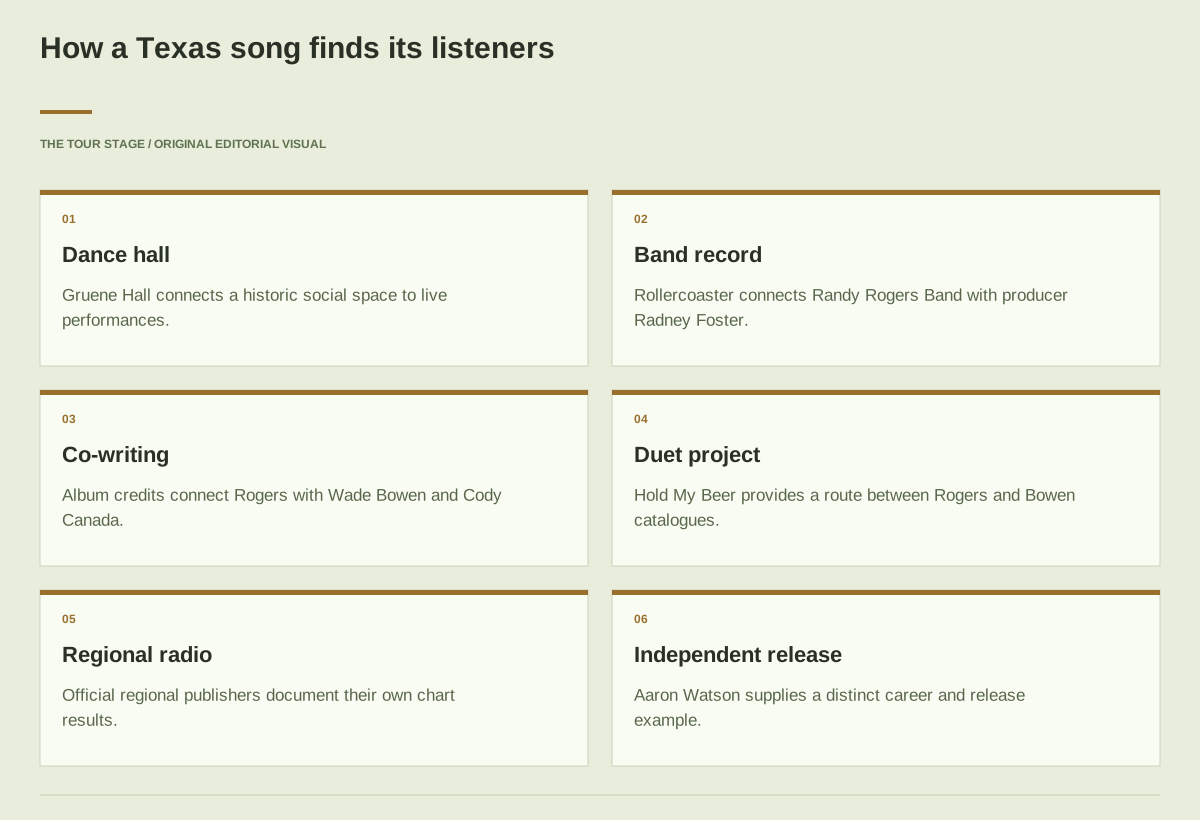
- Dance hallGruene Hall connects a historic social space to live performances.
- Band recordRollercoaster connects Randy Rogers Band with producer Radney Foster.
- Co-writingAlbum credits connect Rogers with Wade Bowen and Cody Canada.
- Duet projectHold My Beer provides a route between Rogers and Bowen catalogues.
- Regional radioOfficial regional publishers document their own chart results.
- Independent releaseAaron Watson supplies a distinct career and release example.
Read the visual as text
- Dance hallGruene Hall connects a historic social space to live performances.
- Band recordRollercoaster connects Randy Rogers Band with producer Radney Foster.
- Co-writingAlbum credits connect Rogers with Wade Bowen and Cody Canada.
- Duet projectHold My Beer provides a route between Rogers and Bowen catalogues.
- Regional radioOfficial regional publishers document their own chart results.
- Independent releaseAaron Watson supplies a distinct career and release example.
Rollercoaster makes the network concrete
Randy Rogers Band’s official anniversary account identifies Rollercoaster as its 2004 second full-length album, produced by Radney Foster. It also credits songs written with Cody Canada and Wade Bowen. Those credits are a small but precise picture of a connected musical world: an established songwriter-producer, a band developing its identity, and peers contributing to the material. Collaboration is visible in the record itself, rather than merely in a story about friendship.2
Listen to “Somebody Take Me Home,” then “This Time Around.” Follow the singer’s attack and the band’s response before comparing lyrical subjects. The performance can be intimate at the level of a line and expansive at the level of a chorus. If you use the twentieth-anniversary edition, note that the official announcement calls it remastered and resequenced. Original and later editions should not be treated as identical objects when discussing track order.
Rogers and Bowen build a second setting
The Hold My Beer partnership shows how artists can keep individual identities while creating a shared space. The duo’s official biography documents the first volume in 2015 and the second in 2020, with later instalments continuing the project. The premise is not that a duet must split every song into an argument. Two recognisable singers can trade lead roles, reinforce a joke or give a familiar phrase a different weight through vocal contrast.3
Compare one duo performance with one solo or band recording by each participant. Listen for who establishes the scene, how the other voice enters, and whether the arrangement changes to make that exchange clear. The result can feel informal while depending on precise timing. The collaboration also gives listeners a practical route between catalogues. If one voice catches your attention, follow it back into the artist’s own records rather than assuming the duo contains the entire story.
Regional radio is a route, not a universal score
Regional charts and specialist broadcasters can help listeners encounter records outside the same national playlist. The Texas Country Music Association’s 2024 statement directs readers to named official chart publishers, including Texas Regional Radio Report. That is a reason to use the original publisher and methodology when discussing chart position. It is not a reason to turn a temporary ranking into a permanent measure of an artist’s worth.4
A radio chart, a ticketed show and an album sequence reveal different things. One measures a defined set of reported plays; another presents a performance to a particular room; the third gives an artist control over a longer listening arc. Avoid borrowing evidence from one to make unsupported claims about another. A useful discovery habit is to note a song you heard on radio, then seek the official album or artist page to establish which recording it was.
Independence describes responsibilities as well as freedom
Aaron Watson’s official site preserves an early account of The Underdog era that describes his independent approach and work on the dance-hall and rodeo circuit. Use that as a documented career example, not a rule that all Texas artists share one business structure. An artist can own a release, work with outside distribution, hire publicity and use national infrastructure. Independence does not mean doing every task alone.5
For a listener, the useful questions are concrete: who released this record, where is the official catalogue, and how does it connect to the next performance or album? Business labels can explain available routes without predicting artistic quality. Watson’s presence alongside Rogers and Bowen makes the ecosystem broader, because the same audience may move among different release models. Our independent-country guide examines those distinctions without inventing revenue or contract details.
Build your own regional listening circuit
Choose one Rogers Band album, one Bowen release and one Watson release. Add a duet from Hold My Beer between them, then compare the movement from solo voice to partnership to band identity. Keep the volumes reasonably similar so a louder master does not automatically feel more exciting. Write down one instrumental feature and one vocal feature per record; “Texas” should be the context for the comparison, not its entire conclusion.
Then follow a venue’s archive or an artist’s official release notes to a new name. Use the Red Dirt guide to understand the related Oklahoma history and the honky-tonk feature for dance rhythm. George Strait provides another connection between a specific Texas room and a much wider country audience. The ecosystem works because these routes overlap: a radio discovery can become an album purchase, a duet can introduce a singer, and a dance hall can make a song newly memorable.
Sources & further reading
- Gruene Hall operator history1878 hall and documented artist associations.
- Randy Rogers Band: Rollercoaster anniversary2004 album, Foster production, writing credits and resequencing.
- Randy Rogers and Wade Bowen official biographyHold My Beer collaboration and volume chronology.
- Texas Country Music Association chart statementNamed chart publishers and original-source guidance.
- Aaron Watson official archiveArchived account of independent career and dance-hall circuit.