
The sound begins with a working scene
Bakersfield’s country history grew through migration, local broadcasting, clubs and musicians who needed to make themselves heard. The Country Music Hall of Fame and Museum’s historical account places Buck Owens and Merle Haggard alongside figures including Bill Woods, Bonnie Owens, Billy Mize and Red Simpson. That wider cast matters. A regional sound is produced through overlapping bands and opportunities, not invented in isolation by the two names most likely to appear on a compilation. The museum’s Bakersfield exhibition closed in 2014; its historical material is still useful evidence, but it should not be presented as a current attraction. Start with the records and use the institutional history to understand the network around them.1
Buck Owens: a bright attack and a clear centre
Begin with Buck Owens and the Buckaroos on “Act Naturally,” then hear “I’ve Got a Tiger by the Tail.” Listen to the clipped guitar attack, the vocal’s directness and the space between the lines. A brisk record can feel full without a thick blanket of instruments because each part has a distinct function. The guitar introduces a recognisable shape, bass and drums keep the song travelling, and the singer’s timing brings personality to economical writing. Then slow the route with “Together Again,” where steel guitar helps carry the emotional argument. The contrast prevents an easy mistake: Bakersfield is not simply fast country with a bright electric guitar. The same scene could make a patient ballad feel as unmistakably itself as a racing single.
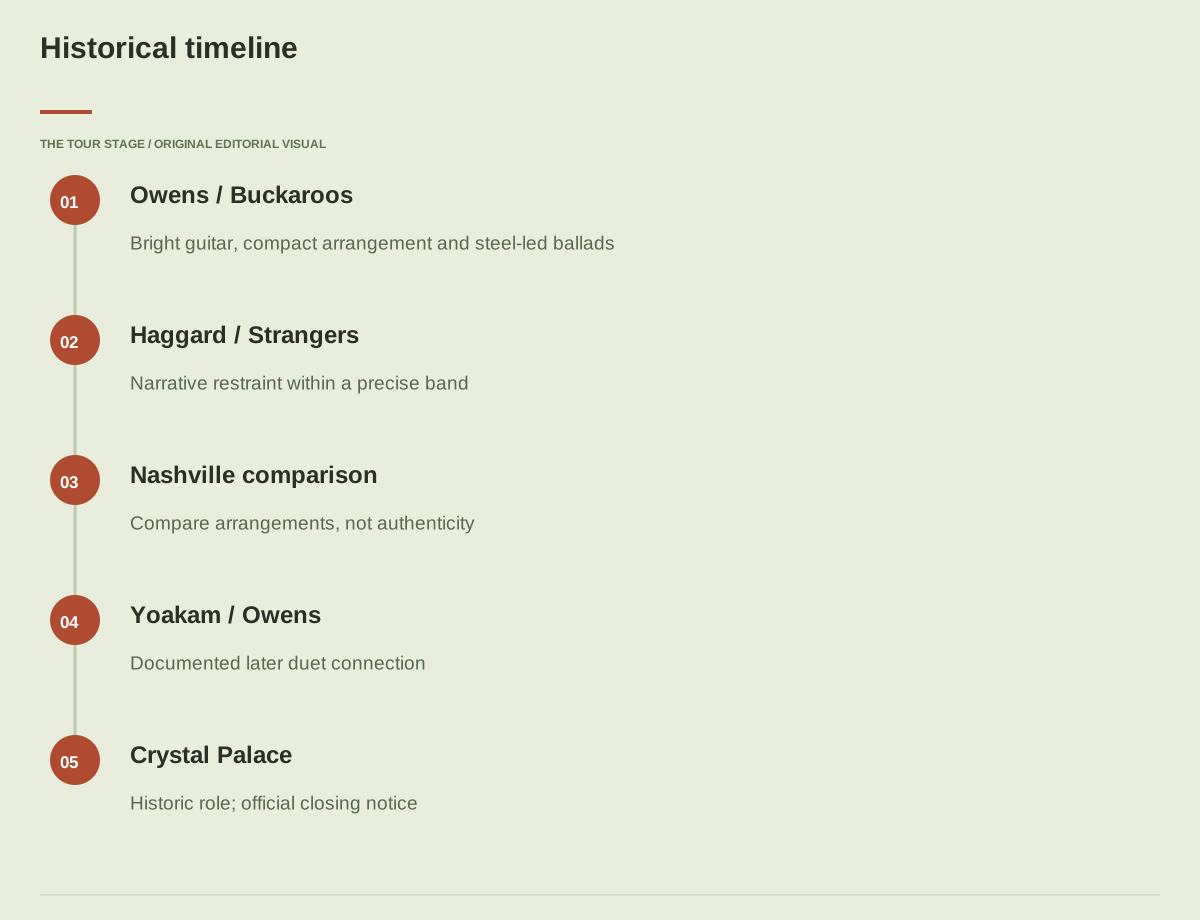
Historical timeline
- Owens / BuckaroosBright guitar, compact arrangement and steel-led ballads
- Haggard / StrangersNarrative restraint within a precise band
- Nashville comparisonCompare arrangements, not authenticity
- Yoakam / OwensDocumented later duet connection
- Crystal PalaceHistoric role; official closing notice
Read the visual as text
- Owens / BuckaroosBright guitar, compact arrangement and steel-led ballads
- Haggard / StrangersNarrative restraint within a precise band
- Nashville comparisonCompare arrangements, not authenticity
- Yoakam / OwensDocumented later duet connection
- Crystal PalaceHistoric role; official closing notice
Merle Haggard: another voice within the same history
Merle Haggard and the Strangers offer a different centre of gravity. Put “Mama Tried” beside “Sing Me Back Home” and hear how the narrator’s restraint changes the band’s emotional work. Haggard can make a line sound lived-in through a small turn of phrasing rather than a large vocal flourish. The Strangers’ precision gives those choices room. Do not infer that every lyric is a literal autobiographical transcript; a recording is still a crafted narrative. Compare Haggard’s voice with Owens’ while holding the shared setting in mind. You will hear related musical vocabulary without needing to claim that the two singers had one technique, one repertoire or a single point of view. The Hall of Fame’s Haggard biography provides the career context for these recordings.2
What the instruments actually do
The familiar list—electric guitar, steel, fiddle, bass and drums—does not explain a sound until you hear the jobs. Guitar can add a percussive edge, deliver a hook or answer the singer. Steel can sustain a chord through a vocal gap or introduce a moving melodic line. Fiddle may sharpen the rhythm as well as provide a tune. Bass and drums make the arrangement’s economy convincing by keeping the pulse clear. A useful exercise is to replay one verse three times, following the voice, then the bass, then the fills. The parts often avoid stepping on one another. That separation helps create energy and intelligibility simultaneously. It is more informative than equating old recordings with rawness or assuming modest instrumentation means unconsidered production.
Compare Nashville arrangements without caricature
Historical descriptions often contrast Bakersfield’s harder-edged band sound with the smoother pop-oriented Nashville Sound. That is a useful starting comparison, provided it does not become a false border. Nashville also recorded vigorous honky-tonk and instrumental virtuosos; California musicians could make polished, carefully arranged records. Compare specific recordings rather than entire cities. Ask whether strings or backing voices create a continuous cushion, whether guitar fills are exposed, and how close the lead vocal feels to the rhythm section. Those choices can shift the sense of intimacy and attack. They do not establish that one city was honest and the other artificial. Country’s recording history becomes more interesting when production is treated as musical decision-making instead of a contest between geographical virtues.
Dwight Yoakam: a later conversation, not a frozen revival
Dwight Yoakam’s Guitars, Cadillacs, Etc., Etc. is a useful later listening connection. His catalogue makes the continuity with honky-tonk audible while his own vocal shape and the records’ attack prevent the music from becoming a museum replica. The Owens–Yoakam recording of “Streets of Bakersfield” gives this route a concrete artist connection rather than a resemblance inferred from two hats or guitars. Compare it with the earlier Owens material and notice what a duet changes: alternating voices can make the song feel like an exchange, while shared lines establish common ground. Yoakam belongs in this history as a later participant in the conversation, not as evidence that every California country record must reproduce a 1960s arrangement.3
History to visit, and a closure to respect
Bakersfield’s Kern County Museum provides a broader local-history context for understanding the city beyond a record sleeve. Check its current exhibitions and visitor information directly before travelling for a specific display. Buck Owens’ Crystal Palace requires particular care: the Owens family’s official website carries a closing announcement, explaining that the family is stepping back and the venue is shutting its doors. This guide therefore does not recommend it as a currently bookable music or dining stop. Older tourism descriptions may preserve a former attraction’s information after operations change. A historical building can remain important to the story without remaining available for a night out. For a present-day show, use a currently operating venue’s own calendar and ticket link.45
A six-record listening route
Start with “Act Naturally” for compact band definition, move to “Together Again” for sustained steel, then “I’ve Got a Tiger by the Tail” for pace. Continue with “Mama Tried” and “Sing Me Back Home” to hear Haggard’s narrative emphasis, then finish with the Owens–Yoakam “Streets of Bakersfield.” These are a manageable introduction, not the final six essential records or a sales ranking. Follow the named bands and instrumentalists in the credits when you continue. The traditional-country starter kit shows how later artists vary these tools, while Texas dance halls puts rhythmic clarity in a different social setting. Your strongest listening note will name an audible choice: an exposed guitar answer, a held steel note or a singer arriving just behind the beat.
Sources & further reading
- Country Music Hall of Fame: Bakersfield exhibition historyScene participants, recordings and historical arrangement context; exhibition closed in 2014.
- Country Music Hall of Fame: Merle HaggardHaggard career and recorded legacy.
- Dwight Yoakam official websiteOfficial catalogue and later artist connection.
- Kern County MuseumLocal historical institution and current visitor-information entry point.
- Owens family: Crystal Palace closingOfficial closing announcement; venue not recommended as an operating attraction.