Listen for the short chord before the solo
The easiest mandolin sound to notice is often a bright melodic break. The sound that quietly organises a bluegrass band may be the short, stopped chord known as the chop. Instead of letting every string ring, the player creates a brief rhythmic event. It adds punctuation between the stronger bass beats and helps the group feel coordinated without a drum kit.
This is a common bluegrass role, not an obligation on every mandolin player or every song. A ballad may call for sustained harmony, a contemporary arrangement may contain drums and a duo may distribute the pulse differently. Listen to the ensemble before naming the technique. The mandolin’s value comes from its relationship with what is already happening: the same little chord can create lift in one context and feel unnecessarily busy in another.
What the instrument diagram should actually show
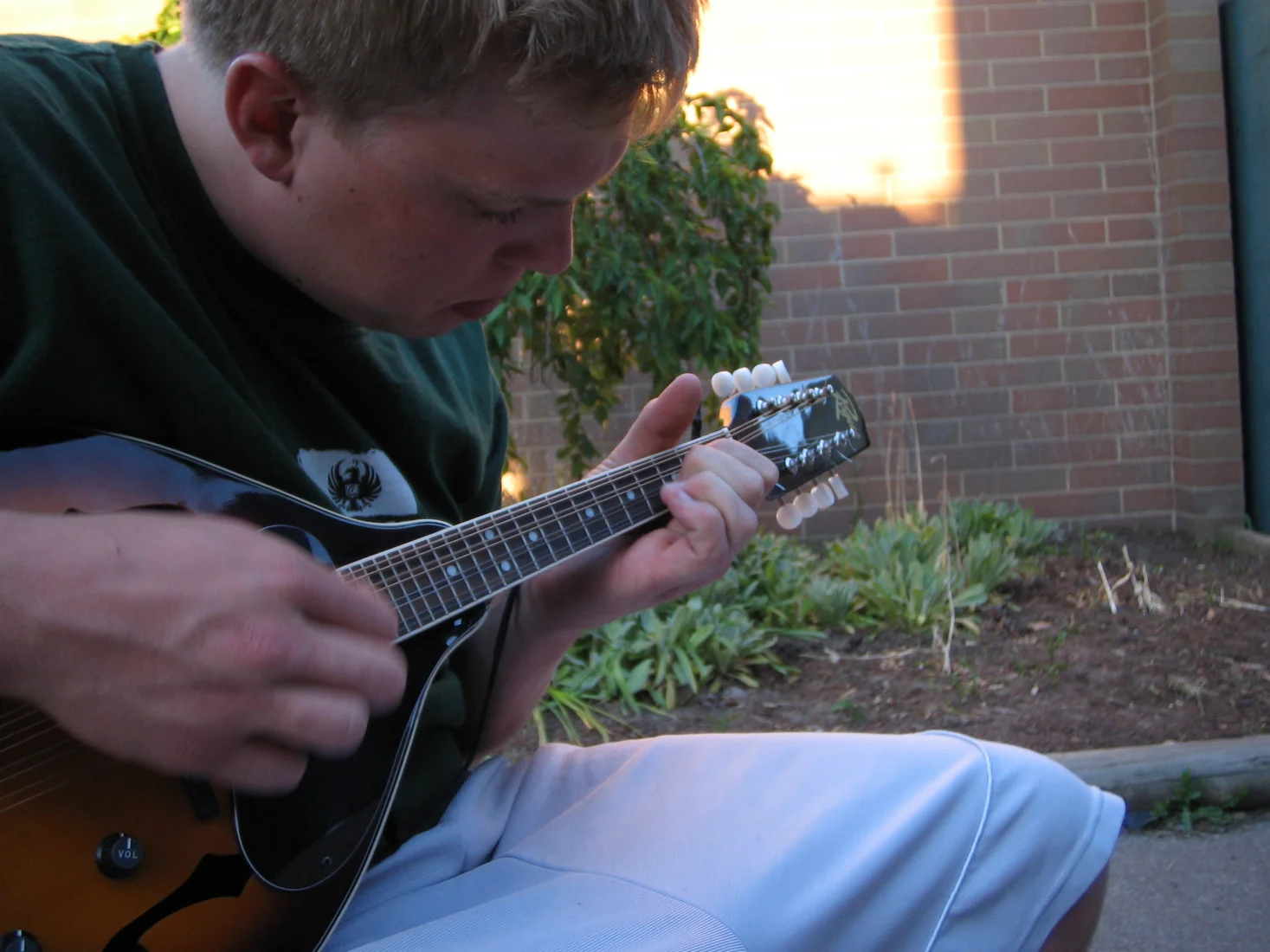
A standard mandolin has eight strings arranged as four paired courses. Each pair is normally tuned to the same pitch, with the courses tuned in fifths, conventionally G, D, A and E from low to high. The right hand uses a pick; the left hand fingers notes and chords against frets. Body shapes vary, and a decorative scroll is not what defines the basic musical role.
The paired strings help explain the instrument’s characteristic shimmer, but they do not determine the whole tone. Touch, picking position and how long the player lets notes ring all matter. In our diagram, label courses as pairs rather than drawing eight unrelated musical voices. A listener does not need to memorise the tuning to hear the contrast between a clipped chord, a sustained single-note melody and tremolo, in which rapid repeated picking helps a note remain present.
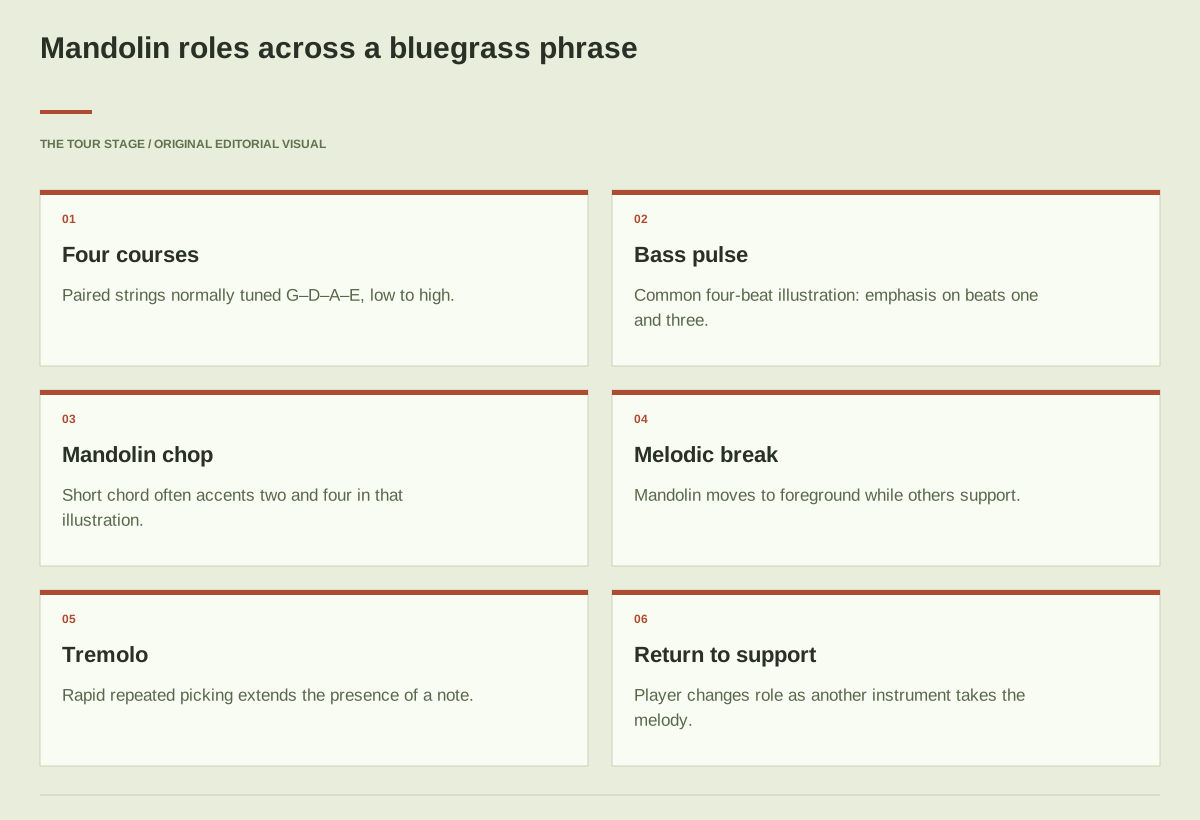
Mandolin roles across a bluegrass phrase
- Four coursesPaired strings normally tuned G–D–A–E, low to high.
- Bass pulseCommon four-beat illustration: emphasis on beats one and three.
- Mandolin chopShort chord often accents two and four in that illustration.
- Melodic breakMandolin moves to foreground while others support.
- TremoloRapid repeated picking extends the presence of a note.
- Return to supportPlayer changes role as another instrument takes the melody.
Read the visual as text
- Four coursesPaired strings normally tuned G–D–A–E, low to high.
- Bass pulseCommon four-beat illustration: emphasis on beats one and three.
- Mandolin chopShort chord often accents two and four in that illustration.
- Melodic breakMandolin moves to foreground while others support.
- TremoloRapid repeated picking extends the presence of a note.
- Return to supportPlayer changes role as another instrument takes the melody.
Bill Monroe’s ensemble provides a clear reference
The National Endowment for the Arts’ Bill Monroe profile identifies the classic Blue Grass Boys personnel and the instrumental combination that crystallised the bluegrass sound.1 Monroe’s mandolin belongs inside that combination. It is misleading to reduce the style to one instrument when the interaction of guitar, banjo, fiddle, bass and voices is so central.
Listen to a documented Monroe performance and follow the mandolin during a vocal verse. Then notice the change when it takes a break. The texture may open because another musician adjusts their support. That shift is one of bluegrass’s most useful listening clues: musicians keep redistributing the foreground. For the neighbouring roles, the flatpicking guide and fiddle guide show how picked and bowed instruments can each carry melody without needing to occupy the spotlight simultaneously.
The chop is an accent, not a metronome replacement
In a common four-beat explanation, bass emphasis falls on one and three while the mandolin’s short chord accents two and four. Count that slowly and hear the alternation. Real bluegrass feel is subtler than a diagram, however. The duration, placement and strength of each event affect whether the music feels buoyant, relaxed or tense. Waltzes and other metres also need different explanations.
A chop is often stopped by relaxing the fretting pressure after the attack, though players may use several muting choices. The important listening result is a short sound with room around it. It is not the same as strumming a full ringing chord continuously. If the banjo and guitar are already busy, a concise mandolin accent can clarify the pulse precisely because it ends quickly. Silence after the chord is part of the rhythmic contribution, rather than an absence the player has forgotten to fill.
Sierra Hull expands the available space
Sierra Hull’s Weighted Mind offers an especially useful contrast with a conventional full bluegrass band. Concord identifies Béla Fleck as producer and describes the recording’s sparer setting.2 With fewer instruments competing, the mandolin can expose details of melody, resonance and accompaniment that might sit inside a denser group texture.
Listen to “Weighted Mind” and ask what carries the pulse when there is no obvious chop. Then explore Hull’s official catalogue for a fuller ensemble performance.3 Our interpretation is about responsibility: the mandolin can suggest harmony and rhythm while remaining a melodic instrument. That flexibility is more informative than treating the record as a departure measured against a single rulebook. A player can remain deeply informed by bluegrass while choosing an arrangement that redistributes its familiar roles.
Follow the handovers in a modern band
Try a documented performance by The Travelin’ McCourys or The Infamous Stringdusters. Identify the mandolinist through the official lineup or release credits instead of assuming the lead singer plays every featured part. Watch what changes when a solo begins: another musician may simplify, the mandolin may stop chopping or a backing line may take over its rhythmic job.
These observations explain why musical roles are more useful than a static stage diagram. The musician on the left is not always the melody, and the instrument with the highest pitch is not always the lead. Pay attention to entrances, exits and changes in note length. A mandolin break can develop a tune in its own right, then return to support with no dramatic visual signal. Hearing that return often reveals the band’s coordination more clearly than the fastest moment of the solo.
Build a short listening map
Use three columns in your notes: rhythm, melody and sustain. Place each passage according to what the mandolin is doing now, allowing more than one column when the duties overlap. A short chord goes under rhythm; a recognisable tune under melody; tremolo may connect melody with sustained presence. This is an editorial listening exercise, not a numerical rating of how traditional the performance is.
Compare a Monroe track, a Hull track and a modern band performance. Describe one change that would be lost if the mandolin were removed. Perhaps the pulse would become less crisp, the melodic exchange less varied or a quiet passage less harmonically complete. The answer is specific to the arrangement. Continue to the country-band instrument map for the wider ensemble, remembering that any stage map is only a starting picture of a musical conversation that keeps moving.
Sources & further reading
- National Endowment for the Arts: Bill MonroeClassic Blue Grass Boys ensemble and instrumental roles.
- Concord: Weighted MindSierra Hull recording, Bela Fleck production and spare ensemble.
- Sierra Hull official musicOfficial mandolinist catalogue and performance entry point.