Establish what the festival website actually shows
The official Watershed homepage remains headed as the 2025 festival, with August 1–3 and an archived bill. It also displays the organiser’s notice that Watershed is taking a hiatus in 2026 after thirteen years at the Gorge. Read those two pieces together: the archived date and artist panels describe the completed edition, while the notice explains the subsequent pause.1
This is consequently a venue-focused guide, with the festival’s history as its context. It does not turn the old poster into a future itinerary. That approach remains useful because the Gorge’s approach roads, camping products and controlled concert area are concrete things readers can research. If revisiting memories or comparing the Gorge with another country destination, start with those physical and practical characteristics rather than a recycled date in a third-party listing.
Understand the two-part Gorge experience
The official venue is Gorge Amphitheatre at 754 Silica Road Northwest in George, Washington. Its current website separates visiting the concert venue from camping and provides distinct planning pages for each. The campground and performance entrance should therefore be treated as linked but separate parts of a visit.23
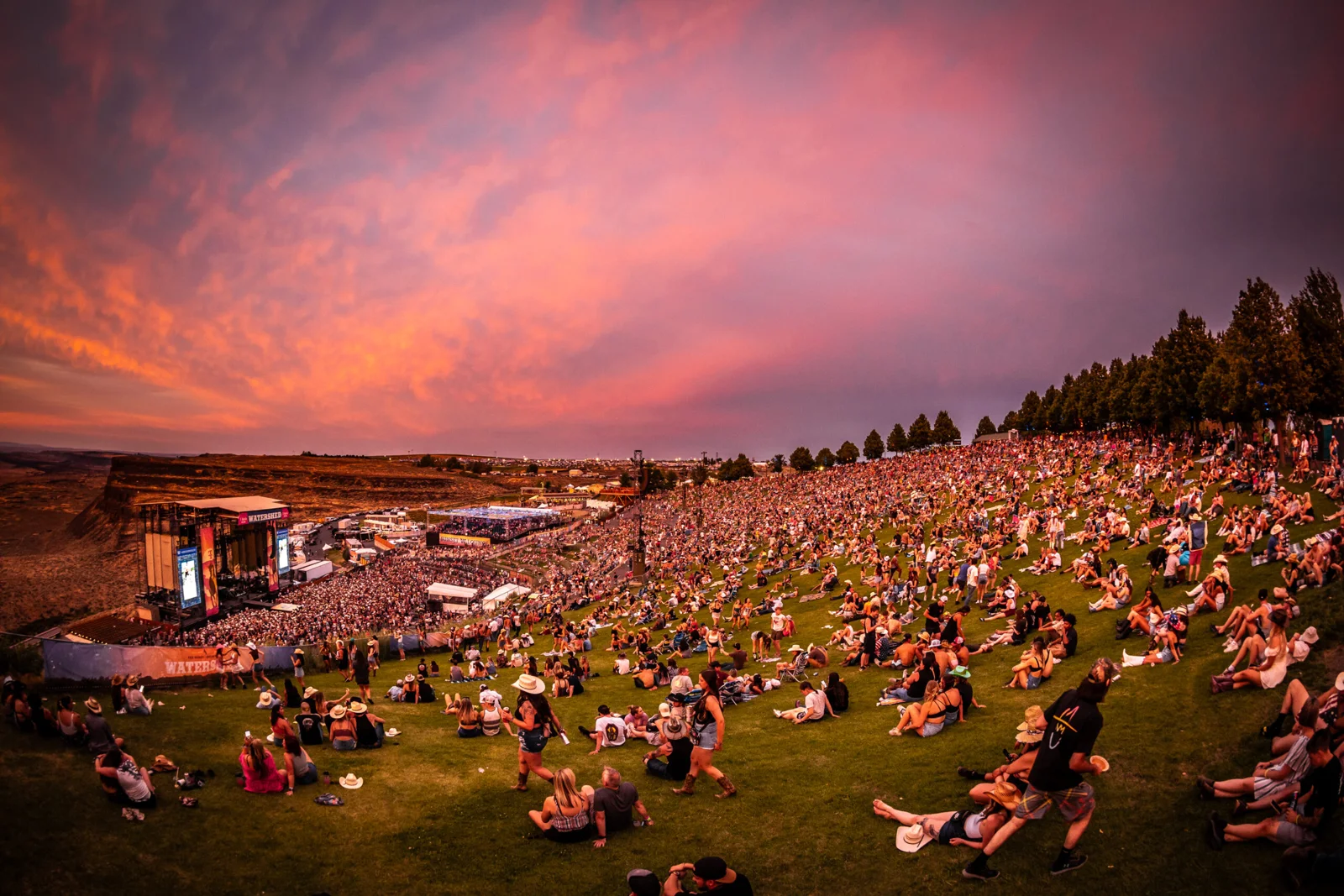
The landscape is part of the appeal, but it is not a substitute for orientation. Use the venue map to locate the relevant gate, your accommodation area and the route between them. A scenic photograph does not establish how long a particular walk takes or whether it suits a person’s mobility needs. If planning another documented show at the venue, build the itinerary around that show’s actual ticket and arrival instructions. The archived Watershed map can explain history, but it should not govern a different event.
Three records that must stay separate
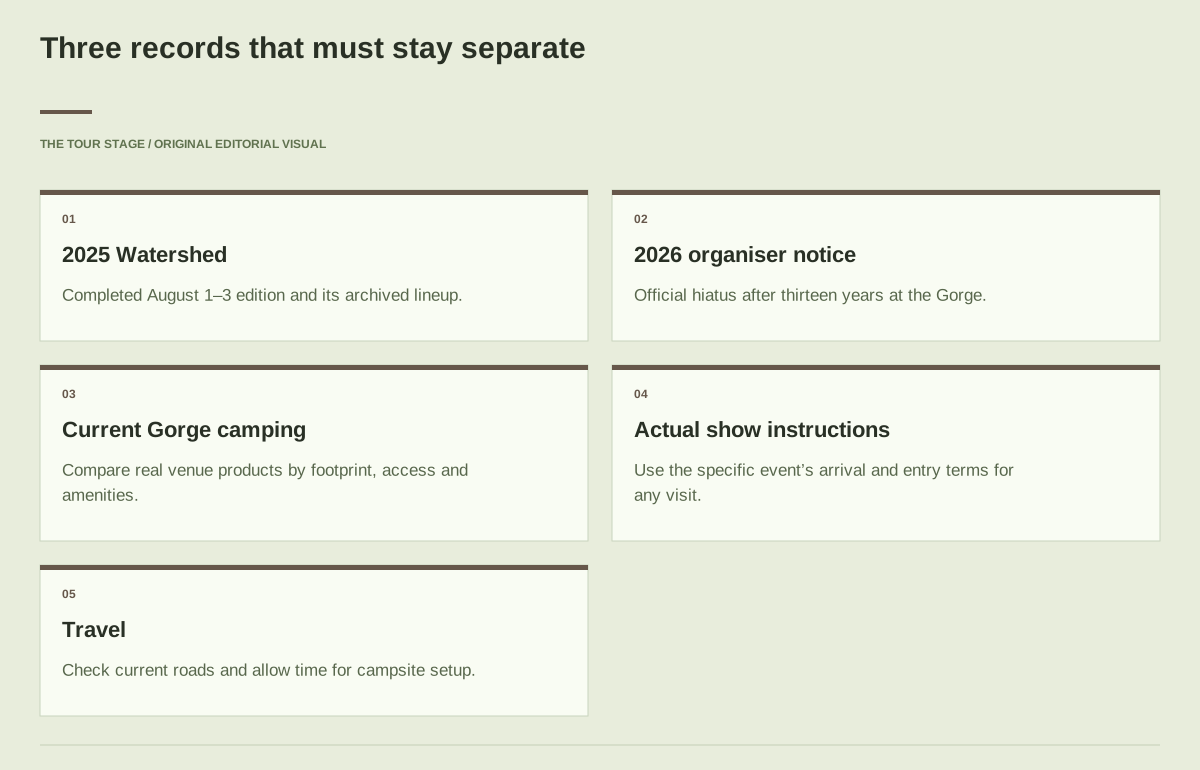
- 2025 WatershedCompleted August 1–3 edition and its archived lineup.
- 2026 organiser noticeOfficial hiatus after thirteen years at the Gorge.
- Current Gorge campingCompare real venue products by footprint, access and amenities.
- Actual show instructionsUse the specific event’s arrival and entry terms for any visit.
- TravelCheck current roads and allow time for campsite setup.
Read the visual as text
- 2025 WatershedCompleted August 1–3 edition and its archived lineup.
- 2026 organiser noticeOfficial hiatus after thirteen years at the Gorge.
- Current Gorge campingCompare real venue products by footprint, access and amenities.
- Actual show instructionsUse the specific event’s arrival and entry terms for any visit.
- TravelCheck current roads and allow time for campsite setup.
Compare camping by what it provides
The current venue lists Standard, Premier, Terrace, Front Yard and The Grove RV Park. Standard is described as the budget-focused option, while the other categories vary in footprint, location and amenities; The Grove includes electrical hookups. These are current venue descriptions, not a statement that every category was sold under identical terms at Watershed in 2025.3
Choose a category by identifying what you need: space, proximity, power or particular facilities. Read the exact current product before calculating a shared cost. Measure the complete setup, including a towing vehicle and anything extended at camp. A larger pitch only helps if it matches your real equipment and the correct entitlement. The camping comparison below is functional rather than a ranked list; a simpler setup can be more suitable than an expensive category whose benefits your party will barely use.
Keep campsite admission and concert admission distinct
The Gorge camping FAQ states that a camping ticket does not include event admission, that campers must possess a concert ticket and that opening and closing times vary by event. It describes up to six people for the standard named camping levels and one included vehicle entitlement. Those conditions need to be checked against the exact booking you intend to use.4
Write a roster with the concert ticket for each person and the shared campsite held by the group. Establish the driver and who can present the booking at arrival. If people travel in different vehicles or arrive at different times, ask the venue how that works before committing to the arrangement. Do not expect to save adjacent sites simply because friends are on their way. A clear plan for arrival is more valuable than trying to negotiate the shape of a group camp while other vehicles queue behind you.
Research the approach close to travel
The current Know Before You Go page warns about I-90 Vantage Bridge construction and links to WSDOT. It also contains show-specific information for an October event, demonstrating why readers must not borrow its displayed gate or campground hours for another show. Use the venue for the approach framework and WSDOT for the current status of the road project.2
Build the drive backward from the actual check-in window, allowing time for breaks, fuel and ordinary delays. Do not assume a navigation estimate includes a festival-entry queue. The return journey deserves the same care: packing and a late finish can leave the driver tired before the long regional leg even begins. If flying into the wider region, add rental collection and grocery stops as separate tasks instead of combining them into a vague travel block. Use the weekend planner to keep those steps visible.
Use landscape photographs as orientation, not a route plan
A Gorge photograph communicates scale and atmosphere, but it leaves practical questions unanswered. The apparent distance between camping and the stage can be compressed by the camera, and a visible slope does not reveal the accessible route or the surface underfoot. Pair photographs with the current official map and the instructions for the particular show you attend. If the route affects a purchase, ask the venue directly rather than estimating it from an image.
For a group new to outdoor camping venues, identify the operations that need daylight and concentration: finding the assigned space, checking the ground, setting up shelter and locating basic facilities. Give those tasks time before turning your attention to the performance area. Keep the equipment plan modest enough that several people can manage it without relying on one expert. A simple, properly fitted setup is more useful than an ambitious collection of gear that blocks access or makes packing slow.
When revisiting Watershed history, the same distinction improves the storytelling. An archival concert photo shows how the festival used the venue at that moment; a current camping photograph shows a real venue facility under current presentation. Neither establishes a future edition or a promised camping package. Clear captions allow both kinds of image to be useful without blurring their dates. The Gorge remains a distinctive place to understand, and a careful planning guide can explain its real characteristics while keeping the festival archive in its proper historical frame.
Pack for camp and performance entry separately
The venue’s current arrival page publishes a bag policy and notes that personal lawn chairs are not permitted inside, with rental described separately. Its Safety and Rules page explains campground vehicle and person screening. These are examples of why equipment appropriate at camp may not enter the performance area.25
Before leaving home, sort the day bag from camping supplies and check both lists against the relevant current rules. Keep essential credentials and belongings available during the arrival process instead of burying them under the tent. Agree where your party will meet after entering the performance area, particularly if some people need more time. For accessibility requirements, describe the whole journey to the venue: parking or campsite, route to viewing and access to facilities. An answer about a seat alone may not solve the entire visit.
Hear the archived music as history
The 2025 homepage’s bill includes Old Dominion, Luke Bryan, HARDY, Jason Aldean, Dierks Bentley and Bailey Zimmerman. That is a historical snapshot of the festival’s programming, not a current schedule.1 Explore Dierks Bentley, Dustin Lynch and Sam Hunt as contrasting country listening routes connected to the broader festival audience, without treating those links as a shared bill.
Compare how different arrangements build an outdoor crowd’s energy: the rhythmic emphasis of a contemporary production, the movement of a band and the space given to a vocal story. The country-pop guide and guitar-tone explainer offer ways to listen beyond the chorus. An old festival poster can be a useful starting point for discovering recordings even when it is no longer a travel document.
Keep the planning file useful and honest
Separate three folders in your notes: Watershed 2025 archive, the 2026 organiser notice and current Gorge venue research. That keeps historical music memories from becoming accidental booking instructions. For an actual venue visit, add the specific event ticket and its dated arrival information as the controlling material.
Use the festival dashboard only with your own live quotes for a real trip: admission, accommodation, transport, food and equipment. Do not give the archived festival a hypothetical price or invent a future camping package. The enduring lesson from Watershed’s setting is practical: a distinctive outdoor venue works best when the group understands where it sleeps, how it enters and how it gets home. The landscape and music then have room to become the memorable part.
Sources & further reading
- Watershed official archive and hiatus notice2025 heading and August 1–3 bill; displayed official 2026 hiatus graphic.
- Gorge Know Before You GoVenue address; current arrival/bag/chair guidance; Vantage Bridge warning; show-specific hours distinguished.
- Gorge camping optionsCurrent named camping types, varying footprint/amenities and Grove electrical hookups.
- Gorge camping FAQSeparate concert and camping admission; group/vehicle framework and event-specific opening times.
- Gorge safety and rulesCampground screening and distinction between camping and controlled event access.