
Related histories, different ensemble habits
Bluegrass and country overlap in songs, players and audiences, but they are not interchangeable names. Bluegrass developed a particularly recognisable approach to acoustic string-band interaction: sharply articulated rhythm, instrumental breaks and close vocal relationships. Country is a broader field that includes those sounds alongside steel-led bands, electric rhythm sections, string arrangements and contemporary production. A useful comparison therefore asks how the ensemble works, rather than which tradition owns a particular instrument.
The Bluegrass Music Hall of Fame’s exhibits identify gospel, jazz and blues among the sources informing Bill Monroe and other musicians, then follow the genre through festival culture and later branches. That history cautions against describing bluegrass as an isolated inheritance from a single population or place. Musical exchange is part of its foundation, just as it is part of country more broadly.1
Hear the pulse before the solo
In a traditional bluegrass setting, bass and short rhythmic attacks from the accompanying instruments can create strong forward motion without a drum kit. The mandolin may supply a dry chordal chop; guitar can alternate bass notes and chord strokes; banjo patterns can add continuous motion around the pulse. These are typical roles, not rules that every record follows. Listen for the partnership between low notes and shorter higher attacks before following the fastest line.
A country band with bass and drums may distribute those responsibilities differently. The kit can supply a backbeat and cymbal texture while guitars or piano leave more space. Neither arrangement is automatically simpler. Each has to coordinate its own kinds of overlap. Compare two performances at similar perceived volume, tapping a steady beat through both. What feels like greater speed may actually be more subdivisions moving around a similar pulse.
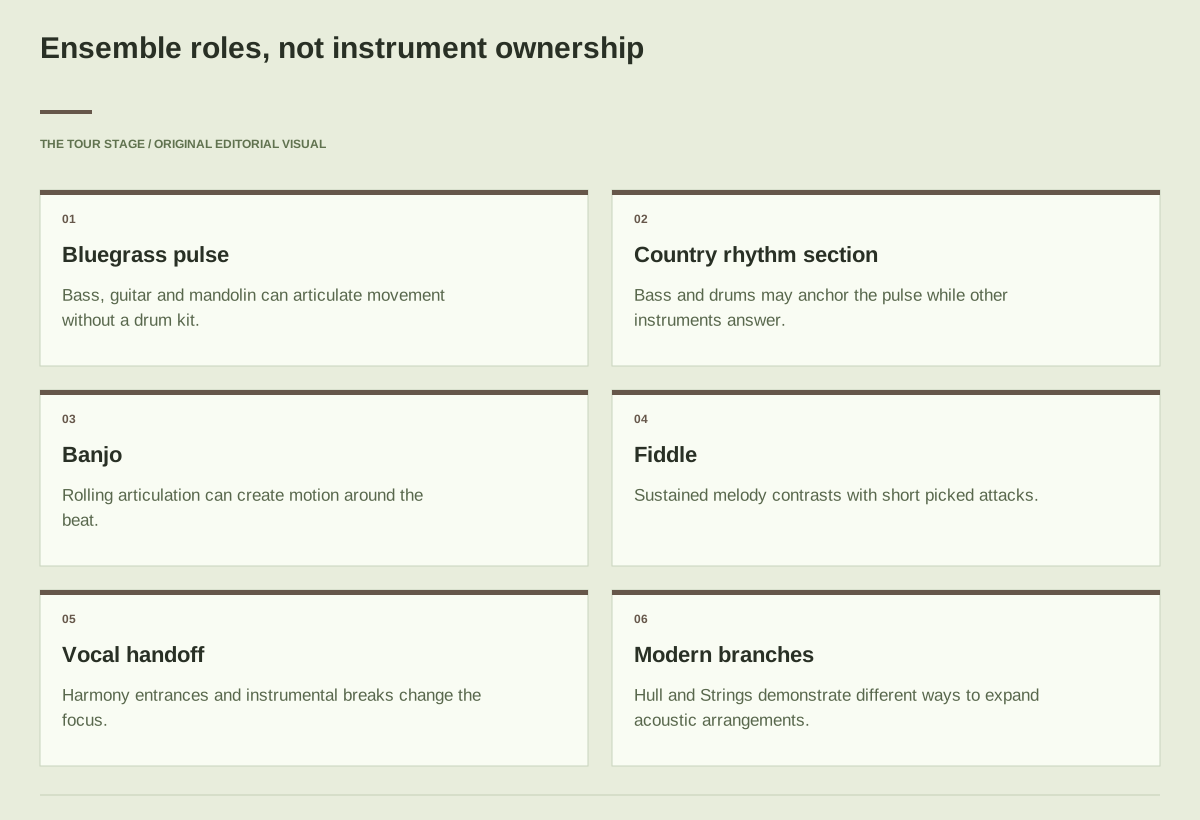
Ensemble roles, not instrument ownership
- Bluegrass pulseBass, guitar and mandolin can articulate movement without a drum kit.
- Country rhythm sectionBass and drums may anchor the pulse while other instruments answer.
- BanjoRolling articulation can create motion around the beat.
- FiddleSustained melody contrasts with short picked attacks.
- Vocal handoffHarmony entrances and instrumental breaks change the focus.
- Modern branchesHull and Strings demonstrate different ways to expand acoustic arrangements.
Read the visual as text
- Bluegrass pulseBass, guitar and mandolin can articulate movement without a drum kit.
- Country rhythm sectionBass and drums may anchor the pulse while other instruments answer.
- BanjoRolling articulation can create motion around the beat.
- FiddleSustained melody contrasts with short picked attacks.
- Vocal handoffHarmony entrances and instrumental breaks change the focus.
- Modern branchesHull and Strings demonstrate different ways to expand acoustic arrangements.
Picking is articulation as well as velocity
Fast bluegrass playing gets attention, but the sound depends on how notes begin, end and relate to one another. Flatpicked guitar uses a pick to articulate melody and accompaniment. A banjo roll produces a different pattern of motion. Mandolin notes have a quick attack and a different decay from a sustained fiddle line. An ensemble becomes legible when those sounds complement each other rather than compete continually for the same space.
Billy Strings is a useful modern case because the official Home album page connects his flatpicking with a broader palette including country, folk rock and psychedelic exploration. Start with “Taking Water,” then “Away from the Mire.” Follow not only the lead passages but the return to the song after an instrumental expansion. That return helps you hear improvisation as part of a larger form.2
Harmony is a relationship between parts
Close harmony means more than several people singing at once. Listen for how the accompanying voices support the lead line and where they enter or leave. A trio can sound tightly interlocked because the parts share phrasing, consonant placement and breath. A solo verse followed by a harmonised chorus can change the emotional scale without a large increase in instrumental density. Treat the entrance of a voice as an arrangement event.
Alison Krauss and Union Station offer a clear route into this detailed listening. Her official catalogue distinguishes Union Station records such as Paper Airplane and Arcadia from projects with Robert Plant and from solo releases. That distinction matters: the same lead singer works within different ensemble identities. Do not infer the whole sound of a record from her name alone. Choose the credited project, then hear how its voices and instruments divide the work.3
Sierra Hull and the space beyond a fixed template
Sierra Hull’s catalogue provides a route through Weighted Mind, 25 Trips and A Tip Toe High Wire. Her official account describes a bluegrass foundation alongside an ongoing interest in expanding her acoustic language. For a listener, the productive question is what remains recognisable when an arrangement changes: the attack of the mandolin, the detail of the phrasing, the interplay with bass, or the song’s sense of forward motion.4
Progressive bluegrass is not a single alternative lineup. It can involve different harmonic language, longer forms, effects or influences from other kinds of music. The label tells you to expect exploration, not exactly what that exploration will sound like. Compare one Hull recording with a Krauss and Union Station selection, then a Strings track. Their shared acoustic resources do not erase differences in pacing, vocal presence or instrumental emphasis.
Live traditions make the handoffs visible
A bluegrass performance can reveal how musicians signal a transition from vocal to instrumental break, or from one soloist to another. Watch an official performance and follow the accompanists during the solo. Their work often becomes less conspicuous precisely because it is successful: they maintain the structure while adjusting the density. If the ensemble uses a shared microphone, movement toward and away from it can also become part of the balance.
Country bands have their own handoffs, whether a guitarist answers a singer, a steel player takes a short break or a drummer guides a dynamic change. The difference is not that one tradition listens and the other merely plays. It is the arrangement of responsibilities and the sounds through which coordination becomes audible. Our mandolin guide and flatpicking explainer focus more closely on two of those roles.
Compare three records without creating a hierarchy
Use a Krauss and Union Station track, a Hull selection and a song from Home as a compact session. First hear each uninterrupted. Next replay the opening and identify the pulse, the lead voice or instrument, and the first change of role. Finally, choose a chorus and follow only the background parts. This process makes ensemble design easier to hear than repeated attention to the most dazzling solo.
Return to the country beginner route for a contrasting steel-and-fiddle or pop-shaped arrangement. The point is not to prove that acoustic music is more authentic or electric music more current. It is to recognise that traditions organise musical conversation differently. Bluegrass can be tightly traditional, spacious, exploratory or several of those things in one album. Country can welcome that variety while including many other ways to build a recording. A good listening map allows both the family connection and the meaningful distinction to remain visible.
Sources & further reading
- Bluegrass Music Hall of Fame exhibitsSources of bluegrass, festival era and later branches.
- Billy Strings official Home albumAlbum tracks and documented stylistic breadth.
- Alison Krauss official musicDistinct solo, Union Station and Robert Plant projects.
- Sierra Hull official biographySelected album catalogue and bluegrass-rooted development.