Three reasons to follow the running order
An album does not need a continuous plot to benefit from sequence. It can create an emotional arc through contrast, introduce a vocabulary before stretching it, or let an ending answer an opening indirectly. The first track establishes expectations; the middle decides when those expectations need relief; the final track chooses what remains after the record stops. These are editorial listening judgments, not claims that every transition was designed with one hidden message.
For this route, use Kacey Musgraves’s Golden Hour, Tyler Childers’s Purgatory, and Sturgill Simpson’s The Ballad of Dood & Juanita. Keep the official original running orders at hand. Expanded editions can add tracks that alter the apparent ending, and automatic shuffle can undo the very relationship you are trying to hear. A full listen is a modest experiment, not a rule against enjoying singles.
Golden Hour: patience establishes the terms
The official Golden Hour track list opens with “Slow Burn,” followed by “Lonely Weekend” and “Butterflies.” That opening gives the listener time to settle into a vocal world before the album explores further textures. Hear the first song as an invitation to a pace of attention, then notice how the next two change the emotional position without abandoning the recognisable lead voice. An album can establish coherence through perspective rather than identical accompaniment.1
Instead of writing a plot summary, follow the scale of each performance. Is the vocal surrounded, exposed or held in an intermediate space? What happens to your sense of intimacy when another layer arrives? A sequence can prepare you to hear a bright track as relief or complication, depending on the preceding mood. The work happens between tracks as well as inside them, so leave the ordinary gaps intact rather than overlapping everything with a streaming crossfade.
Three ways a record makes an ending
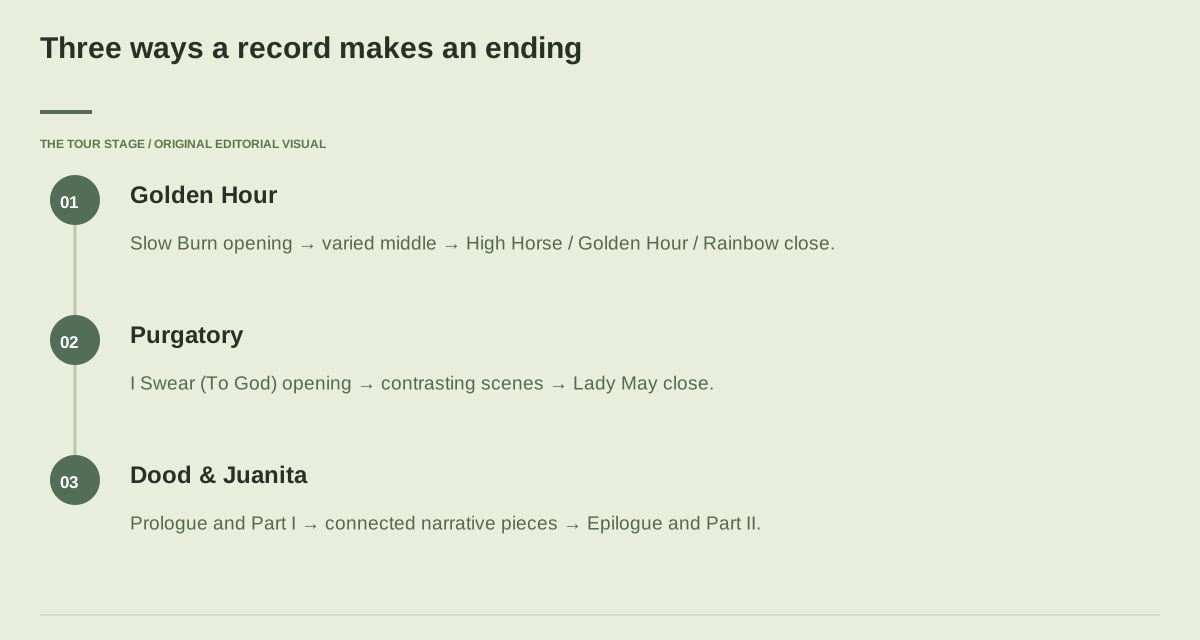
- Golden HourSlow Burn opening → varied middle → High Horse / Golden Hour / Rainbow close.
- PurgatoryI Swear (To God) opening → contrasting scenes → Lady May close.
- Dood & JuanitaPrologue and Part I → connected narrative pieces → Epilogue and Part II.
Read the visual as text
- Golden HourSlow Burn opening → varied middle → High Horse / Golden Hour / Rainbow close.
- PurgatoryI Swear (To God) opening → contrasting scenes → Lady May close.
- Dood & JuanitaPrologue and Part I → connected narrative pieces → Epilogue and Part II.
Golden Hour: the last three tracks change the landing
The documented closing run is “High Horse,” “Golden Hour,” then “Rainbow.” Listen to the movement from a more outward-facing rhythmic statement toward the close rather than treating the final song as a bonus ballad. A quieter or more direct ending can reshape the energy that came before it. The title track’s position near the end also allows it to feel like a gathering point within the sequence rather than a definition presented at the outset.1
A useful second listen starts just before that closing run. Ask what the full album has taught you to expect from the voice, then hear how the ending uses that trust. Do not assume a recurring image means every song has the same narrator. Shared vocal identity can connect different scenes. For a production-focused comparison, the country-pop guide follows how arrangement scale changes a listener’s relationship with a singer.
Purgatory: intensity makes room for a close-up
The official Purgatory listing begins with “I Swear (To God)” and closes with “Lady May.” Between them are songs including “Whitehouse Road,” “Banded Clovis,” the title track and “Universal Sound.” The sequence gives Childers several kinds of narrative and musical space. Hear the final track after the preceding material and compare that impression with hearing it alone. An intimate ending can feel like a narrowing of focus after a larger, more turbulent world.2
The important contrast is not simply loud versus quiet. Follow how closely the singer seems to address you, how much contextual information a song supplies, and whether the band projects movement or reflection. A recognisable vocal grain ties different settings together, but each character or situation still deserves separate attention. The album format lets those differences accumulate without requiring the singer to explain them in spoken commentary. That is one reason an uninterrupted listen can reveal more than a playlist of highlights.
Dood & Juanita: the narrative frame is explicit
The Ballad of Dood & Juanita makes its connected form visible in the track names. The official Bandcamp sequence includes “Prologue,” “Ol’ Dood (Part I),” “One in the Saddle, One on the Ground,” and “Shamrock,” later moving through “Juanita” with Willie Nelson, “Epilogue,” and “Ol’ Dood (Part II).” The release is dated August 20, 2021. Here the running order is part of following an explicitly framed tale, rather than only an emotional progression.3
Listen for how brief framing pieces change your expectations. A prologue can make the next song feel like an entry into a world already in motion; an epilogue can create a sense of distance before a final return. These are structural possibilities you can test in the recording. The split title provides an obvious reason to remember the opening while hearing the end. Skipping randomly would remove information about relationships that the sequence presents in a deliberate order.
An album’s coherence can include friction
A sequence of songs all using the same tempo and density might be coherent but exhausting. Contrast can preserve attention: a short piece after a long one, an exposed voice after a full band, or humour after sustained pressure. The useful question is whether the change gives the listener another way to hear the same artistic world. A surprising transition is not automatically a mistake, and a smooth one is not automatically meaningful.
For each album here, select one transition that changed your mood. Describe the audible difference before interpreting it. “The accompaniment thins and the vocal feels closer” provides evidence for an emotional observation; “the album becomes honest” offers a verdict without explaining the sound. Our annotated album guide develops this practice visually, and the story-song feature distinguishes structural analysis from guessing at a singer’s private life.
A repeatable full-album listening session
Give the record a stretch of time in which you can hear it continuously, then make only three notes: the expectation created by the opener, the most consequential change in the middle and the effect of the final track. On a second listen, focus on the neighbours of the song you first liked most. Does it prepare the next piece, recover from the previous one or temporarily interrupt the album’s prevailing mood?
You do not need to agree that every selection works perfectly. A full listen can expose a transition you find awkward as readily as a brilliant one. The reward is a more specific relationship with the music. Golden Hour, Purgatory and Dood & Juanita demonstrate three different reasons to preserve order, and none requires treating an album as homework. Follow the twenty-album starter shelf when you want another record with a different kind of coherence.
Sources & further reading
- Kacey Musgraves official Golden Hour track listOriginal thirteen-track order.
- Tyler Childers official Purgatory listingOriginal ten-track order.
- Sturgill Simpson official Bandcamp album2021 date, narrative framing tracks, order and Willie Nelson feature.