
Choose the original sequence before drawing conclusions
Start with the standard thirteen-track album, rather than a playlist containing live performances and bonus recordings. The official catalogue begins with “Slow Burn” and ends with “Rainbow”; “Mother” sits fifth and “High Horse” eleventh.1 Those positions provide the factual frame for this guide. The interpretation of pacing below is an editorial listening route, rather than a claim to know the team’s private intentions. On a first pass, let the record run without taking detailed notes. Afterwards, write three observations: where the energy changed, which sound remained in your memory and whether the closing song changed your feeling about the opening. This preserves the experience of the whole before diagrams encourage you to reduce it to components. The album-sequencing guide explains why a running order can become part of a musical argument.
The opening establishes room and patience
“Slow Burn” is an invitation to notice pace. Listen to the space between a vocal phrase and the surrounding instrumental movement, then compare that sensation with the more immediately regular motion of “Lonely Weekend.” You do not need to assign an exact tempo to describe the change. Ask whether the pulse feels like something the singer settles into or pushes against. “Butterflies,” third in the published sequence, offers another chance to hear how a repeated melodic idea can remain clear inside a soft instrumental setting. These are listening prompts, not descriptions of an isolated instrument track. Keep the vocal as your reference point and note when another sound answers it. That simple discipline helps distinguish an arrangement from a list of instruments: the important question is what each sound does at that moment.
Golden Hour: a sequence you can hear
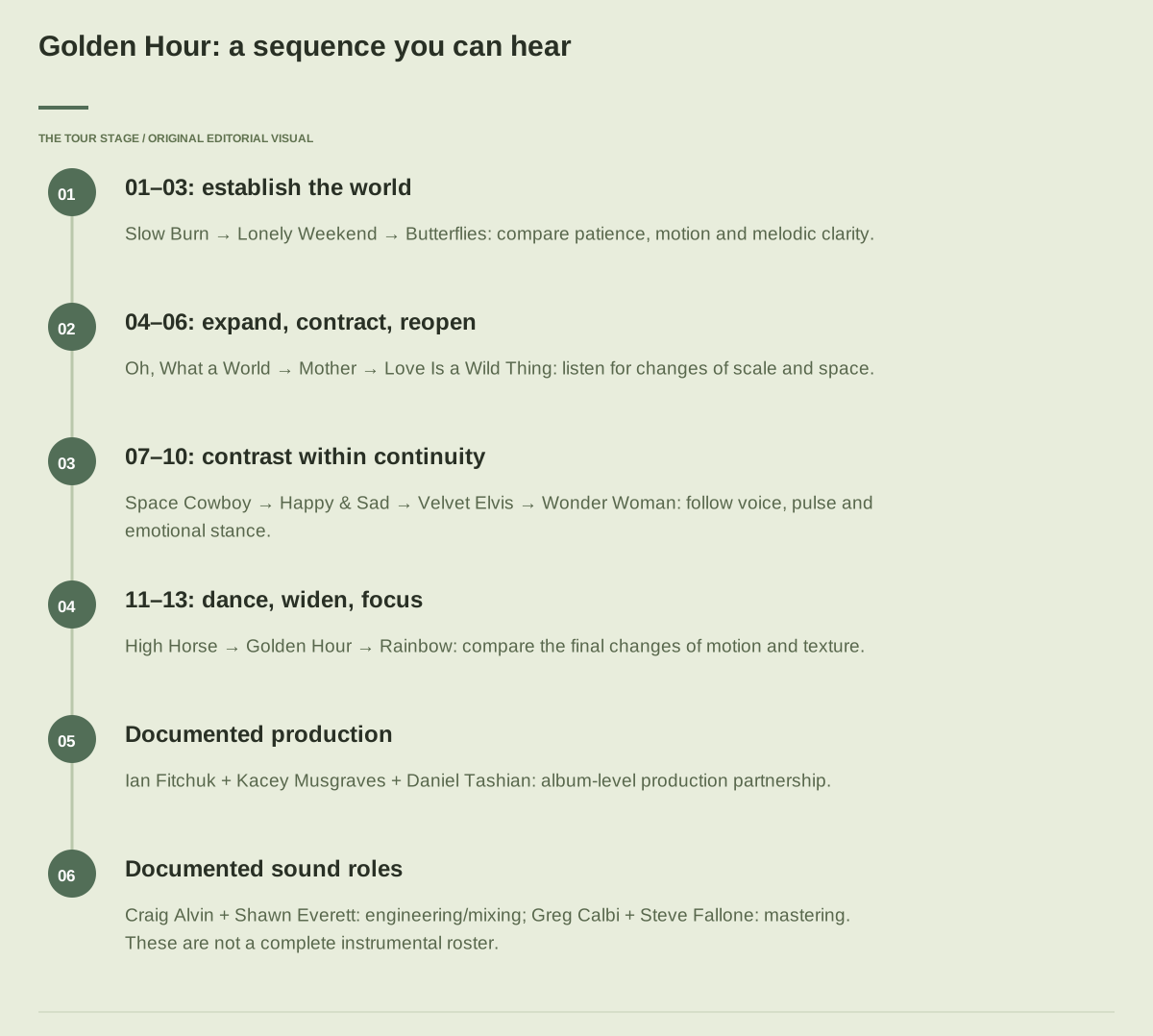
- 01–03: establish the worldSlow Burn → Lonely Weekend → Butterflies: compare patience, motion and melodic clarity.
- 04–06: expand, contract, reopenOh, What a World → Mother → Love Is a Wild Thing: listen for changes of scale and space.
- 07–10: contrast within continuitySpace Cowboy → Happy & Sad → Velvet Elvis → Wonder Woman: follow voice, pulse and emotional stance.
- 11–13: dance, widen, focusHigh Horse → Golden Hour → Rainbow: compare the final changes of motion and texture.
- Documented productionIan Fitchuk + Kacey Musgraves + Daniel Tashian: album-level production partnership.
- Documented sound rolesCraig Alvin + Shawn Everett: engineering/mixing; Greg Calbi + Steve Fallone: mastering. These are not a complete instrumental roster.
Read the visual as text
- 01–03: establish the worldSlow Burn → Lonely Weekend → Butterflies: compare patience, motion and melodic clarity.
- 04–06: expand, contract, reopenOh, What a World → Mother → Love Is a Wild Thing: listen for changes of scale and space.
- 07–10: contrast within continuitySpace Cowboy → Happy & Sad → Velvet Elvis → Wonder Woman: follow voice, pulse and emotional stance.
- 11–13: dance, widen, focusHigh Horse → Golden Hour → Rainbow: compare the final changes of motion and texture.
- Documented productionIan Fitchuk + Kacey Musgraves + Daniel Tashian: album-level production partnership.
- Documented sound rolesCraig Alvin + Shawn Everett: engineering/mixing; Greg Calbi + Steve Fallone: mastering. These are not a complete instrumental roster.
Electronic colour can sit beside familiar country textures
“Oh, What a World” is a useful stop for comparing a treated vocal colour with more recognisably acoustic sounds. Hear how the opening establishes an atmosphere before the sung narrative becomes your main focus. Rather than asking which texture makes the track country or pop, ask how the sounds occupy different spaces. Does one seem close and another distant? Does an effect sustain after a syllable ends? Daniel Tashian’s first-person production interview describes the collaborative sessions and recording circumstances behind Golden Hour.2 It provides context for hearing experimentation as part of making the record, while the audible result remains the listener’s evidence. The country-pop guide offers a wider comparison. A studio effect is not automatically decoration: it can set the emotional scale of an otherwise direct song.
The short fifth track changes the scale
After the broad setting of “Oh, What a World,” “Mother” creates a markedly more compact listening space. Its position is documented by the artist’s track list; its effect as a pause is an interpretation you can test.1 Listen once without looking at a progress bar. Does the track feel like a complete statement, a hinge between longer songs or both? Then continue into “Love Is a Wild Thing” and notice whether the fuller environment feels different because of what preceded it. A useful sequence diagram marks such transitions without pretending they are mathematical measurements of emotion. You can make your own version using plain descriptions such as intimate, expansive, moving or still. Avoid turning those descriptions into a score: another listener may hear a different emphasis and still make a careful, well-supported observation.
The middle gives contrasting emotions related sonic homes
Place “Space Cowboy” beside “Happy & Sad,” then hear “Velvet Elvis” as the next change of scene. The first two offer a productive comparison of vocal restraint and the ways a chorus releases tension. Listen for the accompaniment’s support of the singer rather than searching only for a climactic high note. Then consider how a more playful rhythmic character alters your attention in “Velvet Elvis.” The record does not need every song to have the same emotional subject to feel connected. A consistent degree of space, vocal focus or instrumental warmth can provide continuity while the narrator’s situation changes. Write a sentence explaining the bridge you hear between two tracks. If the bridge is simply the same singer, try again with a more specific feature: phrasing, the length of a sustained sound, or the entrance of the rhythm section.
High Horse creates a late change of motion
“High Horse” arrives after “Wonder Woman” and before the title track in the standard sequence.1 Listen to the more insistent dance-oriented pulse and the way it supports a concise vocal hook. Its energy becomes particularly useful to the album listener because two tracks remain afterwards. Play the final three songs in order and ask whether “Golden Hour” feels like an arrival, a widening of the view or a return to an earlier atmosphere. Then let “Rainbow” bring the focus back toward voice and piano. Those words describe one possible hearing, not an official storyline. The contrast can be heard without claiming that the album has a rigid narrative plot. If you normally shuffle records, this three-song stretch is a manageable experiment in hearing sequence as a creative choice.
Use credits to separate production, engineering and mastering
The Recording Academy’s Golden Hour Album of the Year entry names Ian Fitchuk, Kacey Musgraves and Daniel Tashian as producers; Craig Alvin and Shawn Everett as engineers/mixers; and Greg Calbi and Steve Fallone as mastering engineers.3 These role labels are not interchangeable. They identify different contributions to the released recording, without assigning every audible decision to a single person. The label’s original announcement also identifies the core co-production partnership.4 Keep an album-level credit distinct from a track-specific instrumental credit: knowing someone produced the record does not tell you who played every piano part. The producer explainer and credits guide make those distinctions more concrete. A personnel diagram should show a documented relationship, rather than inviting the reader to infer a complete session roster from a small awards listing.
Make a second annotated pass, then follow a neighbouring album
On your second pass, choose only three tracks for detailed notes. Record the first prominent sound, one important change and the relationship between the voice and accompaniment. Add a fourth note explaining what the following track changes. That gives you a compact track-flow map with evidence you can hear again. Return to Kacey Musgraves through another album rather than assuming one production approach defines her whole catalogue. For a contrast, try the narrative concentration of Sturgill Simpson or the vocal character and writing of Miranda Lambert. Keep those comparisons specific. A useful annotation does more than call a record beautiful or polished: it explains how a particular musical choice creates the feeling that made you want to listen again.
Sources & further reading
- Kacey Musgraves official Golden Hour track listStandard thirteen-track sequence; no bonus or live tracks mixed into the analysis.
- Daniel Tashian first-person production interview, Tape OpProducer’s account of collaborative recording circumstances.
- Recording Academy: 2019 Album of the Year creditsNamed producers, engineers/mixers and mastering engineers.
- MCA: Golden Hour release announcement, March 30, 2018Original release and core co-production partnership.