
The meeting happens inside the recording
Two famous names on a cover tell you that a partnership exists, but little about its musical result. The guest may supply a verse, answer a narrator, sing a refrain or contribute a distinct instrumental texture. Begin by identifying the released version and its credits, then ask what the partner changes. If the track would sound structurally similar without the guest, the contribution may still be valuable through tone and character. Avoid a simple country-versus-everything-else diagram: performers often bring several musical backgrounds of their own. Jelly Roll and BRELAND are especially useful reminders that an artist cannot always be reduced to one fixed genre before a collaboration begins. The collaboration atlas keeps the documented relationship separate from the interpretation.
Post Malone and Morgan Wallen: a shared vocal surface
The official F-1 Trillion release identifies “I Had Some Help” as Post Malone’s collaboration with Morgan Wallen.1 Hear how the bright instrumental opening establishes a recognisable country-pop setting before the voices divide the narrative. Their vocal textures are different enough to remain distinct, yet the phrasing lets them inhabit the same rhythmic world. The important musical question is not which singer certifies the genre. It is how the voices share a hook and make the emotional excuse sound communal. Follow the rhythm guitar and the drums beneath the chorus, then listen again to the space between phrases. The recording’s smooth handoff matters as much as the appearance of a familiar instrument. It is a designed performance, not merely two unrelated solo takes placed next to one another.
Released partnerships, different musical roles
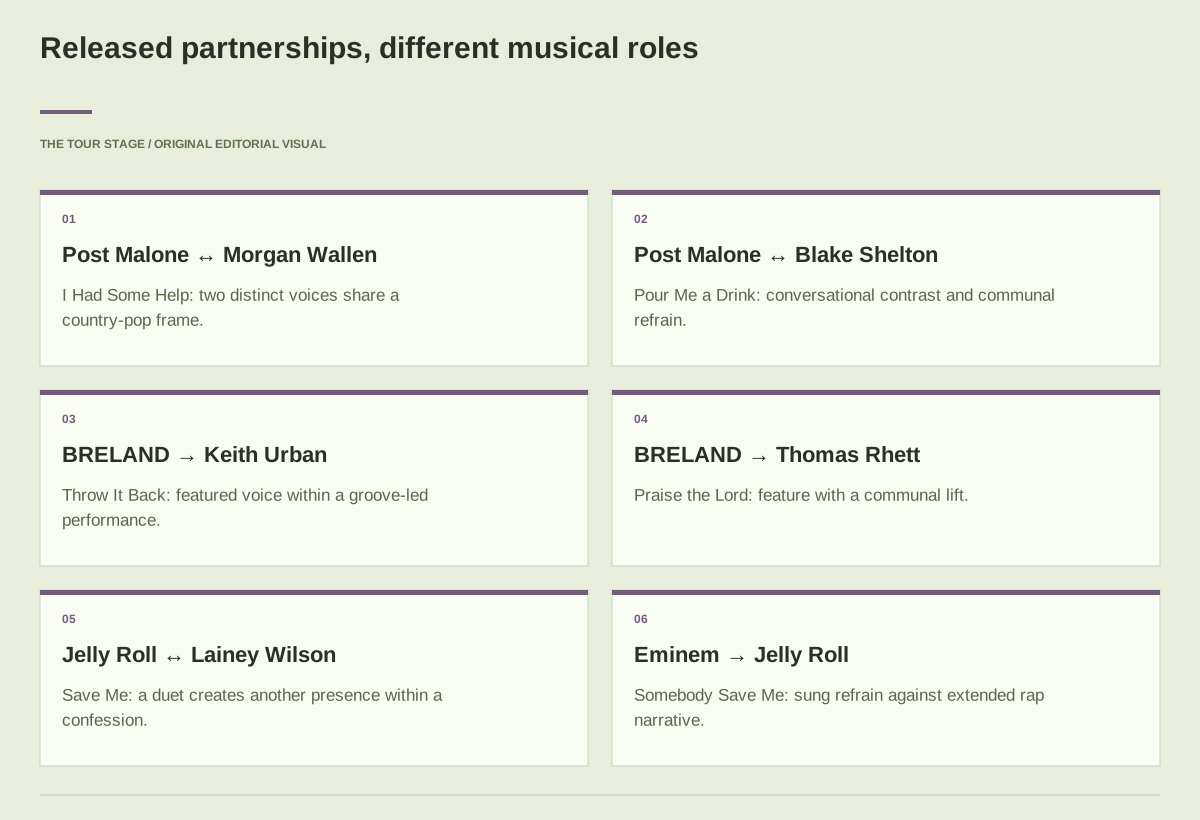
- Post Malone ↔ Morgan WallenI Had Some Help: two distinct voices share a country-pop frame.
- Post Malone ↔ Blake SheltonPour Me a Drink: conversational contrast and communal refrain.
- BRELAND → Keith UrbanThrow It Back: featured voice within a groove-led performance.
- BRELAND → Thomas RhettPraise the Lord: feature with a communal lift.
- Jelly Roll ↔ Lainey WilsonSave Me: a duet creates another presence within a confession.
- Eminem → Jelly RollSomebody Save Me: sung refrain against extended rap narrative.
Read the visual as text
- Post Malone ↔ Morgan WallenI Had Some Help: two distinct voices share a country-pop frame.
- Post Malone ↔ Blake SheltonPour Me a Drink: conversational contrast and communal refrain.
- BRELAND → Keith UrbanThrow It Back: featured voice within a groove-led performance.
- BRELAND → Thomas RhettPraise the Lord: feature with a communal lift.
- Jelly Roll ↔ Lainey WilsonSave Me: a duet creates another presence within a confession.
- Eminem → Jelly RollSomebody Save Me: sung refrain against extended rap narrative.
Post Malone and Blake Shelton: contrast without a rupture
The same official catalogue credits Blake Shelton on “Pour Me a Drink.”2 Compare it directly with “I Had Some Help” rather than assuming every collaboration on the album uses an identical balance. Shelton’s grounded delivery creates a different kind of conversational partner. Listen for the gap between an individual line and a shared refrain: the song can move from a recognisable personal voice into a group-ready release. The country features are not confined to a single decorative steel or guitar sound. They also sit in the way a phrase lands and how a chorus invites repetition. This is an example of contrast serving accessibility. A partnership need not produce a radical hybrid to reveal something useful about how singers adapt to one another.
BRELAND and Keith Urban: groove as a meeting point
BRELAND’s official Cross Country page identifies “Throw It Back” as featuring Keith Urban, and “Praise the Lord” as featuring Thomas Rhett.3 “Throw It Back” offers a different route from the ballad-based crossover model. Follow the rhythmic attack, the space around the voice and the way the feature participates in a song already built around motion. Urban’s name does not replace BRELAND’s point of view. The collaboration works within that established frame. Then compare “Praise the Lord,” listening for a broader, more communal sense of lift. Both examples are on one artist’s project, yet the guests have different musical effects. “Country collaboration” is therefore a useful catalogue category but an incomplete description of the actual arrangements.
Jelly Roll and Lainey Wilson: a new vocal relationship
BMG’s release announcement documents the duet version of “Save Me” with Lainey Wilson.4 Listen to the way a second voice changes a song associated with a central individual confession. The emotional material remains intimate, but the performance now has another human presence inside it. Pay attention to the difference between taking a line alone and joining another singer: shared singing can suggest solidarity without resolving the distress in the narrative. Do not treat the duet as a wholly unrelated song, and do not assume a second vocal makes every existing passage into a dialogue. Some collaborative performances share an emotional position rather than arguing between two characters. The duet listening guide develops those different vocal relationships.
Eminem and Jelly Roll: sung refrain against rap narrative
Eminem’s own release page credits Jelly Roll on “Somebody Save Me.”5 This is a different work from the Jelly Roll/Wilson duet and should retain its own title and artist credit. The contrast between a melodic refrain and rap verses changes how a listener experiences time. A refrain returns to an emotional state, while a verse can pile up detail and move through an extended account. Listen for how the refrain interrupts or frames that movement. Calling the result a collaboration is accurate; calling it a new country version of “Save Me” would erase the distinction between the recordings. Credits, titles and the actual musical structure together provide the necessary evidence. The covers guide explains why cover, feature and reuse of musical material are not interchangeable labels.
Shaboozey and the limits of a single label
Shaboozey belongs in this conversation because his recordings encourage listeners to hear country, popular song forms and hip-hop as resources that can coexist inside an artist’s own work. That is not the same claim as identifying a featured guest on every track. A stylistic influence is not a credit edge. When building a listening network, include a person only when the released recording documents that person’s role. Otherwise a map can accidentally convert an aesthetic comparison into an invented partnership. This distinction is especially important when artists appear together on a festival bill or in an awards medley. Sharing an event, sharing an influence and sharing a released master are three different relationships, each worth describing on its own terms.
A useful comparison in three passes
For each recording, listen first for the main pulse and instrumental frame, then for the distribution of voices, then for the moment the guest changes the song’s emotional perspective. Keep observations specific: a lower voice steadies a phrase, a shared refrain widens the address, or a sung return slows the flow of a detailed verse. Those descriptions are more informative than declaring that two genres collided. Check the artist and feature wording on the official release and follow the credits if you want to connect writers or producers. The roles guide helps prevent a vocal partnership from being mistaken for shared authorship. Finally play a solo recording by each participant. What remains recognisable, and what did this particular collaboration encourage them to do differently?
Sources & further reading
- Universal Music Canada: F-1 Trillion releaseAlbum and Wallen collaboration.
- Republic: F-1 Trillion official release listingWallen and Shelton featured recordings.
- BRELAND official Cross Country releaseUrban and Rhett featured songs.
- BMG: Jelly Roll and Lainey WilsonReleased Save Me duet.
- Eminem official Somebody Save Me videoJelly Roll feature on distinct Eminem recording.