Separate the song from a particular master
A composition and a recording are related but different works. The same melody and words can support several interpretations, while each released master preserves a particular performance and production. A cover generally means a new performance of an existing song. A sample reuses part of an existing recording; an interpolation recreates recognisable material inside another work rather than simply performing the complete earlier song. A duet describes performers sharing a recording, so a duet can also be a cover. These categories answer different questions and should not be used interchangeably. The song credits guide explains how performer and writer credits help untangle them. Begin your comparison with the named source recording and the new version, keeping the writer attached to both instead of treating the later singer as the song’s author.
The Chicks and Landslide: continuity with a different frame
The official Chicks page for Home lists “Landslide,” while Fleetwood Mac’s official catalogue identifies the earlier recording on its 1975 self-titled album and credits Stevie Nicks as writer.12 Listen to the two recordings in sequence, then return to the first. Follow the lead vocal’s relationship to the accompaniment rather than expecting a new interpretation to require a completely new melody. Hear how instrumental colour, harmony and the handling of a phrase can shift the sense of intimacy. A familiar composition invites comparison because you already know where the melody might go. The new performance can redirect that expectation through a changed emphasis or a differently balanced texture. It need not defeat the earlier recording to add something worthwhile to the song’s history.
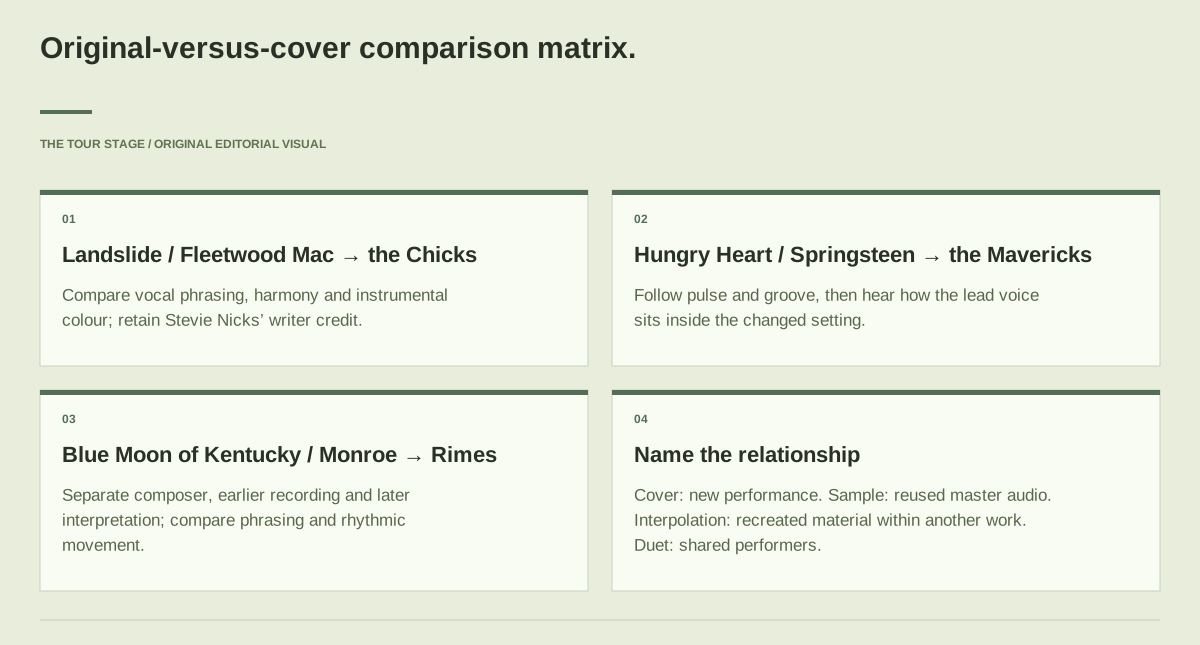
Original-versus-cover comparison matrix.
- Landslide / Fleetwood Mac → the ChicksCompare vocal phrasing, harmony and instrumental colour; retain Stevie Nicks’ writer credit.
- Hungry Heart / Springsteen → the MavericksFollow pulse and groove, then hear how the lead voice sits inside the changed setting.
- Blue Moon of Kentucky / Monroe → RimesSeparate composer, earlier recording and later interpretation; compare phrasing and rhythmic movement.
- Name the relationshipCover: new performance. Sample: reused master audio. Interpolation: recreated material within another work. Duet: shared performers.
Read the visual as text
- Landslide / Fleetwood Mac → the ChicksCompare vocal phrasing, harmony and instrumental colour; retain Stevie Nicks’ writer credit.
- Hungry Heart / Springsteen → the MavericksFollow pulse and groove, then hear how the lead voice sits inside the changed setting.
- Blue Moon of Kentucky / Monroe → RimesSeparate composer, earlier recording and later interpretation; compare phrasing and rhythmic movement.
- Name the relationshipCover: new performance. Sample: reused master audio. Interpolation: recreated material within another work. Duet: shared performers.
Hear what a harmony entrance changes
A useful close-listening exercise for “Landslide” is to follow one passage for the lead line and again for the supporting voices and instruments. Where does the arrangement broaden the thought, and where does it allow a single phrase to stand relatively alone? Avoid reducing the contrast to solo singer versus group: both recordings have deliberately arranged settings, and the lead vocal still establishes a viewpoint. A later harmony entrance can make a phrase seem shared without changing the narrator’s words. Describe the specific effect you hear instead of attributing it to a biographical event. If you prefer one version, explain the musical reason, such as a particular balance of voices or an instrumental response. The harmony guide gives further vocabulary for describing relationships between voices.
The Mavericks and Hungry Heart: follow the pulse
The official Mavericks store identifies Play the Hits as an eleven-song covers project released November 1, 2019, and its track list includes “Hungry Heart.” Springsteen’s official catalogue places the earlier recording on The River, released October 17, 1980.34 Use this pair to focus on rhythmic feel. Tap a gentle pulse through each recording, then hear how the instruments divide and decorate that motion. A change of groove can alter the apparent character of a familiar chorus even when the underlying song remains recognisable. Listen to the lead vocal as part of that rhythmic arrangement: where it places a phrase matters as much as its tone. This is a particularly helpful comparison if you usually describe covers only in terms of whether the new singer sounds like the original performer.
A covers album can reveal a band’s own identity
Play the Hits provides another experiment because the source repertoire comes from different performers. Follow two or three consecutive tracks and listen for features that recur in the Mavericks’ setting. You may notice a vocal manner, an instrumental texture, a rhythmic approach or a consistent way of opening space around a melody. Those are editorial observations to test against the recordings, not a claim that every track uses the same arrangement. A band can make disparate material feel connected without flattening its differences. The official description specifically identifies both expansive and intimate moments, including “Before the Next Teardrop Falls” and “Blue Eyes Crying in the Rain.”3 Move between those quieter settings and a more rhythmically assertive track. The range itself becomes part of the band’s interpretation of the repertoire.
LeAnn Rimes and Blue Moon of Kentucky: a song with a long life
LeAnn Rimes’ official song catalogue lists “Blue Moon of Kentucky” on Unchained Melody (The Early Years). The Library of Congress identifies Bill Monroe’s earlier recording, made in September 1946 and released in1947, and explains the song’s original waltz setting.56 Compare the phrasing and rhythmic movement of the named recordings without assuming every later version follows a single route from the first. This composition has travelled through several traditions and interpretations. For Rimes, hear how the voice negotiates the familiar melodic shape and how the accompaniment positions it. The comparison becomes more informative when you distinguish a song’s authorship from the fame of one performance. Monroe’s role as composer remains visible even when another singer supplies the recording through which you first encountered it.
Build an original-versus-cover comparison that stays fair
Write four headings: vocal stance, pulse, instrumental setting and form. Under vocal stance, describe how the words appear to be addressed; under pulse, note the felt movement without inventing a numerical tempo. Instrumental setting concerns what leads, supports or replies. Form concerns actual changes such as an introduction, an ending or repeated material. Keep the listening volume broadly comparable so a louder master does not automatically feel more exciting. If a version changes a word, a section or a musical credit, consult its release information before deciding why. A shorter running time alone does not prove a faster performance. Your notes should identify what is audible and leave the unverified recording process open. The acoustic comparison guide develops the same method for an artist revisiting their own material.
Use covers as a route back through country music
A persuasive cover can send you in two directions: further into the interpreting artist’s catalogue and backward toward the writer or earlier recording. Keep both routes. Home can lead to more of the Chicks’ ensemble work; Play the Hits can make the Mavericks’ original songs sound newly familiar; Rimes’ repertoire can introduce an older composition without replacing its earlier history. Create a short playlist in pairs and attach the release title to each track. Then switch the order on a second listen. Hearing the later version first may reveal details you overlooked in the older one. The goal is not a permanent winner. It is a more exact account of how a song can remain recognisable while a performer changes the way it reaches an audience.
Sources & further reading
- The Chicks official Home albumLandslide recording on Home.
- Fleetwood Mac official 1975 album catalogueEarlier recording and Stevie Nicks songwriting credit.
- The Mavericks official Play the Hits storeNovember 1, 2019 covers project, repertoire and arrangement context.
- Bruce Springsteen official The RiverOctober 17, 1980 album and Hungry Heart track.
- LeAnn Rimes official song catalogueBlue Moon of Kentucky recording and album identity.
- Library of Congress: Blue Moon of Kentucky essayBill Monroe composition, recording/release distinction and original waltz context.