
Find the melody before counting the voices
A lead vocal carries the principal melody, but it does not have to be the loudest voice at every instant or belong to the same member throughout a group’s catalogue. Harmony voices sing different pitches that relate to that melody and the underlying chords. Doubling repeats a line; unison joins on the same pitch; an octave doubles the melodic shape higher or lower. Those effects can sound full without forming separate moving harmony parts.
Begin with a verse and identify the line you would sing alone. Then follow that line into the chorus. Do new voices reinforce it, surround it or temporarily replace it? This approach is more reliable than assuming the highest voice is the lead. A low or middle melody can remain the centre of attention while harmonies above it provide brightness. Knowing where the melody sits makes the group’s choices much easier to hear.
Close harmony is a spacing choice
Close harmony places voices within a relatively compact range. Wider spacing distributes them farther apart. Neither description measures emotional closeness between performers, and neither guarantees a particular country style. A closely packed chord can sound sweet, tense or both depending on the notes and the context. A widely spaced arrangement can feel open even with only a few singers.
Imagine three original sustained notes on the vowel “ah”: a middle melody with another line above and one below. As the chord changes, the lines might move together or one might remain still. This is a conceptual example, not a transcription of a copyrighted song. Our diagram should show those independent paths rather than three identical arrows. The ear responds to the changing intervals, including the moments when a line holds its ground while the others move around it.
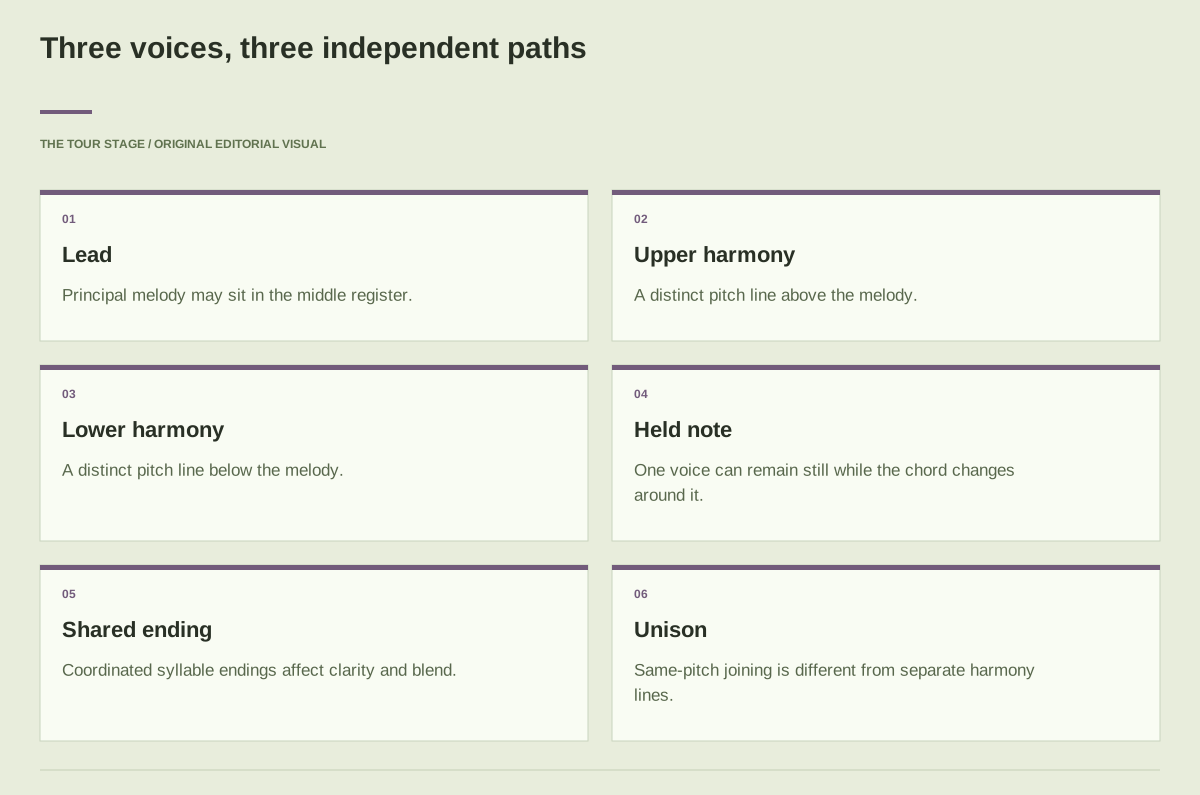
Three voices, three independent paths
- LeadPrincipal melody may sit in the middle register.
- Upper harmonyA distinct pitch line above the melody.
- Lower harmonyA distinct pitch line below the melody.
- Held noteOne voice can remain still while the chord changes around it.
- Shared endingCoordinated syllable endings affect clarity and blend.
- UnisonSame-pitch joining is different from separate harmony lines.
Read the visual as text
- LeadPrincipal melody may sit in the middle register.
- Upper harmonyA distinct pitch line above the melody.
- Lower harmonyA distinct pitch line below the melody.
- Held noteOne voice can remain still while the chord changes around it.
- Shared endingCoordinated syllable endings affect clarity and blend.
- UnisonSame-pitch joining is different from separate harmony lines.
Little Big Town: more than one possible lead
CBS’s account of its interview with Little Big Town identifies Karen Fairchild, Kimberly Schlapman, Phillip Sweet and Jimi Westbrook and the group’s harmony identity.1 Use “Girl Crush” as a listening entry point, then compare a song with a different lead presence. The aim is to hear a group’s resources, not assign one permanent job to each person.
Listen for the moment supporting voices appear. A harmony entrance late in a phrase can change its weight without changing the underlying words. A full chorus can feel larger because of spacing, register and phrasing rather than simply more volume. Our interpretation is that the group’s identity comes partly from these coordinated decisions. Do not infer that every audible layer equals one person singing once: recording can include additional takes, and only specific production evidence can establish how a particular master was assembled.
The Chicks: blend can keep the words sharp
The artist-published Gaslighter credits offer a useful model of how to connect a familiar vocal sound with a particular recording.2 Listen to the title track and compare the leading line with the harmonies around it. A blended sound does not require every individual vocal character to disappear. Distinct timbres can combine while leaving the narrative pointed and intelligible.
Notice consonants as well as pitches. If singers end a word at different moments, the result can feel deliberately loose or unintentionally blurred. If they coordinate closely, a fast phrase can remain clear. Vowels affect the perceived blend too: different shapes can make an interval seem more exposed. These are listening observations, not rules that every group must sing identically. The Chicks provide an accessible comparison because the voices remain central even when the instrumental production around them changes.
A featured voice is a different kind of partnership
Brandy Clark’s official album page identifies “Dear Insecurity” as featuring Brandi Carlile, while her biography identifies Carlile as the album’s producer.3 Those are separate credits. A producer can also sing, but the production role does not itself mean a person supplies a harmony on every track.
Hear the recording as a question about emphasis. When a second voice enters, does it add another perspective, reinforce a phrase or make the emotional space feel shared? Not every duet is arranged as two characters debating. Some partnerships gain their effect from joining a single idea. Explore Clark alongside group performances by Just Jayne, checking each release’s actual credits. Compare how quickly you notice the additional voice and how long it remains. These are different creative models, not stages in a hierarchy from solo singer to fully developed group.
Harmony depends on timing and restraint
The interval is only one part of a harmony. Singers also decide when to breathe, how hard to attack a syllable, whether to slide towards a note and when to stop. A line that enters a fraction later can feel like an answer rather than a duplicate. A harmony that disappears during a verse can make its return in the chorus more meaningful.
Try following only the endings of lines. Do the voices finish together or leave one singer exposed? Then follow the beginnings. A producer may choose a sparse entrance so that the lyric remains personal before the group broadens it. The ballad listening guide explores related uses of restraint, while the duet guide separates dialogue from shared harmony. Both help explain why a technically elaborate arrangement is not automatically the most moving one. The right amount of harmony depends on what the song needs to communicate.
Listen in three layers, then hear the whole song
On your first pass, follow the melody. On the second, choose one supporting voice and trace where it moves, holds or drops out. On the third, listen to the group as a texture and notice how the instruments leave room for it. You can do this without naming every chord or identifying a singer by ear.
An official live performance may reveal who sings which line in that version. It does not automatically prove how the studio arrangement was recorded. Keep those pieces of evidence distinct and let uncertainty remain when credits do not resolve it. The reward is a more accurate kind of listening: hearing harmony as coordinated choices about pitch, time and perspective. Continue to the song-credit guide when you want to distinguish vocalist, writer and producer, rather than using the word collaboration to cover several very different contributions.
Sources & further reading
- CBS: Little Big Town interviewBroadcaster account of its interview, group members and vocal harmonies.
- The Chicks: Gaslighter creditsArtist-published songwriters, production and performance credits.
- Brandy Clark official biographySelf-titled album produced by Brandi Carlile.