Two labels doing several jobs
A genre name can describe a sound, the audience around that sound, or the institutions that help it circulate. Those meanings need not line up perfectly. Country might bring to mind a radio format, a dance rhythm, a vocal inflection or a Nashville recording tradition. Americana can describe a space where several roots traditions meet. An artist may participate in both communities while making records that differ substantially from one another.
The Center for Texas Music History describes Americana as difficult to define and discusses roots rock, country rock, singer-songwriters and R&B among its possible elements. That breadth is more useful than an acoustic-only rule. Electricity is not a passport out of roots music, and a fiddle does not settle a recording’s identity. Here, the aim is to hear overlap without flattening the differences that artists and audiences find meaningful.1
Songwriting is shared ground
Start by asking how a song works before asking where it belongs. Is there a sharply drawn speaker? Does the chorus clarify the conflict, or complicate it? Is the central image allowed to remain ambiguous? Those techniques travel readily between country and Americana. A close character study does not become more honest when its market label changes. A direct chorus does not become less thoughtful because it is easy to sing back.
Brandy Clark is a useful bridge because her official biography documents both her solo work and songs recorded by other artists, including Miranda Lambert and Kacey Musgraves. Her 2023 self-titled album was produced by Brandi Carlile. These credits describe a working network, not proof of a single permanent genre. Compare the intimacy of one Clark recording with the fuller presentation of a song she wrote for someone else; the writer and the interpreter solve different problems.2
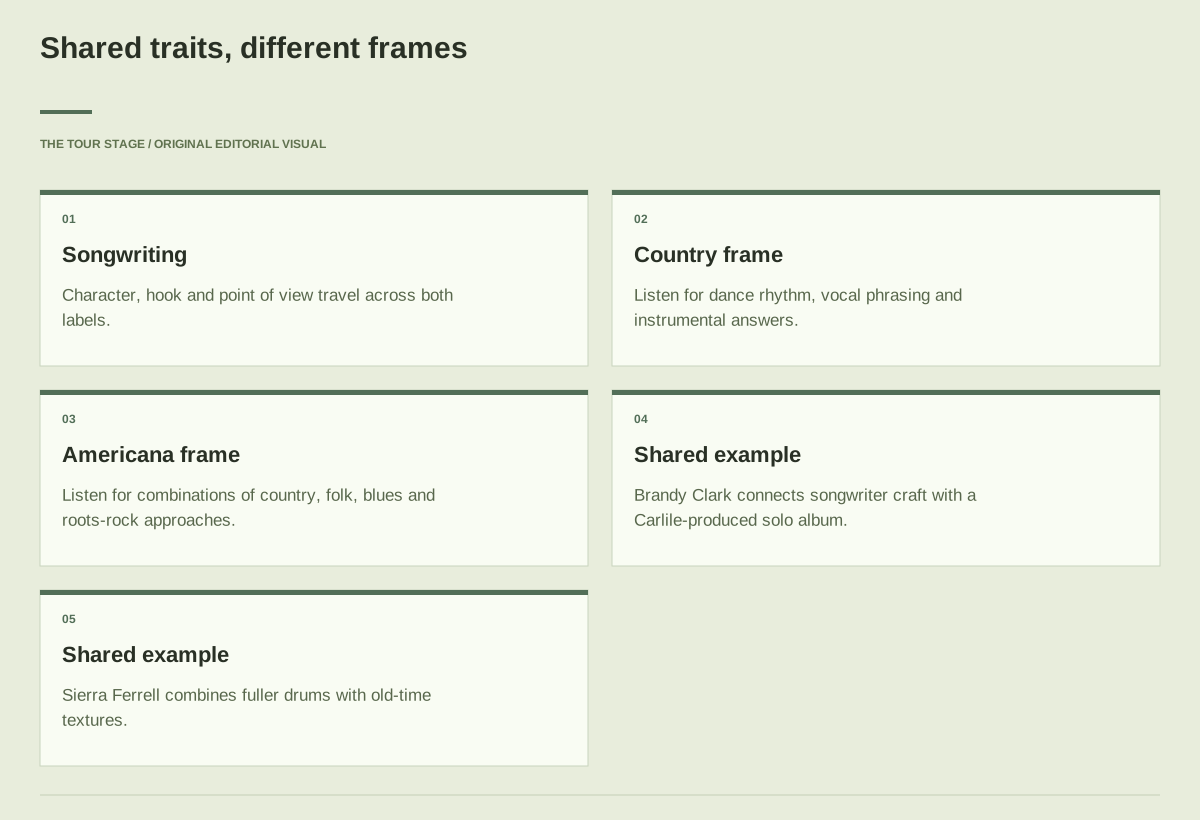
Shared traits, different frames
- SongwritingCharacter, hook and point of view travel across both labels.
- Country frameListen for dance rhythm, vocal phrasing and instrumental answers.
- Americana frameListen for combinations of country, folk, blues and roots-rock approaches.
- Shared exampleBrandy Clark connects songwriter craft with a Carlile-produced solo album.
- Shared exampleSierra Ferrell combines fuller drums with old-time textures.
Read the visual as text
- SongwritingCharacter, hook and point of view travel across both labels.
- Country frameListen for dance rhythm, vocal phrasing and instrumental answers.
- Americana frameListen for combinations of country, folk, blues and roots-rock approaches.
- Shared exampleBrandy Clark connects songwriter craft with a Carlile-produced solo album.
- Shared exampleSierra Ferrell combines fuller drums with old-time textures.
Jason Eady: a voice need not announce its category
Jason Eady offers a practical listening route through his official catalogue: Daylight & Dark, the self-titled Jason Eady, I Travel On, and To the Passage of Time. Rather than guessing which shelf an album deserves from its cover, compare the way the voice sits against the accompaniment. Is the rhythm defined by a firm backbeat or by interlocking acoustic parts? Does an instrumental answer reinforce the melody or lead into another emotional colour?3
Keep the comparison small: two songs from one album, then one from another. A singer’s recognisable phrasing can connect arrangements that are otherwise quite different. The label Americana is often helpful precisely when it permits that range; country can also accommodate it. Do not turn this observation into a claim that the two words are interchangeable. They gather different histories and institutions, even when the same record makes sense within both.
Sierra Ferrell makes the overlap audible
On Trail of Flowers, Sierra Ferrell moves between contrasting ensemble textures. Her own album notes identify Eddie Spear and Gary Paczosa as producers and discuss her interest in fuller drums alongside the intimacy of old-time music. The track list gives concrete starting points: “American Dreaming,” “Dollar Bill Bar,” “Fox Hunt,” and “I Could Drive You Crazy.” Pick two and listen for the changing balance of pulse, instrumental detail and vocal character.4
This does not require hearing one track as country and the next as something that escaped country. It is more revealing to notice the arrangement’s job. A busier pulse can make a wandering or uncertain speaker feel physically propelled; a lighter texture can place attention on a turn of phrase. Those are editorial listening observations, not claims about Ferrell’s intent in every bar. The album is a good reminder that roots traditions can function as active materials rather than museum exhibits.
Production changes the frame
A recording with a broad chorus may place the singer inside a polished public statement. A close, relatively exposed vocal may feel like someone addressing a single listener. Neither effect proves that a record was easy or difficult to make. Apparent simplicity can require careful balancing; a dense arrangement may depend on disciplined subtraction. Listen for the placement of the vocal, the amount of room around an instrument, and the point where extra voices enter.
Then try the same experiment with headphones and speakers at a comfortable volume. A bass part or quiet harmony can alter your impression when you finally notice it. Avoid treating “raw” as the opposite of produced: all released recordings involve decisions about takes, balance and sequence. Our acoustic recording guide examines what is revealed when an arrangement changes, while the country-pop feature considers how a larger presentation can serve a song.
Community matters without policing the listener
Festivals, awards, labels, specialist broadcasters and local venues give artists ways to find a public. Their programming can tell you which conversations a record enters, but it cannot answer every musical question. An Americana award is evidence of recognition within that organisation’s categories. It is not a laboratory result that cancels an artist’s country connections. Equally, commercial country exposure does not erase influences from folk, gospel, blues or rock.
A useful habit is to separate three statements in your notes: what you can hear, what a verified credit establishes, and how a community describes the record. “Acoustic guitar carries the pulse” is a listening claim. “Brandi Carlile produced this album” is a credit claim. “This recording received an Americana honour” is an institutional claim. They may support one another, but substituting one for the others makes genre discussion less precise.
Build a comparison session rather than a border wall
Choose one Eady song, one Clark song and one Ferrell song. For each, write down the singer’s stance, the dominant rhythmic texture and one memorable instrumental response. Keep each note concrete: “the harmony arrives late in the chorus” tells you more than “authentic.” Replay the records in a different order. You may find the apparent distance between two artists changes when a third performance provides a bridge.
The visual accompanying this article uses overlapping listening traits, explicitly chosen by the editors. It is a discovery aid, not a definitive taxonomy. Follow the beginner listening route for a broader introduction and the illustrated country map for more connections. The productive question is not whether you have sorted every artist correctly. It is which feature made you listen more closely, and which adjacent record might develop that interest. That question leaves room for artists to change and for your own preferences to change with them.
Sources & further reading
- Texas State University Center for Texas Music HistoryAmericana’s breadth and multiple roots traditions.
- Brandy Clark official biography2023 album producer and selected songwriting credits.
- Jason Eady official musicSelected official album catalogue.
- Sierra Ferrell official album notesTrail of Flowers production and contrasting musical approaches.