A map of listening choices, not a scientific taxonomy
The map groups recognisable approaches so a listener can travel between them. It does not assign every artist to one permanent box or claim that a song’s identity can be calculated from its instruments. Country, bluegrass, Americana, country-rock and pop-oriented recordings share histories, musicians and audiences; their names also describe communities and institutions. Use a branch as a practical question: do you want acoustic interplay, a dance pulse, a sharply drawn story or a large studio hook? The answer leads to a record, where listening can become more specific. The beginner’s listening guide offers a shorter first route. Here the connections are deliberately porous: a fiddle can appear in several branches without making them the same style.
Honky-tonk and neotraditional routes
For a dance-floor-centred start, hear a George Strait record and follow the relationship between a measured vocal, rhythmic guitar and instrumental replies. The museum’s Strait biography connects his music to honky-tonk and Western swing traditions.1 Move toward newer traditional country when you want a contemporary recording with clearly audible steel, fiddle or a familiar country pulse. These are tendencies, not compulsory ingredients. The honky-tonk guide explores rooms and rhythms; the neotraditional guide follows phrasing and arrangement. One helpful distinction is between the historical context of a style and an artist’s later use of its vocabulary. A recent recording can draw on older sounds while using a different studio balance or songwriting perspective.
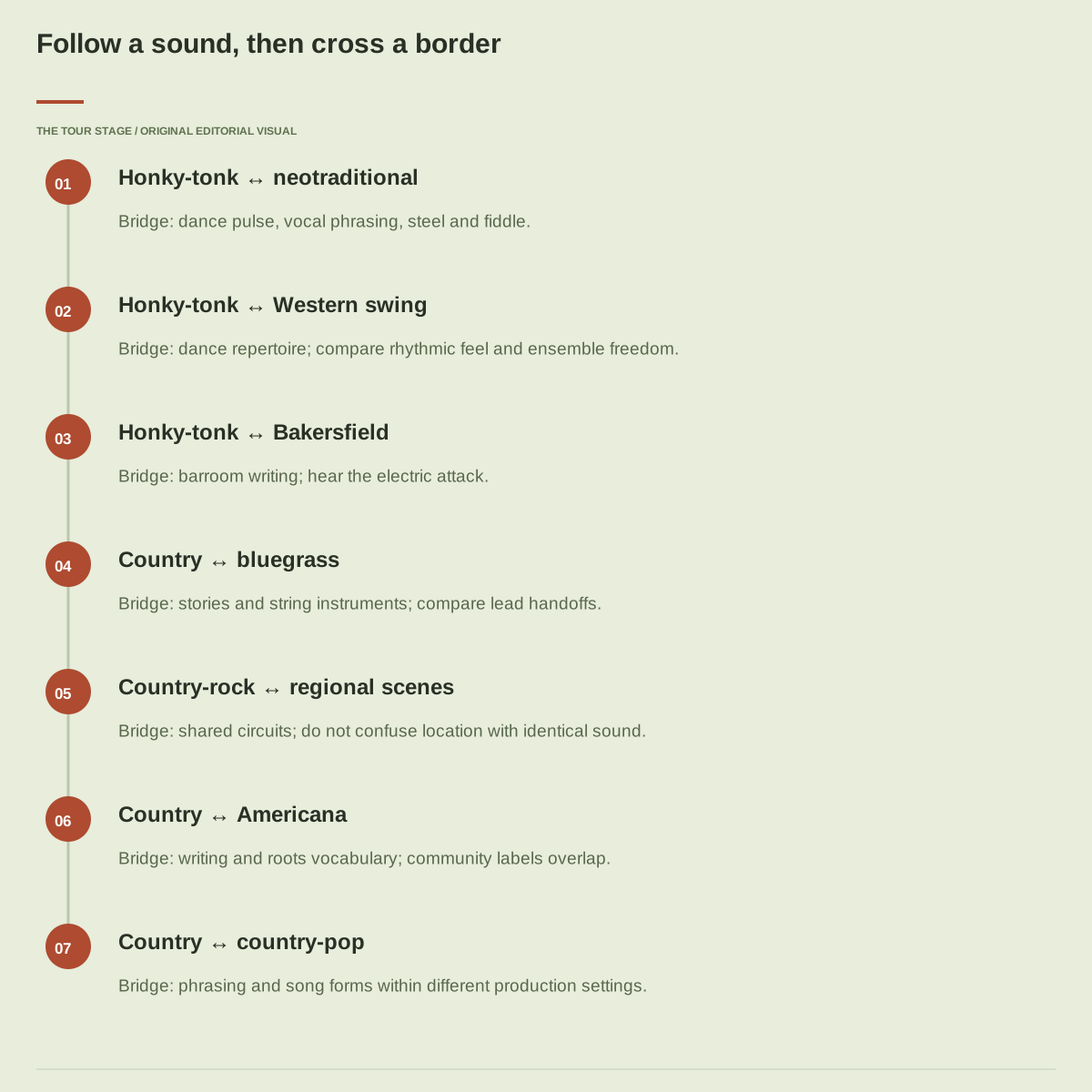
Follow a sound, then cross a border
- Honky-tonk ↔ neotraditionalBridge: dance pulse, vocal phrasing, steel and fiddle.
- Honky-tonk ↔ Western swingBridge: dance repertoire; compare rhythmic feel and ensemble freedom.
- Honky-tonk ↔ BakersfieldBridge: barroom writing; hear the electric attack.
- Country ↔ bluegrassBridge: stories and string instruments; compare lead handoffs.
- Country-rock ↔ regional scenesBridge: shared circuits; do not confuse location with identical sound.
- Country ↔ AmericanaBridge: writing and roots vocabulary; community labels overlap.
- Country ↔ country-popBridge: phrasing and song forms within different production settings.
Read the visual as text
- Honky-tonk ↔ neotraditionalBridge: dance pulse, vocal phrasing, steel and fiddle.
- Honky-tonk ↔ Western swingBridge: dance repertoire; compare rhythmic feel and ensemble freedom.
- Honky-tonk ↔ BakersfieldBridge: barroom writing; hear the electric attack.
- Country ↔ bluegrassBridge: stories and string instruments; compare lead handoffs.
- Country-rock ↔ regional scenesBridge: shared circuits; do not confuse location with identical sound.
- Country ↔ AmericanaBridge: writing and roots vocabulary; community labels overlap.
- Country ↔ country-popBridge: phrasing and song forms within different production settings.
Western swing and Bakersfield are different routes
A swinging rhythm can open the music toward jazz-influenced phrasing and ensemble conversation, while Bakersfield-associated recordings often highlight a sharper electric attack. The museum’s Bakersfield materials document the roles of Buck Owens, Merle Haggard and key instrumentalists, rather than presenting the sound as one singer’s invention.2 Treat the difference as a listening comparison: follow the guitar, the drum accents and the space given to instrumental statements. Do not let a Western shirt or a California birthplace stand in for musical evidence. These routes connect to honky-tonk, but neither is merely another name for it. A map is useful when it preserves such differences and lets the listener move sideways instead of insisting on a single chronological ladder.
Bluegrass: follow the handoff between instruments
Bluegrass is a particularly rewarding route for hearing ensemble responsibility. A mandolin chop, bass pulse, banjo pattern and guitar accompaniment create motion while solo roles move through the group. Billy Strings’ official Home and Renewal pages document records that use this background while making room for wider textures and extended approaches.34 Hear one song for the supporting parts rather than only the fastest break. Then follow Sierra Hull into a contrasting mandolin-led setting. The bluegrass comparison explains why an acoustic country recording and a bluegrass ensemble are not automatically equivalent. The instruments matter, but so do the rhythm, the exchange of leads and the community of performance practices around them.
Country-rock: hear what the rhythm section changes
For the guitar-band route, start with Whiskey Myers and hear how sustained electric sounds and a forceful rhythm section alter the scale of a song. A distorted guitar is an audible texture, not a complete genre definition. The writing may retain a compact narrative while the arrangement gives a chorus the release associated with rock performance. Compare a quieter verse with the full-band entrance instead of describing the whole record as loud. The country-rock history route supplies earlier reference points. This branch also connects naturally to regional scenes, because venues, collaborators and shared bills can support guitar-driven bands without making their records sonically identical. A scene connection and a stylistic connection should remain separate labels.
Americana and roots: a broad route with overlapping sounds
Americana can be a useful destination when a listener values storytelling, roots instrumentation or a recording that does not sit comfortably in a single mainstream country frame. It is also a real musical community, so the label cannot be reduced to a checklist of instruments. Sierra Ferrell provides a route into a highly characterful voice and varied roots vocabulary. Compare the rhythm, vocal stance and instrumental setting of individual recordings before assigning an entire career to a box. The country and Americana comparison explores that overlap. In this map, an artist can appear near more than one route because the purpose is discovery. Multiple connections are useful information, not a classification error that needs to be eliminated.
Country-pop: production is part of the musical idea
Kacey Musgraves’ Golden Hour and Shania Twain’s Come On Over provide two documented album routes into country-pop’s different possibilities.56 Hear the contrast between a spacious, intimate vocal setting and an arrangement built around an immediately repeatable hook. Both can include country phrasing while organising the surrounding sounds differently. “Pop” need not mean the absence of craft or a uniform level of polish. Follow the bass, the layering of voices and the transitions into choruses. The country-pop guide makes a more detailed comparison. For the map, the useful connection is between recording choices: acoustic and electronic textures can coexist, and a listener may enjoy both a steel-led ballad and a dance-oriented production for related emotional reasons.
Choose two adjacent routes and test the connection
Begin with a route you already enjoy and choose a neighbouring one that changes just one major feature. Move from traditional country to bluegrass for different ensemble roles, or from country-rock to country-pop for a different use of repetition and studio space. Write down the specific bridge you hear: phrasing, narrative, rhythm or instrumental colour. If the connection feels weak, choose another record rather than assuming the map has diagnosed your taste. The sound preference quiz offers another editorial starting point, while the discovery calendar gives the process more time. A useful listening map should keep producing questions. It has done its job when you can name what attracted you to a recording and follow that quality into an unfamiliar catalogue.
Sources & further reading
- Museum: George StraitTraditional and swing context.
- Museum: Bakersfield exhibitionSound and ensemble contributors.
- Billy Strings: HomeAlbum and acoustic/bluegrass context.
- Billy Strings: RenewalAlbum’s broader textures.
- MCA: Golden HourNamed album and production.
- Shania Twain official Come On Over listingAlbum editions and sequence.