
A dated selection with a musical purpose
Carter Faith, Mae Estes, Willow Avalon and Emily Ann Roberts belong together here because each provides a distinctive entry into contemporary country listening. They do not form a documented group or a single musical movement. Rising is an editorial discovery description, not an assertion that none has an established career, and shared momentum does not mean comparable sales or identical opportunities. The selections below are grounded in named records and official artist material. Rather than award one singer the best voice, ask what a voice makes possible inside a song: intimacy, humour, ambiguity, a sharp turn of feeling or a phrase that stays clear over an energetic band. That question leaves room for four artists to matter for different reasons.
Carter Faith: atmosphere that still serves a country song
Begin with Carter Faith’s “Grudge,” then explore Cherry Valley. MCA’s official artist material documents the album and identifies a catalogue that ranges beyond one mood. Listen to how the vocal can feel suspended inside the arrangement without surrendering the song’s narrative direction. Breath, a slight delay or a soft edge can create tension as effectively as a forceful note. The surrounding production matters too: sustained colour behind the singer changes how close the listener feels to a line. Do not translate that atmosphere into a claim that Faith lacks traditional-country connections. The more useful observation is how she makes different elements cooperate within an individual recording. Hear a second song before deciding whether the first has explained the whole artist.1
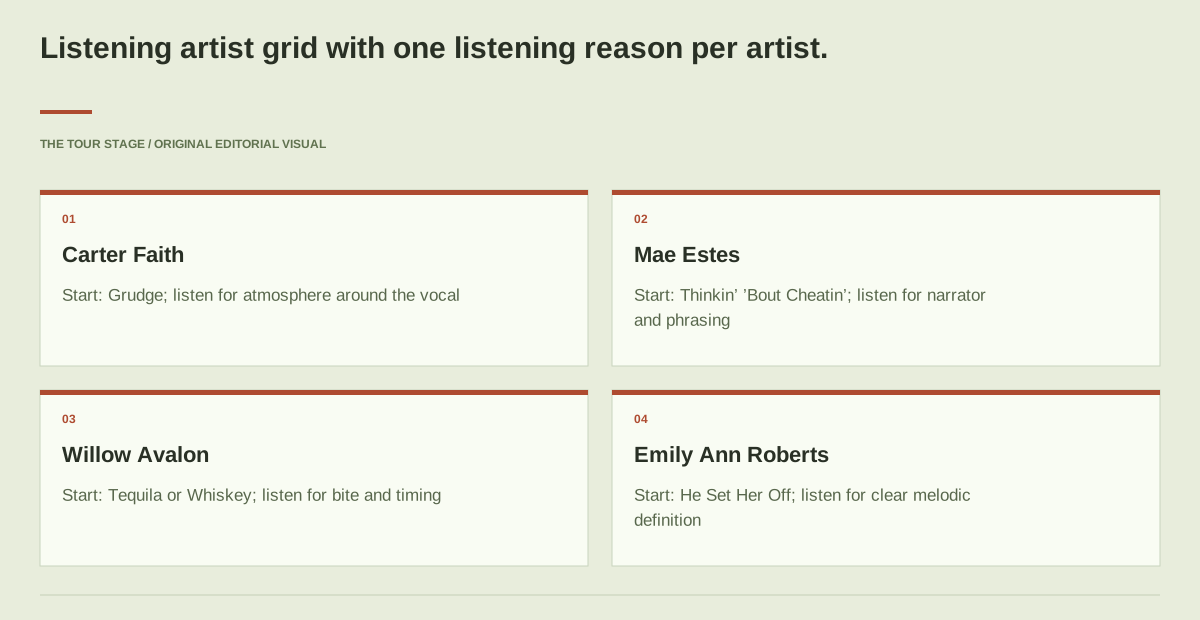
Listening artist grid with one listening reason per artist.
- Carter FaithStart: Grudge; listen for atmosphere around the vocal
- Mae EstesStart: Thinkin’ ’Bout Cheatin’; listen for narrator and phrasing
- Willow AvalonStart: Tequila or Whiskey; listen for bite and timing
- Emily Ann RobertsStart: He Set Her Off; listen for clear melodic definition
Read the visual as text
- Carter FaithStart: Grudge; listen for atmosphere around the vocal
- Mae EstesStart: Thinkin’ ’Bout Cheatin’; listen for narrator and phrasing
- Willow AvalonStart: Tequila or Whiskey; listen for bite and timing
- Emily Ann RobertsStart: He Set Her Off; listen for clear melodic definition
Mae Estes: an uncomfortable thought delivered clearly
Mae Estes’ “Thinkin’ ’Bout Cheatin’” and Before the Record make a strong second stop. The Opry documents the six-song debut project and its release context. Listen to the difference between a song describing a thought and endorsing an action. A country narrator can be conflicted, unreliable or tempted; the singer’s job is to make that state intelligible, not necessarily comfortable. Estes’ phrasing rewards attention to where a word is pressed and where the line settles back into the band. The traditional musical vocabulary supports an adult complication rather than functioning as decoration. On a second listen, follow the steel or other answering parts and ask whether they soften the thought, sharpen it or simply leave the listener space to judge.2
Willow Avalon: personality in the attack
For Willow Avalon, start with “Tequila or Whiskey” and move into Southern Belle Raisin’ Hell. Her official material provides the catalogue; the Opry also supplies a performance-facing artist introduction. Listen to the bite of the vocal and the way an energetic arrangement can give humour and frustration a physical presence. A witty line still needs timing: entering too early or too heavily would change the joke’s temperature. Then choose a less immediately rowdy song to test whether your first impression holds. It is easy to turn a vivid public image into a musical box. The records reward a broader hearing, including the moments when the voice’s roughness communicates vulnerability rather than defiance.3
Emily Ann Roberts: precision without emotional stiffness
Emily Ann Roberts’ Can’t Hide Country is a useful fourth entry, with “He Set Her Off” offering an immediate song-level starting place. Her official music page is the source for release titles and versions. Listen to the clarity of the vocal line and how well-defined words can coexist with swing, force and emotional shading. Traditional-country singing is not simply hitting a clean note at the correct time. A phrase can lean, brighten or tighten while remaining easy to follow. Compare a full-band track with a quieter official performance and notice what survives without the production’s support. If the musical attraction is clarity, look for the choices that produce it rather than using wholesome or classic as substitutes for describing a sound.4
Compare the narrator before comparing the voice
Choose one song per artist and describe the person speaking inside it. Are they making an accusation, admitting a temptation, delivering a joke or trying to understand a loss? Then ask how the singing makes that perspective audible. Faith’s atmosphere, Estes’ directness, Avalon’s bite and Roberts’ clear melodic shape are starting observations for these recordings, not rules that govern their catalogues. A ballad could reverse your expectations. Comparing narrators also avoids a common shortcut in discussions of women in country: treating every personal lyric as a diary entry. A songwriter and performer can draw on observation, invention or collaboration. Unless a first-person source establishes the background, discuss the story the record presents rather than inventing the artist’s private life.
Hear the arrangements as active collaborators
On a second pass, ignore the lead vocal for a verse and follow the band. Which recording creates a continuous atmosphere, and which lets an instrumental reply stand out? Does the rhythm feel straight, swinging, heavy or deliberately spacious? Do backing voices act as agreement, contrast or another layer of colour? These choices help explain why a shared genre does not imply a shared sound. They also prevent a four-woman selection from becoming four miniature biographies. For a different kind of vocal partnership, try the duo and trio guide. If the traditional-country elements are what draw you in, the newer traditional voices supplies another set of contrasts without declaring a winner.
Make a second session that changes the first
After the four entry points, choose one contrasting song from each artist’s official catalogue. Avoid simply selecting another track with the same tempo and lyrical topic. Your first session might have favoured atmosphere or wit; the second can test phrasing in a ballad, the lift of a faster chorus or the effect of stripped-back instrumentation. Keep a short note with the exact recording title and a specific reason to return. That is more useful than saving a generic artist-to-watch list that expires as soon as a release cycle changes. The sound finder offers a next starting point, while clip-to-catalogue listening explains how to extend a first impression into an informed relationship with a full record.
Sources & further reading
- Carter Faith: MCACherry Valley and official recordings.
- Opry: Mae EstesBefore the Record and Thinkin’ Bout Cheatin’ release context.
- Willow Avalon official siteOfficial album and singles catalogue.
- Emily Ann Roberts official musicCan’t Hide Country and song-level entry points.