
Begin with the sound you want today
A useful discovery tool starts with a limited question. Instead of asking which artist is best, decide whether you want a driving electric band, intricate acoustic interplay, a restrained vocal setting or a familiar country pulse. Your answer can change tomorrow. Leave filters open when you want a wider set of possibilities, and add one preference at a time when the initial suggestions feel too broad. The catalogue presented here is deliberately selective: it provides clear starting points rather than pretending to contain every artist who might fit. You can follow a result into an existing artist guide, then find the named record through the artist’s official catalogue. The beginner’s guide offers a broader introduction if the sound labels are unfamiliar.
Read the filters as editorial shorthand
The finder uses musical starting point, energy, instrument focus and vocal or listening focus. These tags describe a route into particular recordings; they do not permanently define an artist’s entire career. “Driving” asks you to attend to forward movement, while “relaxed” points toward a less forceful initial experience. Neither is a numerical tempo claim. Similarly, an electric-guitar route can still contain acoustic instruments, and a harmony-led act still has individual lead voices. The tags are deliberately transparent so that you can disagree with them and try another choice. If the exact combination produces no match, nearby routes are suggestions that share some of your preferences. They are not concealed perfect matches. A record that challenges a tag may be the most interesting result of the session.
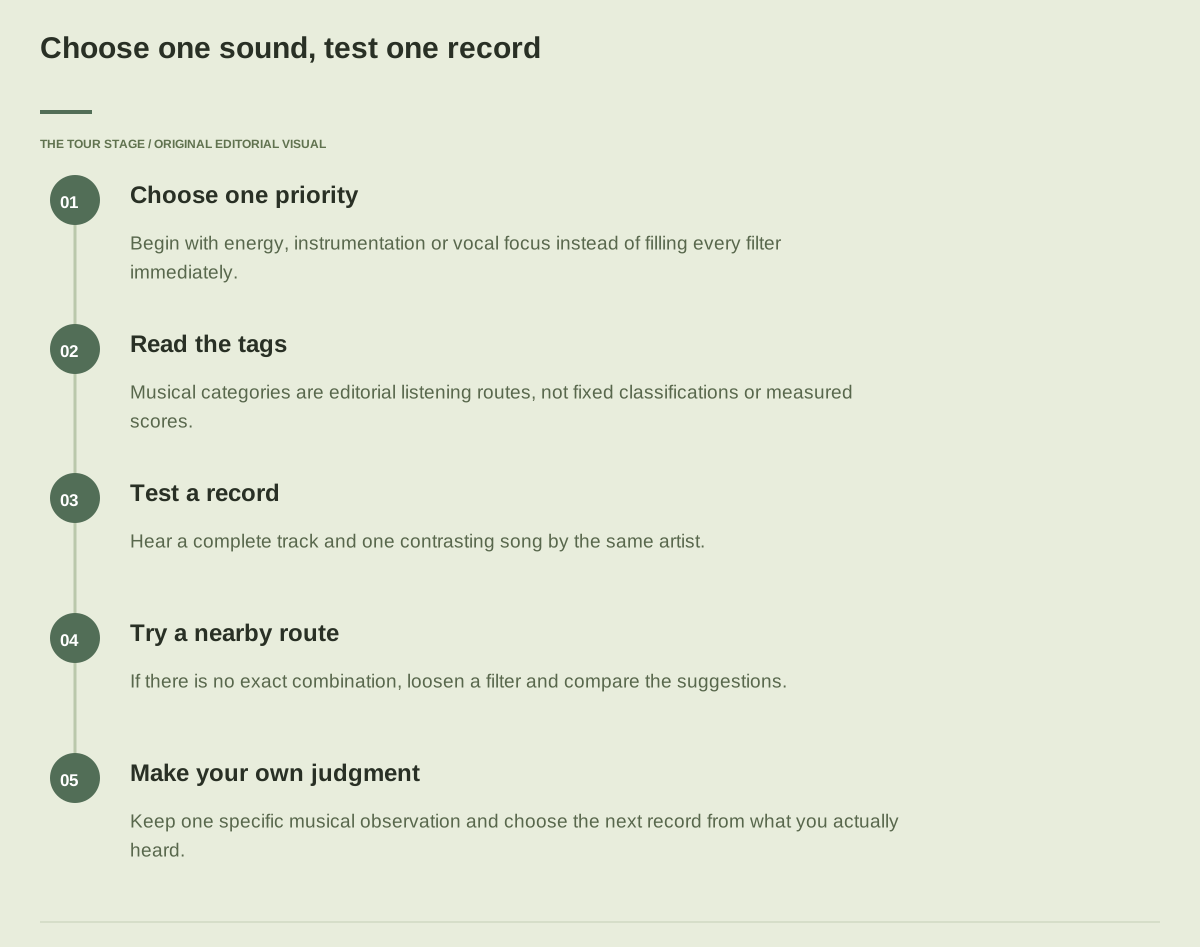
Choose one sound, test one record
- Choose one priorityBegin with energy, instrumentation or vocal focus instead of filling every filter immediately.
- Read the tagsMusical categories are editorial listening routes, not fixed classifications or measured scores.
- Test a recordHear a complete track and one contrasting song by the same artist.
- Try a nearby routeIf there is no exact combination, loosen a filter and compare the suggestions.
- Make your own judgmentKeep one specific musical observation and choose the next record from what you actually heard.
Read the visual as text
- Choose one priorityBegin with energy, instrumentation or vocal focus instead of filling every filter immediately.
- Read the tagsMusical categories are editorial listening routes, not fixed classifications or measured scores.
- Test a recordHear a complete track and one contrasting song by the same artist.
- Try a nearby routeIf there is no exact combination, loosen a filter and compare the suggestions.
- Make your own judgmentKeep one specific musical observation and choose the next record from what you actually heard.
Ty Myers: use the country-soul route to follow phrasing
The official biography for Ty Myers documents The Select and its Deluxe and Acoustic editions.1 The finder’s country-soul route uses the standard record as a starting point for hearing expressive vocal movement and guitar colour. Listen to how a phrase stretches across the supporting pulse, then compare a more exposed arrangement from an explicitly labelled acoustic edition. The soul-related tag here is editorial listening guidance, not a claim that Myers belongs to a formally bounded new movement. If the result appeals, choose a second complete song before changing artists. The country-soul listening route develops this comparison through additional performers. Use the sound of the recording to decide whether the suggested connection works for you.
Sierra Hull: hear instrumental detail within the song
For the acoustic and instrumental-detail route, Sierra Hull provides a way into mandolin-led music without reducing listening to speed or virtuosity. Her official site identifies Weighted Mind, 25 Trips and A Tip Toe High Wire as separate projects, while Concord documents the relationship between Weighted Mind and its follow-up.23 The finder names Weighted Mind as an entry point. Follow one supporting part for a verse, then listen again with attention returned to the voice. An intricate instrumental moment may become more expressive when heard as a response to the song rather than as an isolated display. If you want a fuller or different studio setting, move to another documented project rather than assuming the suggested record describes every stage of Hull’s work.
Carter Faith: follow vocal atmosphere into an album
The official Carter Faith catalogue and MCA’s album listing document Cherry Valley and its named tracks.45 The finder’s country/pop and vocal-atmosphere tags offer a route into the way a recording frames the singer. Choose a complete song and compare its verse setting with the chorus: how close does the voice feel, which sounds become more prominent, and what changes when the main hook returns? These are practical questions rather than a formula for deciding whether a record contains enough country influence. A catalogue can draw on several traditions without requiring the listener to resolve that boundary first. After the initial song, hear a contrasting track from the same album so that the result becomes a route into musical range rather than another isolated single.
Treaty Oak Revival and Randall King offer different kinds of momentum
Treaty Oak Revival’s official music page is the starting source for the band route, while Randall King’s official store documents Into the Neon.67 The finder places Treaty Oak Revival near driving electric-band energy and King near a traditional-country starting point. These are different ways to organise movement, not opposite levels of authenticity. With the band, hear how a fuller guitar texture changes the scale of the chorus. With King, follow the vocal’s relationship to a steady pulse and instrumental replies. In both cases, return to the complete song after isolating a detail. A shared preference for energy can lead to more than one kind of arrangement, which is why the tool presents a set of routes rather than one definitive answer.
Use exact and nearby results differently
When several filters return a small group, choose one suggested record and hear two songs before refining the search. When the tool offers nearby routes, loosen the preference you care about least and compare the new set. This is a useful way to discover which musical feature matters most to you. You may find that a vocal quality matters more than instrumentation, or that the rhythm holds your interest across very different voices. The finder does not read streaming accounts, monitor your listening or infer private information. Its suggestions come from the displayed choices and editorial tags. Start again clears those choices for a fresh session. The listening quiz offers a related set of prompts if you prefer a shorter path through the same kind of decision.
Turn the recommendation into your own listening judgment
Keep a simple three-step session: hear a suggested complete track, play a contrasting song by the same artist, and then choose one neighbouring route. Write one sentence about a musical choice that worked and one about something you would like to hear differently. Avoid converting the exercise into a score for taste or artistic quality. A suggestion can be useful even when you decide against it, because the comparison clarifies what you want next. For a longer project, the discovery calendar supplies existing albums to explore over time. Return to the finder whenever your mood or curiosity changes. Its purpose is to get you listening attentively, after which your response to the music is more informative than the tag that first brought you there.
Sources & further reading
- Ty Myers official biographyThe Select and identified editions.
- Sierra Hull official siteNamed catalogue projects.
- Concord: Sierra Hull 25 Trips announcementWeighted Mind and 25 Trips relationship.
- Carter Faith official siteOfficial catalogue entry.
- MCA: Cherry Valley album listingNamed album and complete track listing.
- Treaty Oak Revival official musicOfficial music entry point.
- Randall King official music catalogueInto the Neon catalogue entry.