First separate the three kinds of lineup
A band member belongs to the group’s public artistic identity. A session player is credited for a particular recording, while a touring musician is hired for a live production; one person can occupy more than one of these roles. A photograph cannot reliably tell you which applies. Read the album personnel for the record and the official current biography for the group. Neither document automatically describes a show from ten years earlier. This matters because country recordings often combine a band’s defining voices with outside instrumental expertise. The collaboration does not make the band less real. It simply means the sound on a record has more contributors than the artist name on its cover. The instrument map explains musical functions without confusing them with employment or membership.
Alabama: a band sound built for songs
The museum’s history of Alabama traces the group to cousins Randy Owen, Teddy Gentry and Jeff Cook and their earlier Wildcountry years.1 In “Mountain Music,” listen to the movement between the vocal narrative, the rhythmic push and the instrumental release. Its appeal does not rest on a single texture appearing uninterrupted from beginning to end. A recognisable lead voice provides continuity while the group opens up around it. Then hear “Feels So Right,” where the same collective identity can accommodate a smoother, more intimate performance. These are useful comparisons because an enduring band needs more than a signature fast-song trick. It needs an approach that survives a change of pace. Keep the historical lineup attached to its era rather than assuming that every credited musician played every studio part.
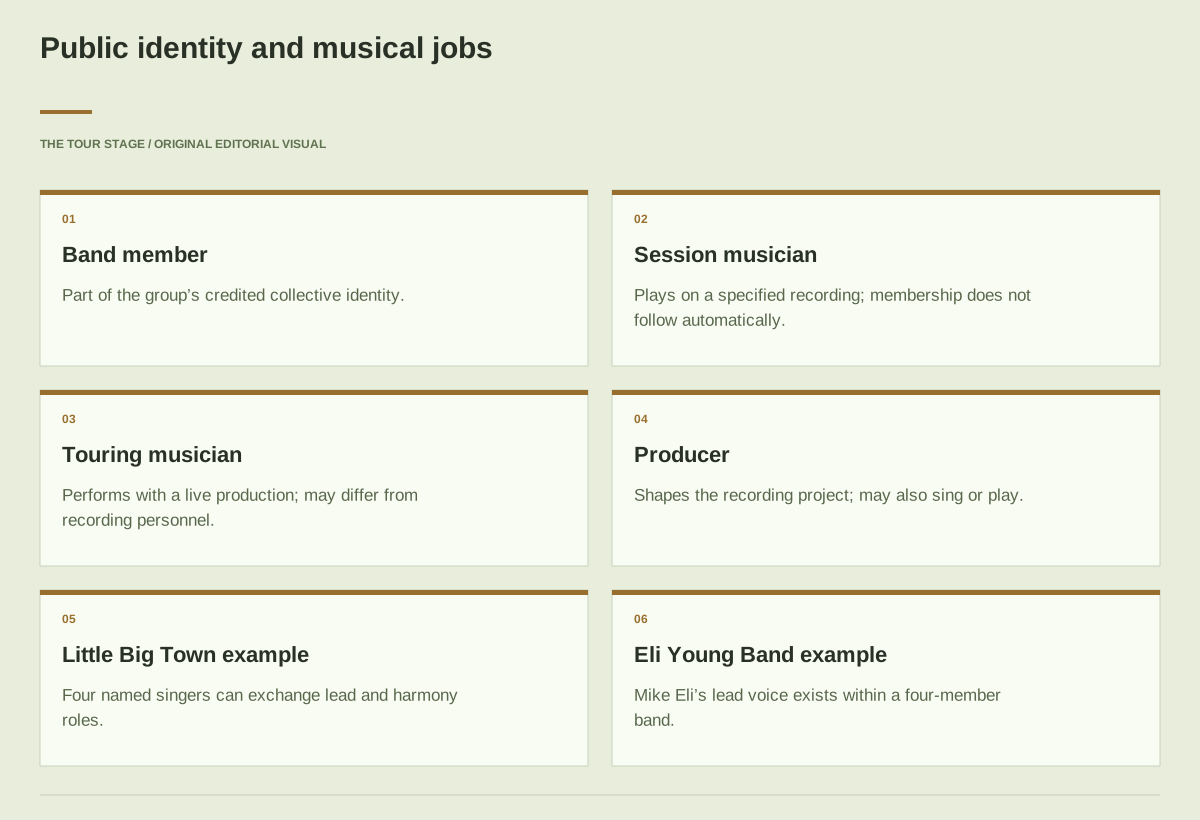
Public identity and musical jobs
- Band memberPart of the group’s credited collective identity.
- Session musicianPlays on a specified recording; membership does not follow automatically.
- Touring musicianPerforms with a live production; may differ from recording personnel.
- ProducerShapes the recording project; may also sing or play.
- Little Big Town exampleFour named singers can exchange lead and harmony roles.
- Eli Young Band exampleMike Eli’s lead voice exists within a four-member band.
Read the visual as text
- Band memberPart of the group’s credited collective identity.
- Session musicianPlays on a specified recording; membership does not follow automatically.
- Touring musicianPerforms with a live production; may differ from recording personnel.
- ProducerShapes the recording project; may also sing or play.
- Little Big Town exampleFour named singers can exchange lead and harmony roles.
- Eli Young Band exampleMike Eli’s lead voice exists within a four-member band.
Little Big Town: four voices, several centres
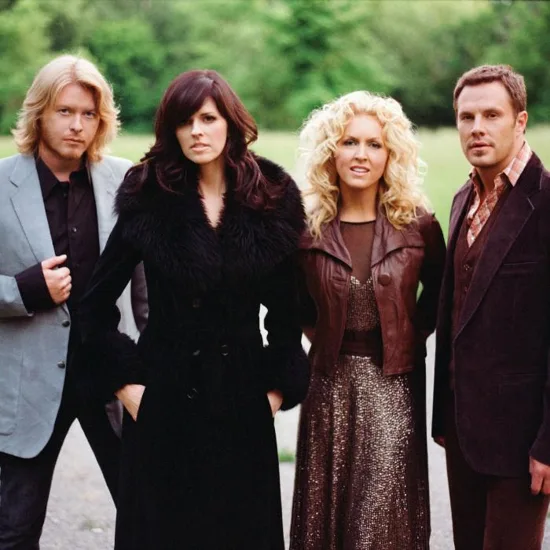
Karen Fairchild, Kimberly Schlapman, Phillip Sweet and Jimi Westbrook form Little Big Town; the band’s own 2026 album announcement names all four.2 Their catalogue makes a particularly clear distinction between a lead role and a permanent lead singer. On “Girl Crush,” follow the central vocal and the way other voices become part of its frame. Switch to “Boondocks” and hear a different distribution of energy and attack. Harmony is not merely a decorative layer added after the song is complete. Its timing, vowel shape and entry point can change the sense of community around the narrator. Try listening to a chorus without following the words: identify the highest and lowest sounding voices, then hear what happens when they enter together. Avoid assigning individual harmony notes from hearing alone unless a verified performance or credit identifies them.
The Mavericks: a historical identity with room to travel
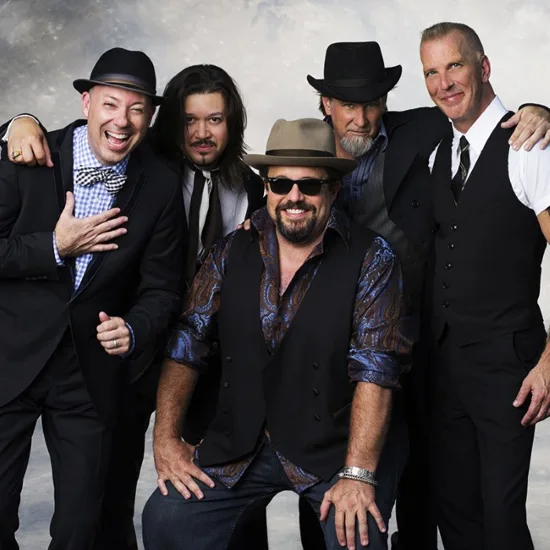
The Mavericks demonstrate why a band should not be defined by a single genre ingredient. Their official history describes the Miami group’s country, rock and Latin influences, while the 2020 En Español announcement documents its Spanish-language project and additional sidemen.3 Compare “All You Ever Do Is Bring Me Down” with “Poder Vivir.” Follow the dance pulse first, then the interplay of voice and instrumental punctuation. The recordings belong to different settings but share an appetite for movement and a theatrical sense of release. Discuss Raul Malo’s singing in the context of the recordings he made; the band’s present-day history and lineup are separate questions. A historical listening guide should not silently turn an album-era credit into a promise about who will appear at a future concert.
Eli Young Band: the name is a partnership
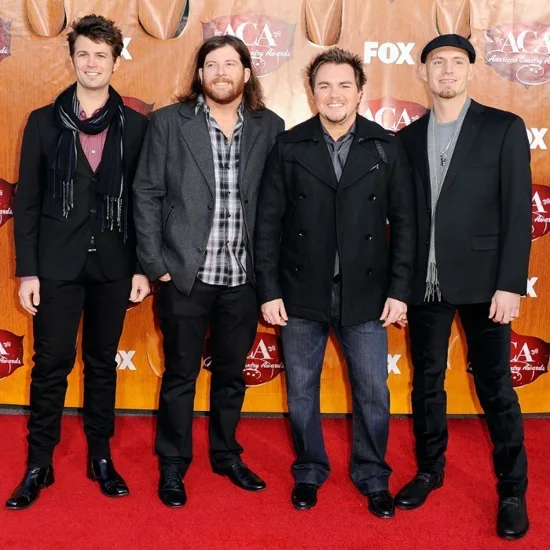
The Opry’s biography identifies Eli Young Band as Mike Eli, James Young, Jon Jones and Chris Thompson, formed at the University of North Texas in 2000.4 The name can mislead a new listener into imagining a solo artist with an anonymous backing group. Hear “Even If It Breaks Your Heart” for the way the vocal and guitar-led momentum make encouragement feel earned rather than merely announced. Then play “Crazy Girl” and notice a more contained emotional setting. The band’s identity remains audible through the lead voice and the arrangement’s sense of proportion. The practical lesson is to identify the group before drawing conclusions from a name. Some bands rotate vocal leads, some organise around one lead voice, and some emphasise instrumental interplay. Each can still sustain a collective identity.
A rhythm section carries memory
A listener often notices a singer or a spectacular guitar fill first. The rhythm section can be the deeper source of recognition: where the bass note lands, how firmly the snare marks the pulse, how a drummer approaches the space before a chorus. These details are not fixed measurements of quality. A slightly looser feel can serve one song, while a clipped, sharply synchronised attack serves another. Compare two recordings by the same band and describe the groove with ordinary language before consulting a style label. Does the music lean forward, settle back or bounce? Does the bass simply underline the harmony or lead into the next chord? The guitar tone guide and instrument map help separate texture from the underlying rhythmic job.
Shared identity does not require identical records
Production changes, guest players and a new writing partner can alter a band’s surface without erasing its identity. Equally, a familiar logo does not guarantee an unchanged lineup or a uniform sound across decades. Use an album as the unit of evidence. Note its year, producer, credited players and principal voices, then describe what you actually hear. A brass part on one recording does not mean every concert includes horns. A keyboard credit does not identify the keyboard player as a member. This method also gives outside musicians proper recognition: rather than treating them as invisible support, it acknowledges their work accurately. For a contrast with family-based groups, see family connections in country and roots music. Shared history can be familial, professional, or both.
Try a four-record comparison
Choose one recording from each of these four bands and listen in a single sitting. For every song, write down the central vocal arrangement, the instrument that answers it, and the moment when the rhythm changes its emphasis. On the next pass, compare two tracks from one group rather than four unrelated favourites. This second comparison tests whether the qualities you first noticed are enduring tendencies or simply features of one song. If a live video includes introductions, use those to identify performers; do not reconstruct personnel from appearance. Then check the recording credits and see which roles match. The result is a more useful understanding of a band than a list of members: you can hear how its musicians make decisions together, and you know which parts of that explanation are documented.
Sources & further reading
- Country Music Hall of Fame: AlabamaFounding history and historical band context.
- Little Big Town official 2026 album announcementFour member names; album production credit.
- The Mavericks official En Español announcementAlbum-era production, musical approach and sidemen.
- Opry: Eli Young BandMembers, instruments and 2000 formation.