Draw the relationship before drawing the conclusion
A family tree and a band diagram answer different questions. The first shows kinship; the second shows who works in a named project. A line between siblings does not establish a shared record deal, current tour or identical musical taste. This guide uses three documented groups of relatives to keep those layers visible: the Castellows sisters, the McCourys and the Braun brothers. None is evidence for a universal rule about musical families. A shared childhood can provide rehearsal time and musical vocabulary, but a convincing performance still depends on choices made in the present. Use the relationships as a route to recordings, then listen for the particular decisions that distinguish each ensemble. The country band guide explains why membership itself is another separate category.
The Castellows: three sisters with distinct musical jobs
The official biography of The Castellows identifies sisters Ellie, Powell and Lily, with Ellie on lead guitar, Powell on banjo and Lily on vocals. It also emphasises the trio’s three-part harmonies.1 That account supplies both a family relationship and an artistic organisation. Begin with A Little Goes a Long Way and hear how an acoustic texture can make small changes in vocal blend unusually clear. Do not assume that the lead instrument and lead vocal must always claim attention together. One can supply a brief melodic response while another carries the story. The named roles make a helpful starting map; the actual recording tells you how those roles interact. “Family harmony” describes a relationship, but it is not a substitute for hearing entrances, balance and phrasing.
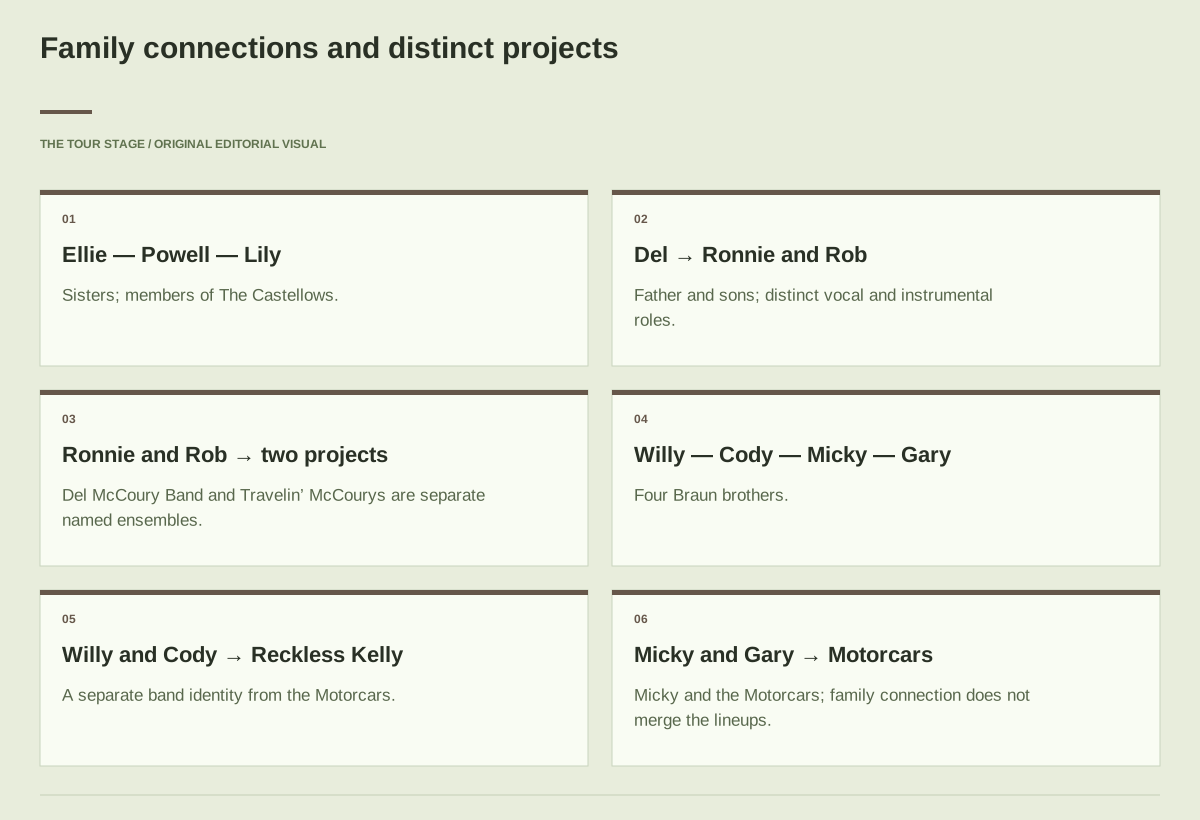
Family connections and distinct projects
- Ellie — Powell — LilySisters; members of The Castellows.
- Del → Ronnie and RobFather and sons; distinct vocal and instrumental roles.
- Ronnie and Rob → two projectsDel McCoury Band and Travelin’ McCourys are separate named ensembles.
- Willy — Cody — Micky — GaryFour Braun brothers.
- Willy and Cody → Reckless KellyA separate band identity from the Motorcars.
- Micky and Gary → MotorcarsMicky and the Motorcars; family connection does not merge the lineups.
Read the visual as text
- Ellie — Powell — LilySisters; members of The Castellows.
- Del → Ronnie and RobFather and sons; distinct vocal and instrumental roles.
- Ronnie and Rob → two projectsDel McCoury Band and Travelin’ McCourys are separate named ensembles.
- Willy — Cody — Micky — GaryFour Braun brothers.
- Willy and Cody → Reckless KellyA separate band identity from the Motorcars.
- Micky and Gary → MotorcarsMicky and the Motorcars; family connection does not merge the lineups.
What a vocal blend can tell you
Related singers may have recognisably similar timbres, but similarity alone does not create a polished harmony. Listen for a shared vowel shape, simultaneous consonants and the way a held note is released. A slightly different entrance can produce tenderness or friction, whether the singers are siblings or unrelated colleagues. The useful comparison is between passages in a recording, not between imagined biological explanations. Try following the lowest audible harmony through one chorus and the upper harmony through the next. Then listen to a single central voice and notice how the surrounding voices change its character. You need not identify every singer by ear to describe the effect accurately. When an official performance isolates the parts, it can support a more specific attribution. Otherwise, keep your observation at the ensemble level.
Del, Ronnie and Rob McCoury: family within an ensemble
The Del McCoury Band’s individual biographies identify Ronnie McCoury as Del’s son and a mandolin player, and Rob McCoury as a banjo player in the family’s musical history.2 Hear The Del McCoury Band as an ensemble rather than a family photograph with accompaniment. The instrumental breaks change who occupies the foreground; the other players continue making the groove rather than merely waiting their turn. That distribution of responsibility is central to bluegrass. Ronnie and Rob have distinct sounds because their instruments perform distinct rhythmic and melodic work. The relationship explains a long shared musical environment, but it does not make the musicians interchangeable. The mandolin guide and banjo history help identify what each instrument contributes.
The Travelin’ McCourys are a separate project
The same official biographies also document Ronnie and Rob’s work with The Travelin’ McCourys.2 That shared personnel does not turn two band names into synonyms. Read the project name on the release or event listing, then check its own current lineup. The singer, arrangements and balance of instrumental emphasis can differ even when several people are familiar. An audience member buying a ticket should not infer that Del is performing simply because his sons are on the bill. Musically, the overlap is an opportunity: compare how a musician supports a vocal in one setting and takes more space in another. Professional relationships extend beyond family, and the contributions of unrelated bandmates deserve to remain visible. The diagram therefore gives project connections their own labels rather than presenting every musical relationship as kinship.
Four Braun brothers, two band identities
Micky and Gary Braun are brothers of Willy and Cody Braun. The Motorcars’ agency biography documents the family’s Idaho background and the distinction between Micky and the Motorcars and Reckless Kelly.3 Micky and the Motorcars and Reckless Kelly have connected roots without being one touring group. Follow “Hearts from Above” into the Motorcars catalogue, then compare Reckless Kelly’s “Wicked Twisted Road.” Listen to how each lead voice sets the emotional temperature and how the electric instruments support the song. Similar roots do not require identical arrangements. In a festival announcement, two separately printed band names mean two artist bookings unless the organiser explicitly describes a combined performance. Family ties are a discovery connection, not permission to rewrite the billing.
A shared upbringing can lead to different choices
Reckless Kelly’s official history identifies Willy and Cody alongside the band’s other core personnel, while the Motorcars’ label biography discusses Micky and Gary’s work in its own right.45 These accounts are useful precisely because they place the relatives inside functioning bands rather than treating the bands as satellites of a family story. Recordings result from writing partnerships, rhythm sections, producers and repeated live decisions as well as upbringing. Pay attention to a non-relative’s contribution when following a family connection. A bass part or a guitar response may explain the difference between two records more clearly than a surname does. This also prevents a familiar error in roots music: hearing a shared regional influence and attributing every feature of it to family inheritance.
Use the diagram as a listening itinerary
Start with one recording by the Castellows, one by the Del McCoury Band, one by the Travelin’ McCourys and one each from the Braun brothers’ bands. For every selection, note the artist name exactly as printed and identify one musical difference from the previous stop. Keep a second note for the documented relationship. Those two columns should complement each other, not collapse into a single explanation. Recheck current official artist pages when planning a concert, because personnel and projects have dates while kinship usually does not. The collaboration atlas offers a separate way to follow writing and recording partnerships. A family connection is one valuable path into a catalogue, but the next rewarding discovery may be the unrelated musician who makes a particular performance come alive.
Sources & further reading
- The Castellows official biographySister relationship, instruments and debut EP.
- Del McCoury Band individual biographiesRonnie and Rob’s family relationships, instruments and both projects.
- New Frontier Touring: Micky and the MotorcarsBraun family relationship and distinction between bands.
- Reckless Kelly official historyWilly and Cody Braun and band context.
- Blue Rose Records: Motorcars biographyMicky and Gary’s distinct band and collaborative writing context.