
Three terms that describe different events
A debut marks an artist’s first appearance on the Grand Ole Opry. A subsequent appearance can be a guest performance without changing the artist’s membership status. Membership follows an invitation and induction rather than automatically arriving after a certain number of bookings. These descriptions can all apply to one career at different times, but they are not interchangeable. Read the specific noun in an announcement: debut, invitation, induction, member or guest. A promotional phrase such as “Opry artist” may simply mean an artist who has appeared on the show. It does not supply an induction date. The official Opry artist page and membership list are better evidence than a shortened third-party biography. This guide’s named examples were checked against those official records for November 2026.
How membership is decided
The Opry says its management makes membership decisions, considering career accomplishment, commitment, relationships and the balance of its roster. Its explanation expressly avoids reducing the decision to hits or the number of appearances.1 That means there is no reliable public arithmetic in which a debut plus a handful of return bookings equals membership. It also means a new artist can have an important Opry appearance without having received an invitation. A listener does not need to downgrade a debut to understand the distinction. The debut is a genuine career event with its own emotional and professional meaning. Treat each milestone accurately, and let the artist’s announcement describe it. Do not infer a private invitation from a photograph backstage, an appearance on a themed night or an association with an existing member.
Debuts and inductions are different milestones
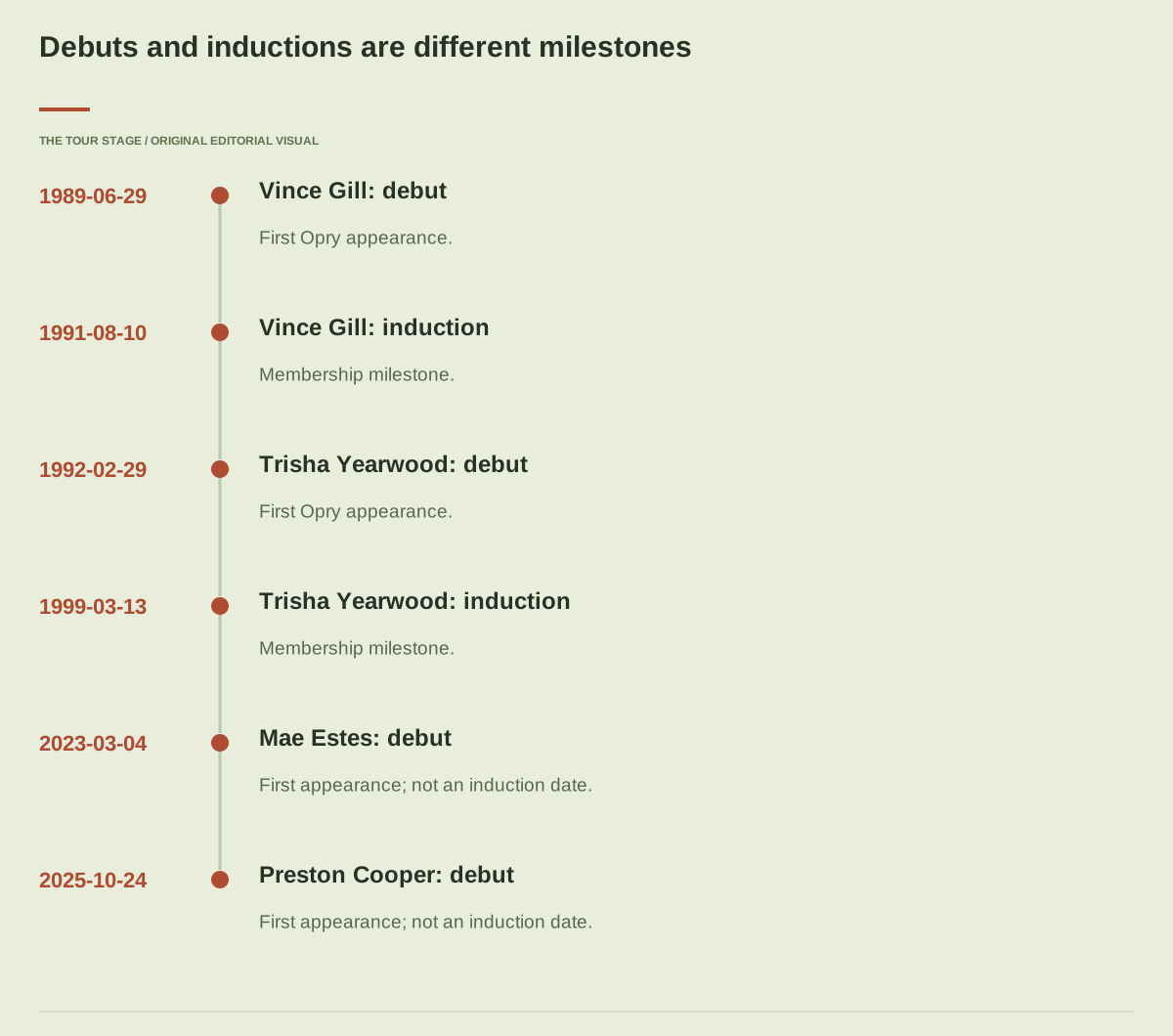
- 1989-06-29 · Vince Gill: debutFirst Opry appearance.
- 1991-08-10 · Vince Gill: inductionMembership milestone.
- 1992-02-29 · Trisha Yearwood: debutFirst Opry appearance.
- 1999-03-13 · Trisha Yearwood: inductionMembership milestone.
- 2023-03-04 · Mae Estes: debutFirst appearance; not an induction date.
- 2025-10-24 · Preston Cooper: debutFirst appearance; not an induction date.
Read the visual as text
- 1989-06-29 · Vince Gill: debutFirst Opry appearance.
- 1991-08-10 · Vince Gill: inductionMembership milestone.
- 1992-02-29 · Trisha Yearwood: debutFirst Opry appearance.
- 1999-03-13 · Trisha Yearwood: inductionMembership milestone.
- 2023-03-04 · Mae Estes: debutFirst appearance; not an induction date.
- 2025-10-24 · Preston Cooper: debutFirst appearance; not an induction date.
Vince Gill: two separate dates
The official record for Vince Gill lists an Opry debut on June 29, 1989 and an induction on August 10, 1991.2 Those dates provide a particularly clear demonstration of why a biography should preserve both events. The first identifies his entry into the show’s performance history; the second identifies membership. Neither date alone tells the whole story of the music he brought to the stage. Gill’s singing, instrumental work and collaborations can be explored through his recordings without turning the Opry into a ranking system. When writing a caption for an archival photograph, use the event documented by the caption or programme. A picture from a later anniversary should not be relabelled as the debut merely because it commemorates the same relationship.
Trisha Yearwood: a debut is not an induction
Trisha Yearwood’s Opry page records February 29, 1992 as her debut and March 13, 1999 as her induction.3 A date with a leap day can look like an error when copied without checking, which makes the official entry especially valuable. The interval also demonstrates that there is no uniform wait between first appearance and membership. Do not compare it with Gill’s interval and invent a rule about which artist progressed faster. Different careers and institutional relationships develop differently. For a listener, the useful consequence is simply that an article can celebrate the recording breakthrough, the first Opry appearance and the induction as three distinct moments. The women’s listening history places Yearwood’s musical contribution in a wider context beyond institutional milestones.
Mae Estes and Preston Cooper: describe the verified milestone
The Opry lists Mae Estes’ debut as March 4, 2023 and Preston Cooper’s as October 24, 2025.45 These are debut examples; the dates are not presented here as inductions. That distinction is particularly important when a reader encounters a headline announcing a first performance. A debut can be a place to discover a singer’s live approach, hear the response to a less familiar song and follow a new catalogue. It does not need the extra claim of membership to matter. If a later official announcement changes an artist’s status, cite that announcement and its actual date. Do not rewrite an older debut date as if it had always denoted a membership event.
The show, the building and the broadcast
“The Opry” can refer to the continuing show and institution, while a ticket also specifies a particular venue and performance time. A visit to the Opry House and a visit to the Ryman are different journeys; the official site gives separate addresses and visitor information.6 Read the venue field before organising transport. A performer’s membership does not imply an appearance at every edition of the show, and a ticket is not a tour through the entire member roster. The date’s published lineup is the relevant starting point. For broader trip organisation, use the concert weekend planner to write the actual venue, arrival plan and return route. Keep a saved copy of the booking details so the institutional history does not obscure the practical information you need on the night.
Read a lineup as a shared evening
An Opry bill places different artists inside a continuing presentation rather than promising each act a full standalone headline set. Approach the evening as a route through voices and traditions, and use the official performance listing for the people advertised on that date. A debut artist may share a programme with an established member without receiving identical billing or status. That mixture can make the show useful for discovery: one singer becomes a doorway to another style, era or instrument. Listen for how a voice works in a shared context rather than judging the appearance by the length of a regular arena concert. The country band guide also helps distinguish a named artist’s musicians from other players involved in a production.
A reliable way to check an announcement
First find the Opry’s own artist page and look for its labelled dates. Next check the membership explanation or roster if the claim concerns membership. Finally open the show listing for the actual performance being discussed. If the evidence establishes only a debut, say debut. If it establishes an invitation but not yet an induction, preserve that sequence. For historical writing, attach each fact to its own date; for travel, check the venue and current bill again close to departure. These checks take less effort than correcting an overstated biography later. More importantly, they leave the musical event intact. A guest performance, a first appearance and a long membership each mean something specific, and understanding the difference gives the reader a clearer relationship with the show.
Sources & further reading
- Opry membership explanationManagement decisions, commitment and roster.
- Opry: Vince Gill1989 debut and 1991 induction.
- Opry: Trisha Yearwood1992 debut and 1999 induction.
- Opry: Mae EstesMarch 4, 2023 debut.
- Opry: Preston CooperOctober 24, 2025 debut.
- Opry visitor informationSeparate venue addresses, date-specific show listings and visitor links.