Let the playlist make its own journey
The route below is a musical sequence, not an itinerary or a claim that a particular road must sound a certain way. It works on a train, in a passenger seat or at home. Its purpose is to make contrast intentional: forward motion has more impact after a lighter texture, and a reflective song feels different when it follows an energetic stretch. You can shorten or extend each stop without breaking the idea.
Choose the recordings before setting off, and let a passenger handle any changes while the vehicle is moving. That small bit of preparation also makes the listening better: you can identify a version, put the sequence in order and avoid repeated searches. The official links here lead to artist-controlled catalogues, where you can select a service you already use. No invented streaming playlist or promised running time is needed.
Departure: Dierks Bentley makes motion feel easy
Begin with Dierks Bentley’s “Free and Easy (Down the Road I Go).” His official music catalogue lists it within Greatest Hits: Every Mile a Memory. Hear the way the vocal rides a clear pulse: the sense of travelling comes from the performance’s movement as well as its subject. It is an effective opener because it establishes a forward direction without requiring the playlist to begin at its maximum intensity.1
Follow with “Every Mile a Memory,” another documented selection from that catalogue, if you want the opening stage to become more reflective. The pairing introduces a central idea for this route: motion and recollection can exist together. A track that invokes memory does not have to stop the journey. Listen for how the chorus changes the apparent size of the scene, and whether the singer sounds like he is addressing one person or a larger public.
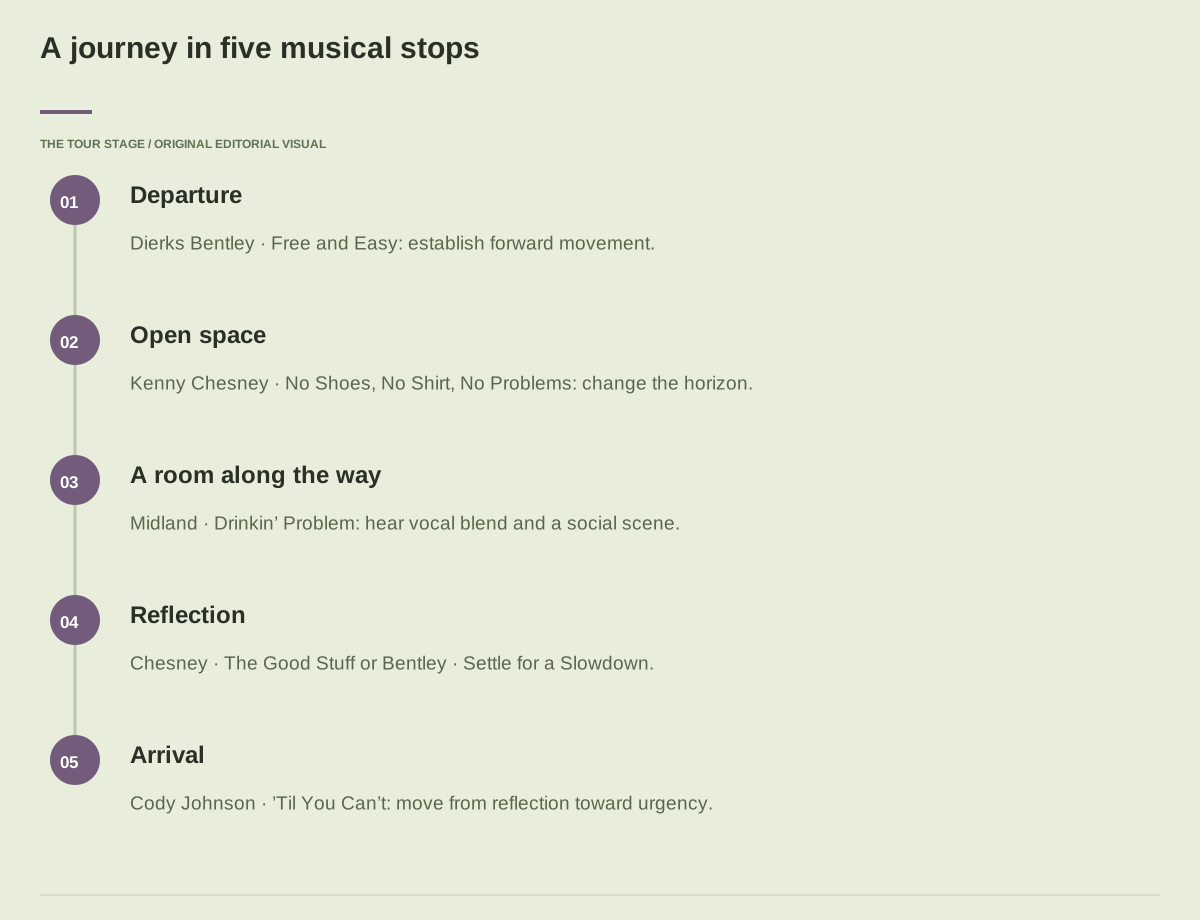
A journey in five musical stops
- DepartureDierks Bentley · Free and Easy: establish forward movement.
- Open spaceKenny Chesney · No Shoes, No Shirt, No Problems: change the horizon.
- A room along the wayMidland · Drinkin’ Problem: hear vocal blend and a social scene.
- ReflectionChesney · The Good Stuff or Bentley · Settle for a Slowdown.
- ArrivalCody Johnson · ’Til You Can’t: move from reflection toward urgency.
Read the visual as text
- DepartureDierks Bentley · Free and Easy: establish forward movement.
- Open spaceKenny Chesney · No Shoes, No Shirt, No Problems: change the horizon.
- A room along the wayMidland · Drinkin’ Problem: hear vocal blend and a social scene.
- ReflectionChesney · The Good Stuff or Bentley · Settle for a Slowdown.
- ArrivalCody Johnson · ’Til You Can’t: move from reflection toward urgency.
Open space: Kenny Chesney changes the horizon
Move to Kenny Chesney’s “No Shoes, No Shirt, No Problems.” The official album page supplies a listening link and the album’s full track list. The change of frame is useful: instead of escalating immediately into another hard-driving selection, the sequence can open a little space. Hear the texture and the vocal stance before treating the song as a postcard with a beat.2
Then try “On the Coast of Somewhere Beautiful” from the same record. A setting can carry longing as readily as escape. Listen to how the singer’s distance from the imagined place affects the mood. Together these choices prevent a travel playlist from becoming a uniform string of celebrations. The route gains perspective when it permits a destination to be an idea someone longs for, rather than a place the narrator has already reached.
A familiar room along the way: Midland
Midland’s On the Rocks offers the next change of colour. The official release page links to authorised listening services. Start with “Drinkin’ Problem” and follow the vocal blend and the band’s measured movement. The choice here is about musical feel and character, rather than a literal instruction for the journey. A barroom scene can supply a useful contrast to the open-air settings around it.3
Keep attention on the instrumental answers after a line. The apparent ease of a performance can conceal tightly coordinated entrances, and a slightly rueful voice can complicate an agreeable rhythm. In sequence, this stop should feel like a change of social space. You have moved from an outward view to a room with a particular speaker inside it. That shift can renew attention without requiring a sudden leap in tempo or volume.
The reflective stretch: lower the density
Return to Chesney’s “The Good Stuff,” also listed on No Shoes, No Shirt, No Problems, or choose Bentley’s “Settle for a Slowdown” from the official hits listing. Either gives you a way to reduce the sense of constant propulsion. Listen for how a vocal line changes when there is more room around it, then notice whether the song’s emotional movement is actually slower than its surface suggests.12
Do not fill this section with nothing but the saddest songs you know. The role of a reflective stretch is to change attention, not exhaust it. One clear narrative or a more restrained arrangement may be enough. Our ballad guide follows phrasing and space in detail, while the story-song feature explains why an apparently small scene can sustain a whole recording.
Arrival: Cody Johnson gives the sequence a decision
Finish the core route with Cody Johnson’s “’Til You Can’t.” His official release page links to the video and identifies Ben Stennis and Matt Rogers as writers, with the track on Human The Double Album. The song’s urgency makes it a strong editorial ending after a reflective passage: the route moves from observation toward a call to act.4
Hear the vocal’s increasing scale without assuming that loudness alone supplies conviction. The placement of a phrase, the build toward a refrain and the band’s support all contribute. If this feels too emphatic for your destination, reverse the last two stops and let reflection close the sequence. A route is a design you can adapt, not a test with one approved answer. Keep the reason for the change explicit so the playlist remains intentional.
Extend the route through contrast
For a longer session, add songs in pairs: one that shares a musical feature with the previous track and one that changes it. A harmony-rich recording might lead to another with a close vocal blend, then to a single exposed voice. A bright rhythm section might lead to a more spacious acoustic performance. This builds continuity without making every track sound alike.
Keep a note of the version and album for any song you add. Live, acoustic and remixed recordings can serve different roles even when their titles match. Follow the acoustic comparison guide and the live-album guide when you want alternate textures, or use the starter album shelf to find material beyond familiar singles. The best result is a sequence that supports your attention through changes of mood, with enough space for a song to make an unexpected impression.
Sources & further reading
- Dierks Bentley official musicNamed tracks on official hits catalogue and listening links.
- Kenny Chesney official albumSelected track list and official listening route.
- Midland official On the RocksOfficial album listening destination.
- Cody Johnson official video releaseAlbum, video and writer credits.