A performance has more than one foreground
A studio record can focus your attention with extraordinary precision. A live album adds another frame: the songs occur within a performance that has to keep moving through a room full of people. Listen for the transitions, not only the applause. A count-in, an instrumental pickup or the speed with which a band settles into the next number can communicate a shared working language. That does not mean every live record presents an untouched concert from beginning to end. Identify the release and its documented setting before making claims about the session. This guide uses confirmed live albums as listening starting points and treats observations about energy and interaction as editorial interpretations. The country-band guide offers a useful vocabulary for following roles inside the ensemble instead of hearing only the lead voice.
Randy Rogers Band at Billy Bob’s Texas
The venue’s own catalogue identifies Randy Rogers Band’s Live at Billy Bob’s Texas and gives its recording date as January 21, 2005. Its track list includes “Somebody Take Me Home,” “Down and Out,” “This Time Around” and “An Empty Glass.”1 Choose a familiar song and listen through its entrance, main sections and ending. Hear whether a supporting instrument answers the vocal immediately or gives the phrase room to settle. Follow the rhythm section while the lead instrument moves forward. The useful discovery may be the steadiness underneath a moment that initially seemed spontaneous. A concert recording allows you to hear an arrangement as collective coordination: someone must keep the shape intact while another musician supplies the detail that makes this performance memorable.
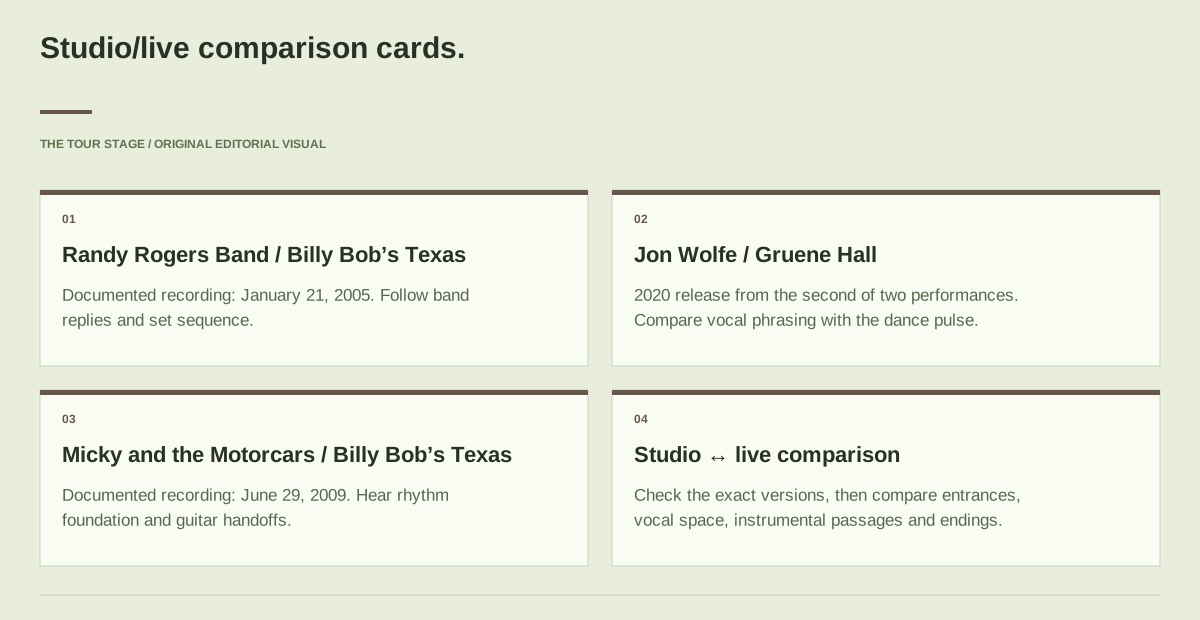
Studio/live comparison cards.
- Randy Rogers Band / Billy Bob’s TexasDocumented recording: January 21, 2005. Follow band replies and set sequence.
- Jon Wolfe / Gruene Hall2020 release from the second of two performances. Compare vocal phrasing with the dance pulse.
- Micky and the Motorcars / Billy Bob’s TexasDocumented recording: June 29, 2009. Hear rhythm foundation and guitar handoffs.
- Studio ↔ live comparisonCheck the exact versions, then compare entrances, vocal space, instrumental passages and endings.
Read the visual as text
- Randy Rogers Band / Billy Bob’s TexasDocumented recording: January 21, 2005. Follow band replies and set sequence.
- Jon Wolfe / Gruene Hall2020 release from the second of two performances. Compare vocal phrasing with the dance pulse.
- Micky and the Motorcars / Billy Bob’s TexasDocumented recording: June 29, 2009. Hear rhythm foundation and guitar handoffs.
- Studio ↔ live comparisonCheck the exact versions, then compare entrances, vocal space, instrumental passages and endings.
A set sequence is an argument about the band
The same Billy Bob’s listing supplies an ordered programme, which lets you consider the record as a sequence rather than a shuffle of individual tracks. Compare the mood of two neighbouring songs before skipping to a favourite. Does the second sustain the first song’s momentum, change the emotional temperature or give the vocal a different kind of space? These are listening questions, not a reconstruction of decisions made backstage. A live album can gather songs from different studio projects into one account of a band’s identity. The listener hears common features that may be less obvious when the songs sit on separate releases. For a further regional route, the Texas country guide connects records with the circuits and rooms through which bands build their working audience.
Jon Wolfe: a documented night at Gruene Hall
Jon Wolfe’s official album page identifies Live at the Legendary Gruene Hall as his second live album, released in 2020. It states that the recording uses the second of two performances and names Mills Logan as producer.2 That is valuable session context: a live album is still a produced recording, and the chosen night matters. The published track list includes “Boots on a Dance Floor,” “Any Night in Texas” and “A Country Boy’s Life Well Lived.” Hear one song for the vocal and then for the band’s movement behind it. A dance-oriented pulse can remain purposeful without becoming forceful at every moment. The record is useful for studying how a singer’s phrasing sits inside a regular groove, rather than assuming audience excitement must always sound like a faster tempo.
Micky and the Motorcars: a catalogue enters a room
Billy Bob’s own release page documents Micky and the Motorcars’ live recording on June 29, 2009. Its programme includes “Naïve,” “Carolina Morning,” “The Band Song” and “Bloodshot.”3 The group’s official shop also lists Live in Germany alongside studio titles such as Naive and Raise My Glass.4 Start with one of the documented shared titles and compare how the band establishes it on stage with how it sits within a studio album. Listen to the bass and drums as well as the guitars: an energetic surface depends on a rhythmic foundation that may sound deceptively straightforward. If a passage feels wider or more urgent in the live setting, describe the instruments and their spacing before reaching for an explanation about the crowd.
Audience sound is evidence of presence, not a rating
Applause, singing and room noise can help you hear the boundary between stage and audience. They cannot supply a reliable attendance count, a measure of how much every person enjoyed the show or proof that the recording represents an entire venue evenly. Microphone placement and mixing influence what reaches the listener. Hear when audience sound enters and recedes, and whether it changes your perception of a chorus or a pause. A familiar song may acquire a communal feeling even while the lead performance remains relatively controlled. Keep your observation specific: the crowd becomes audible at a particular musical point, rather than the entire crowd goes wild. The producer explainer helps distinguish the event itself from the recorded perspective through which you hear it.
Compare studio and live versions without guessing
Before starting a pair, check that the title, performer and recording version match. A live medley, a later re-recording and a studio single edit can differ for reasons beyond the room. Write the release names beside your notes. Compare the introduction, the point where the rhythm establishes itself, the space around the voice and the ending. Notice any extra instrumental passage you can actually identify; do not assume a longer running time automatically means improvisation, because applause and spoken introductions also take time. If the same musicians seem to react closely to one another, describe the audible handoff rather than inventing an onstage glance. A precise account of one guitar reply is more useful than a broad claim that the live version has greater soul.
Hear one whole side of the performance
After making a close comparison, return to an uninterrupted stretch of the live album. Three or four consecutive songs are enough to hear changes in intensity and the work of maintaining attention. Keep the volume comfortable and let quieter transitions remain quieter. The benefit of the record is not only access to a version you could not hear on a studio release; it is the chance to notice how songs share a stage. You may leave wanting to revisit a less familiar studio album, or become more aware of a musician whose part you previously took for granted. Use the concert-weekend guide when that curiosity turns into a trip, while keeping these documented recordings separate from expectations about any future set list.
Sources & further reading
- Billy Bob’s Texas: Randy Rogers Band live CDRecording date and album sequence.
- Jon Wolfe official Gruene Hall live album2020 live album, chosen second night, producer and track list.
- Billy Bob’s Texas: Micky and the Motorcars live CDJune 29, 2009 recording and named programme.
- Micky and the Motorcars official album shopStudio catalogue and Live in Germany listing.