
Describe the visit you need in practical terms
Accessibility can involve mobility, hearing, vision, sensory conditions, communication and other needs. A wheelchair symbol on a map answers only part of that picture. Begin with the actual tasks: arriving, reaching a place, watching, using facilities, taking a break and leaving. Identify the feature required at each stage rather than assuming one ticket category covers everything.
You do not need to disclose unrelated medical detail to formulate a useful question. “I need a route without stairs from the drop-off point to this section” is specific enough to start a conversation. So is asking whether an assistive listening system works in the area you are considering. The examples here concern U.S. venues and official U.S. ticketing guidance. Other countries have different legal frameworks; the same practical method still helps, but their requirements should be checked through local official sources.
Separate the ticket from the route to it
A location can be suitable once reached and still have a problematic approach. Ask about the path from the actual parking space, drop-off zone or transit stop, including distance, slope, surface and any lift or elevator. Then ask about the route from that entrance to the ticketed place. A map that shows only the room can hide the longest part of the visit.
Red Rocks gives a concrete example of venue-specific detail: its accessibility page identifies wheelchair-accessible rows 1 and 70 and explains that these arrangements depend on the tickets selected.1 Those facts are not interchangeable with another amphitheatre’s layout. Ask which route serves the specific location and how the return works after the show. The venue comparison explains why outdoor topography and arena tiers create different questions even when both offer accessible seating.
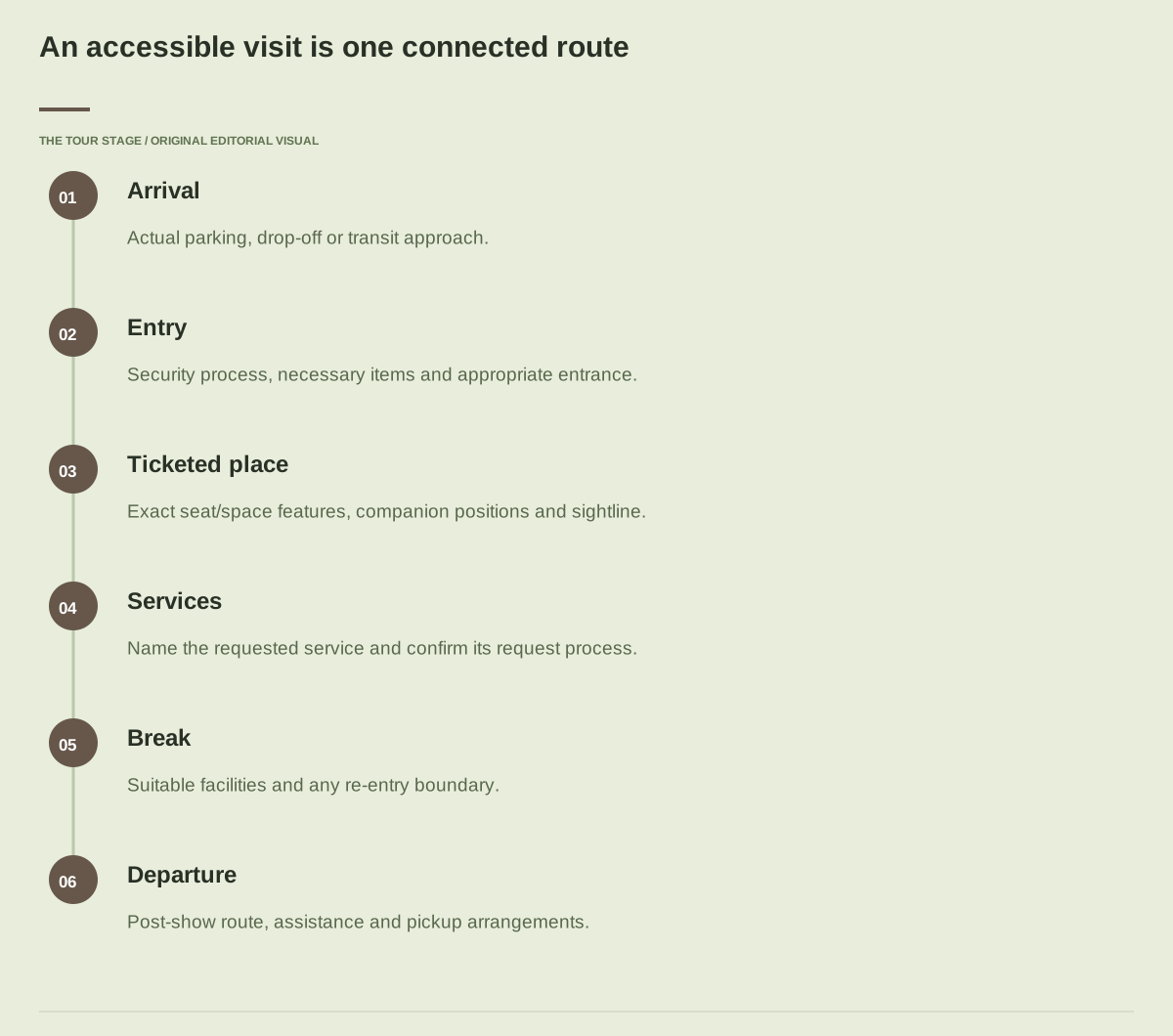
An accessible visit is one connected route
- ArrivalActual parking, drop-off or transit approach.
- EntrySecurity process, necessary items and appropriate entrance.
- Ticketed placeExact seat/space features, companion positions and sightline.
- ServicesName the requested service and confirm its request process.
- BreakSuitable facilities and any re-entry boundary.
- DeparturePost-show route, assistance and pickup arrangements.
Read the visual as text
- ArrivalActual parking, drop-off or transit approach.
- EntrySecurity process, necessary items and appropriate entrance.
- Ticketed placeExact seat/space features, companion positions and sightline.
- ServicesName the requested service and confirm its request process.
- BreakSuitable facilities and any re-entry boundary.
- DeparturePost-show route, assistance and pickup arrangements.
Understand the U.S. companion-seat framework
The U.S. Department of Justice’s ticket-sales guidance explains accessible ticketing, including the ability to purchase up to three contiguous companion seats, subject to the circumstances and ticket limits described there. It also states that proof of disability cannot be required as a condition of buying accessible tickets.2 Read the full official guidance for its scope rather than treating this paragraph as a complete account of every situation.
For the practical booking, ask where the companions will be, how the places are represented in the checkout and whether the whole party can use the same route. If the venue’s displayed process does not answer the need, contact its accessibility or box-office team before buying an unsuitable alternative. Do not assume a standard ticket can always be relocated after arrival. The question is whether an appropriate arrangement is available for this event, not whether a helpful staff member might solve it later.
Ask for the service by name and confirm the process
An assistive listening device, sign-language interpretation, captioning and an audio description are different services. State which you need and ask how to request it, what notice is needed, where to collect equipment and how it works in your chosen location. A venue offering one service does not establish the availability of all the others.
Ryman Auditorium’s accessibility information describes its own facilities, routes and visitor arrangements.3 Use that detailed page as the beginning of a specific conversation rather than assuming the historic setting rules a service in or out. Ask whether the event introduces any relevant lighting, sound or visual effects and where that information will be communicated. If a request needs advance coordination, record the deadline and confirmation. A service that exists in principle is not yet the same as an arrangement confirmed for your date.
Clarify what the seat or space actually provides
Ask whether a location is a wheelchair space, a transfer seat, a designated aisle seat or another arrangement. If transferring, confirm the chair and armrest features you need and where a mobility device can remain. If remaining in a wheelchair, clarify the viewing position and companion placement. The word accessible alone is not precise enough to answer these questions.
Sightlines also matter. Ask how the view works if people in nearby areas stand, and whether any railing or event production affects it. A close location is not automatically a better one if its view or route does not suit you. The seat guide separates elevation, distance and obstructions. For artists such as Luke Bryan, Tim McGraw or The Chicks, use the specific event configuration rather than an assumption based on the tour’s publicity images.
Join up breaks, facilities and departure
Ask where the nearest suitable restroom is and whether the route stays available throughout the event. If a quiet break would help, ask what area exists, how to reach it and whether leaving the ticketed boundary changes re-entry. Clarify necessary items against current bag and security rules, especially when equipment does not fit an ordinary personal-bag category.
Then plan the return. A lift, shuttle or staffed route may have an operating arrangement after the final song that differs from arrival. Check pickup location and the route to it. Keep a practical buffer for leaving the section and reaching transport. If travelling with companions, decide who holds the tickets and whether everyone must enter together. The mobile-ticket guide explains why official transfers and confirmed access are separate parts of that plan.
Keep a short confirmation record
Write down the event, ticket location, requested feature, confirmed route and relevant contact channel. Keep the source link and date of any confirmation with the plan. Recheck event information close to departure, especially when a production layout or transport arrangement can change. This is a useful operational note, not a dossier of personal medical information.
On arrival, locate guest services and ask early if the actual arrangement differs from what was confirmed. Give staff a concrete description of the problem and the location. After the visit, note what worked so the next booking starts with better questions, while remembering that another venue still requires its own check. The full concert guide and weekend planner can hold these details alongside transport and timing. Accessibility planning works best when it connects the entire visit rather than stopping at the purchase screen.
Sources & further reading
- Red Rocks accessibilityVenue-specific accessible rows and arrangements; reviewed November 2026.
- U.S. Department of Justice: ADA ticket salesU.S. accessible-ticketing requirements and companion-seat framework.
- Ryman accessibilityVenue-specific access routes, services and seating information.