
Choose the kind of evening before choosing the ticket
Begin with the music you want to hear and the physical experience you want around it. A seated arena, an outdoor lawn and a standing dance hall can all host country artists, but they ask different things of your time, stamina and attention. Decide whether you want a reserved place, space to dance, a close view or a relaxed group outing. These preferences are more useful than assuming the most expensive option is automatically the best first show.
Use the official pages of artists such as Cody Johnson, Lainey Wilson or Luke Bryan to identify an announced performance, then follow the venue’s ticket link. Check the city, building and date carefully. A festival appearance, an Opry segment and a full headline show are different products. The artist’s name alone does not tell you how long they are billed to perform or what other admission arrangements apply.
Build a complete price before buying
Write down the checkout total, then add transport, parking, food and any accommodation you actually need. Keep optional merchandise separate so that it cannot quietly consume the money reserved for getting home. For a group, agree on a per-person ceiling and who will make each booking before anyone buys tickets that depend on another person’s assumptions.
A low-priced ticket can be a poor choice if the return journey requires an unplanned hotel. An excellent seat can be a comfortable choice if it keeps the rest of the evening simple. These are personal trade-offs, not universal rankings. Read cancellation, resale and transfer terms for the actual purchase. Do not assume a change of mind guarantees a refund or that every ticket can be transferred. If the group is uncertain, resolve that uncertainty before committing to transport and accommodation with their own separate conditions.
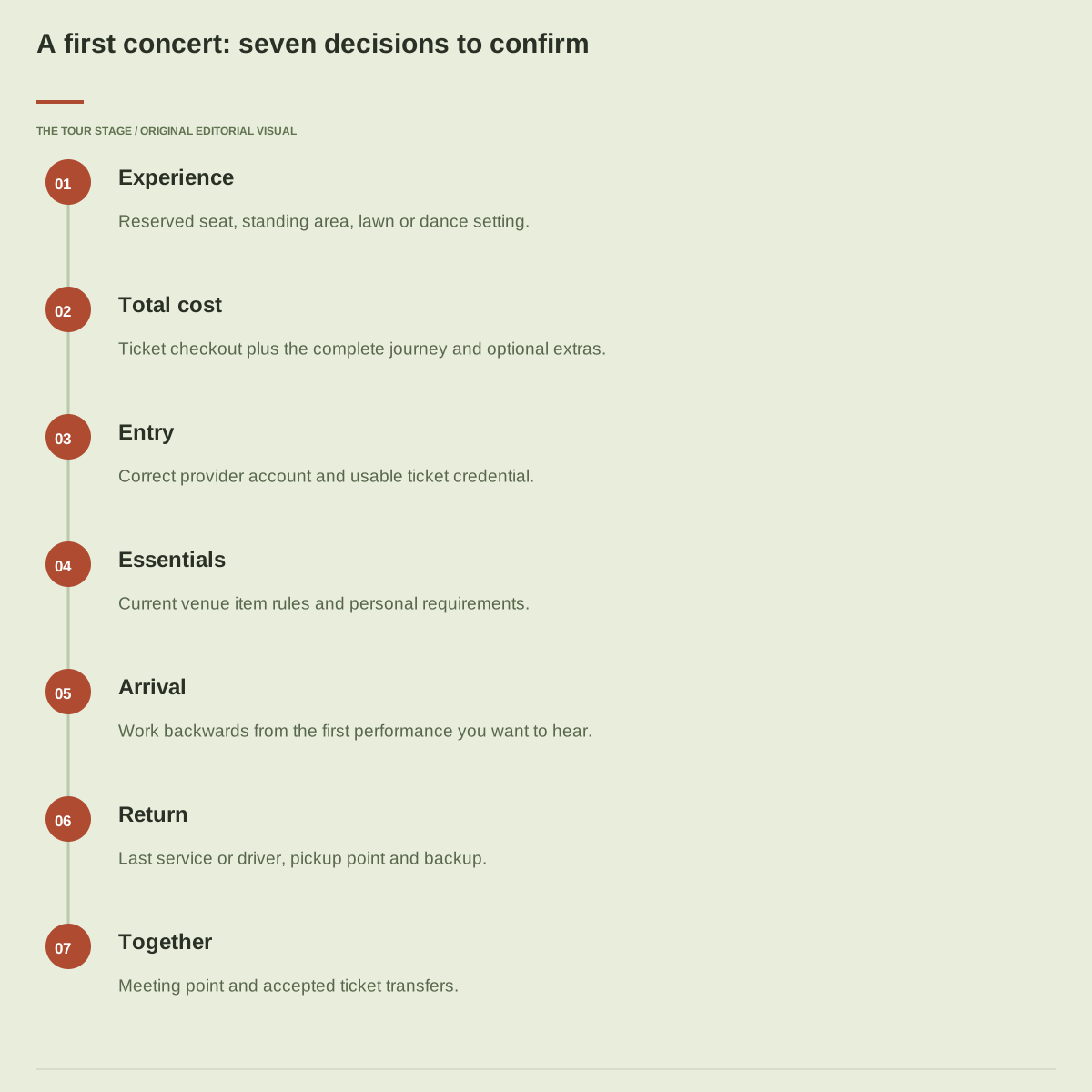
A first concert: seven decisions to confirm
- ExperienceReserved seat, standing area, lawn or dance setting.
- Total costTicket checkout plus the complete journey and optional extras.
- EntryCorrect provider account and usable ticket credential.
- EssentialsCurrent venue item rules and personal requirements.
- ArrivalWork backwards from the first performance you want to hear.
- ReturnLast service or driver, pickup point and backup.
- TogetherMeeting point and accepted ticket transfers.
Read the visual as text
- ExperienceReserved seat, standing area, lawn or dance setting.
- Total costTicket checkout plus the complete journey and optional extras.
- EntryCorrect provider account and usable ticket credential.
- EssentialsCurrent venue item rules and personal requirements.
- ArrivalWork backwards from the first performance you want to hear.
- ReturnLast service or driver, pickup point and backup.
- TogetherMeeting point and accepted ticket transfers.
Read the event map as a description of access
The event-specific seating map matters more than a generic photograph of the room. Locate the stage, your section and any floor zones. A floor ticket may mean a chair or a standing area; general admission describes an allocation method, not one guaranteed physical arrangement. Restricted-view notes deserve attention even when the section looks close to the stage.
Think about how you want to watch. A raised side section may offer an easier view over a standing audience, while a floor position can feel close but place heads between you and the performer. A seat does not guarantee everyone around it remains seated. If you need step-free routes, a particular seat feature or assistance, check arrangements before buying. The seat-selection guide explores sightlines, and the accessibility guide provides a more detailed set of booking questions.
Keep the venue’s rules attached to that venue
Policies are specific to the building and sometimes to the performance. For example, Ryman Auditorium says its camera policy can be set by the promoter or performer.1 That is a useful warning against packing from another fan’s old photograph. Check the current page for bags, cameras, water, medication, age restrictions and any other item you need to bring.
Make a short list with two columns: confirmed and still to ask. A bag that fits one venue’s policy may fail another’s. An accessibility arrangement that worked on a previous tour may need organising again. Keep the official event link in your notes so you can recheck it shortly before departure. This is not an invitation to pack for every hypothetical problem; it is a way to take fewer items with more confidence. Carry essentials in the simplest arrangement the actual policy permits.
Separate the receipt from the ticket you will scan
A purchase confirmation tells you the order exists. It may not be the ticket used for entry. Ticketmaster’s mobile-ticket information explains access through the app or supported mobile-wallet route and warns against using a forwarded screenshot as a substitute.2 Other providers have their own systems, so follow the instructions attached to your order.
Open the account while you still have time to recover a password or update an app. Confirm that the correct event and ticket quantity appear. If friends will arrive separately, check whether official transfer is available and make sure recipients complete the process. An invitation sitting unread is not a finished handover. The mobile-ticket guide explains delivery, acceptance and entry separately. Charge the phone and know where to seek box-office help if something is unresolved; a screenshot of a receipt can be useful order evidence without being a valid entry credential.
Work backwards from the first act you want to see
Doors, support and headline times answer different questions. Doors describe when entry begins; the advertised start may refer to the first performance rather than the headline artist. Use the event’s published information and avoid assuming every tour runs to the timetable you saw in a social post. If no detailed schedule is published, plan around the stated start and treat the exact set order as unknown.
Work backwards through your own tasks: reaching the entrance, security, finding the section and any food or restroom stop. Then add a buffer that reflects your transport and needs. There is no universal arrival time that guarantees the front of a standing crowd or eliminates every queue. A modest earlier arrival can, however, turn an unfamiliar building into a manageable place. Locate the exit, guest services and the way back to your transport before the room becomes busy.
Plan for listening, comfort and changing conditions
Choose footwear for the actual walking and standing involved rather than an imagined dress code. Check the outdoor forecast close to departure and consider the temperature during the journey home, not only the afternoon. For an indoor event, layers can help with transitions between street, concourse and seat. Pack only what the venue allows.
Health Canada’s guidance for entertainment events recommends hearing protection, distance from loudspeakers and breaks from loud sound.3 A seat farther away is not a promise of a safe exposure level, and discomfort is a reason to move or seek help rather than something to prove you can tolerate. For a family visit, use the children’s planning checklist. Build breaks into the plan if they help you enjoy the evening. Protecting your capacity to listen is part of making the music more enjoyable.
Treat support acts as part of the ticket
An opening set is a chance to encounter an artist in a different setting from a short online clip. Give yourself enough time to hear at least some of the performance if the bill interests you. Listen for one song or instrumental detail to investigate later rather than trying to learn a whole catalogue overnight.
You also do not need to know every song to belong in the room. A first concert can be enjoyable precisely because it contains surprises. Avoid filming so much that your screen blocks the view or replaces your own attention, and follow the event’s recording rules. If you want to remember a song, a brief written note after the set can be more useful than an indistinct video. Other fans may stand, sing or dance within the venue’s rules; ask staff for help with a problem rather than assuming you must settle it yourself.
Make the journey home a real booking decision
Before leaving, identify the correct parking area, public-transport stop or authorised pickup point. Check the last practical service for your date and direction, then decide what happens if the show runs beyond that option. A theoretical bus route is not a return plan unless a service operates when you need it. If driving, settle the driver arrangement in advance.
Choose a meeting point your group can describe without relying on a tiny moving map dot in a crowded street. Keep enough phone charge for the return trip. A planned departure buffer is more useful than assuming you will be at the kerb the instant the final song ends. You may need time to leave the section, reach the exit and walk to the pickup zone. The evening is complete when everyone reaches the intended destination, so protect that final step with the same attention you gave the tickets.
Your final check fits on one page
Keep the checklist short: correct event, correct tickets, permitted essentials, route in, route out, meeting point and any confirmed arrangements. Add one line for the question still unanswered and resolve it through the venue or provider before departure. Save the relevant official links with your notes so that a last check does not become a search through old messages.
After the concert, note one thing that worked and one you would change. Perhaps a different section would improve your view, a meal earlier in the evening would help or an opening artist deserves a full listening session. That turns a first experience into useful knowledge for the next one. For a trip that includes an overnight stay, the concert-weekend template expands this approach into two flexible days without turning every hour into an appointment.
Sources & further reading
- Ryman Auditorium FAQCurrent venue-specific bag, camera and visitor policies; reviewed November 2026.
- Ticketmaster: mobile ticketsProvider-specific mobile ticket access and screenshot limitations.
- Health Canada: protect your hearingOfficial guidance on distance, hearing protection and breaks at entertainment events.