Read the year on every programme page
The AMERICANAFEST landing page now points toward 2027 wristbands, while its FAQ and several programme pages still describe 2026. This guide uses the completed September 15–19, 2026 edition as the documented example of how the event works; its detailed entitlements should not be silently treated as the next edition’s contract.12
The distinction is useful rather than merely administrative. You can decide whether the showcase-and-conference model suits you before the entire next programme exists, while reserving exact dates, venues and pass benefits for the matching published edition. Label saved material by year. When a search result leads to an artist or event you particularly want to see, establish whether it is an archive, a past announcement or the programme you are actually purchasing.
Think of a venue network, not one field
The organiser’s August 2026 announcement described a schedule across more than fifty venues with showcases, panels and special events. Those figures describe that edition, not a forecast. The important planning implication is the distributed structure: moving between rooms is part of the experience rather than an occasional detour.3
Choose one geographic cluster for an evening, then decide whether a particular performance is worth leaving it. A programme can look manageable when read as a list of start times and become unrealistic once travel, queues and entry are added. Put the venue address beside every saved set. If two shows overlap, make a positive choice about the one you want to hear fully. The goal is not to collect the greatest number of rooms but to find several performances you can actually attend with your attention intact.
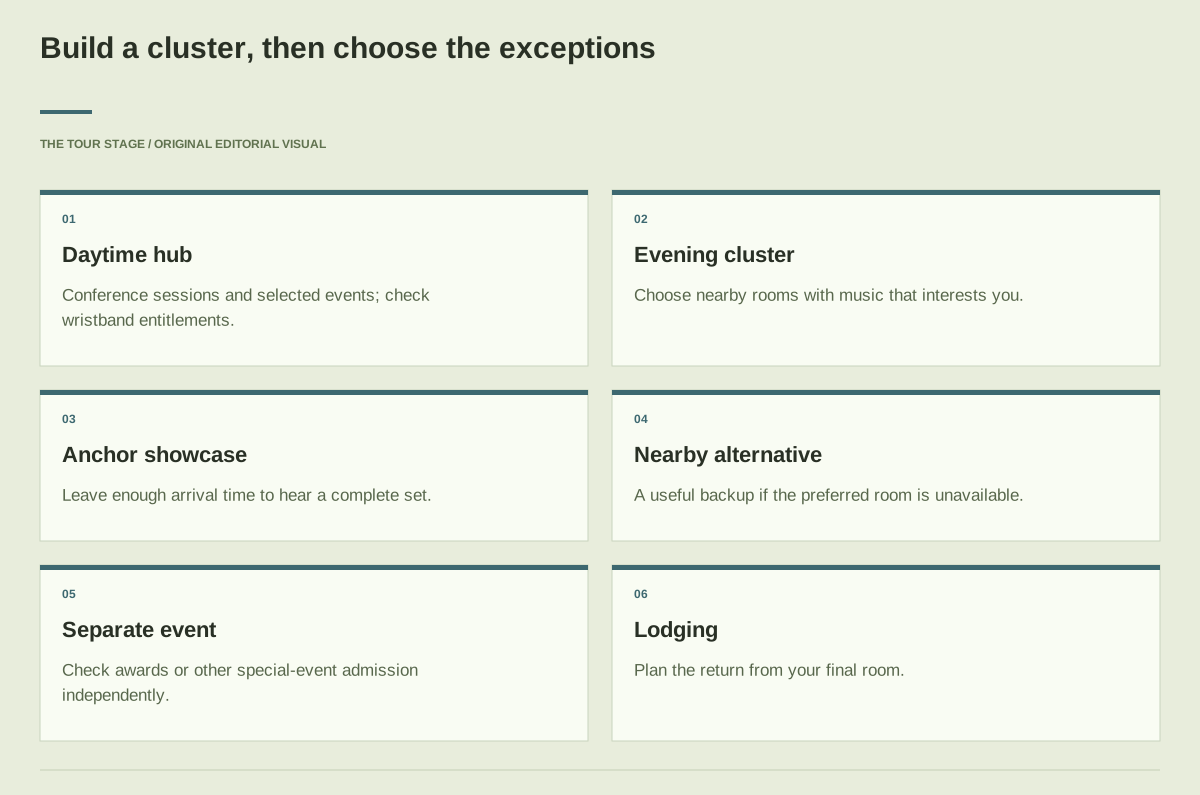
Build a cluster, then choose the exceptions
- Daytime hubConference sessions and selected events; check wristband entitlements.
- Evening clusterChoose nearby rooms with music that interests you.
- Anchor showcaseLeave enough arrival time to hear a complete set.
- Nearby alternativeA useful backup if the preferred room is unavailable.
- Separate eventCheck awards or other special-event admission independently.
- LodgingPlan the return from your final room.
Read the visual as text
- Daytime hubConference sessions and selected events; check wristband entitlements.
- Evening clusterChoose nearby rooms with music that interests you.
- Anchor showcaseLeave enough arrival time to hear a complete set.
- Nearby alternativeA useful backup if the preferred room is unavailable.
- Separate eventCheck awards or other special-event admission independently.
- LodgingPlan the return from your final room.
Understand the conference and showcase relationship
The 2026 materials describe a Silver Wristband connecting festival showcases with daytime conference programming and sanctioned events. The FAQ says membership is not required to attend, although members may receive a different purchase rate. Its detailed terms also distinguish event-specific access conditions; read the matching wristband page before assuming an activity is included.24
Decide whether you want daytime learning, evening music or a combination. Someone interested in songwriting careers or the working music community may value a panel as much as a concert. Someone visiting primarily to discover records should still consider a carefully chosen conversation that adds context to what they hear at night. Value is measured by the programme you will use, not by the longest list of theoretical inclusions. Ask a focused ticketing question when a specific event will determine your purchase.
Treat the Honors & Awards as a separate check
The official organisation presents its Honors & Awards alongside AMERICANAFEST, but a close relationship between events does not establish identical admission. Its 2026 awards announcement describes ticket access for Silver Wristband holders, demonstrating that a wristband and an awards seat need to be understood through the stated process rather than equated automatically.5
If the ceremony matters to your visit, investigate its booking terms before setting the rest of the itinerary around it. Note whether a product includes an actual seat, an opportunity to purchase or another form of access. Do the same for receptions, reservations and separately ticketed special events. A clear admission ledger avoids a disappointing evening in which the group meets for an event but discovers that its confirmations describe different things. Keep the final ticket or reservation alongside the wristband purchase details.
Build a showcase route from musical curiosity
Use Brandy Clark, American Aquarium and Gabe Lee as a listening exercise in lyrical detail, band dynamics and vocal storytelling. These are examples for roots-music discovery, not a claim about a future showcase bill. Compare how each recording builds a scene and leaves room for the singer.
Then choose a few unfamiliar artists from the actual programme, listening to more than one song by each. Mark one specific reason you want to hear them live: a harmony arrangement, a guitar conversation, a distinctive narrator or a change between restraint and force. The country and Americana guide can help with the broad musical overlap, while artist discovery offers a practical next step. A good showcase choice begins with curiosity about the music rather than the fear of missing a fashionable room.
Choose a panel with a question you can take away
A conference session is most useful when you know what you hope to understand. Before selecting one, write a question about a process: how a songwriter chooses a collaborator, how a recording takes shape or how an artist presents unfamiliar material live. Then choose the actual published session whose speakers and topic address it. Do not assume a broad industry title promises personal advice or access to a particular person.
At the session, listen for the distinction between one speaker’s experience and a rule about the whole music business. A musician describing a successful choice offers evidence about that choice, not a guarantee that every career follows it. Record the idea you can test through listening afterward. You might compare the arrangement described in a discussion with the finished recording, or notice how a showcase performer talks about the writing before playing the song. That links the daytime programme to the evening music.
Leave time after a worthwhile conversation to reflect rather than immediately racing to another room. If you speak to someone, be considerate of their time and the setting; a public event is not an entitlement to a private meeting. A few relevant questions and a useful note can be enough. For a music fan without professional ambitions, the conference can still enrich the visit by revealing the choices behind records and performances. Its value lies in understanding more of what you hear, not in collecting the most crowded schedule.
Protect full sets and make alternatives nearby
The 2026 official mobile-app announcement directs visitors to a consolidated schedule containing showcases, panels and special events. That makes the official timetable the starting point, with individual admission conditions checked alongside it. A saved personal schedule expresses your preferences; it does not reserve physical capacity in every room.3
For each essential set, make a nearby alternative that interests you. Avoid an alternative requiring another long journey, because that simply repeats the original timing problem. Arrive with enough margin to locate the entrance and settle in without interrupting a quiet performance. If you stay for several artists in one room, you may hear relationships between their styles that a rapid venue-hopping plan would miss. Leave space to respond to a discovery: an unexpectedly strong set can justify changing the next hour.
Choose lodging through the late-night return
The organiser provides travel and lodging information from the event navigation. Use it as a starting point, then inspect the precise address and booking conditions of the property you choose.1 A central-sounding neighbourhood name does not establish a comfortable journey from your final showcase venue.
Estimate the return from the cluster you intend to use most, and keep an alternative for an evening ending elsewhere. If sharing rides, agree where the party will meet after its final performances rather than expecting everyone to leave the same room. Do not schedule an early morning panel simply because it is interesting on paper if the previous night leaves no realistic sleep. One well-chosen daytime session heard attentively is more useful than several attended while exhausted. Put meals and travel into the weekend planner as real activities.
Bring discoveries home in a useful form
Keep a short listening notebook: artist, song or album to revisit, venue and one observation about the performance. Avoid trying to write a full review while another song is underway. A few precise notes make it easier to find the recording later and remember why the live version mattered.
After the visit, build a small route linking the artists you discovered rather than a huge playlist you never replay. Listen once for the writing, once for the instrumental relationships and once for what the recording changes from your memory of the room. Use the live-album guide to think about that difference. AMERICANAFEST is rewarding when the distributed programme becomes a set of connected musical experiences. A selective route, clear admission checks and realistic journeys leave room for those connections to develop.
Sources & further reading
- AMERICANAFEST official landing page2027-facing wristband messaging; official travel and event navigation.
- Americana Music Association FAQ2026-context pass/conference model and membership distinction; summarized concisely.
- Official 2026 schedule announcementCompleted September 15–19, 2026 edition; distributed programme and official scheduling tools.
- AMERICANAFEST wristband page2026-labelled wristband purchasing and admission context.
- 2026 Honors & Awards announcementAwards tickets offered to Silver Wristband holders; does not imply an included awards seat.