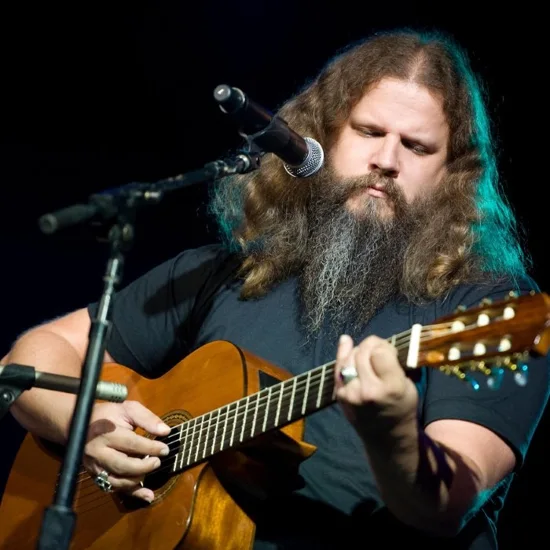
The argument was about making records
Long hair, denim and an unruly public persona are easy to reproduce. Control over repertoire, musicians, arrangements and recording conditions is harder to see, but it is central to understanding the outlaw era. The historical movement did not produce one standard sound. Willie Nelson’s flexible phrasing and sparse dramatic settings differ from Waylon Jennings’s forceful rhythmic identity, even though the two became closely connected in public memory.
The Country Music Hall of Fame describes Nelson’s return to Texas in 1970, the freer atmosphere he found around Austin, and his association with Jennings. That history matters because audiences and working conditions helped make different choices possible. It does not support a simple claim that creative music existed only outside Nashville. Musicians, songs, managers and labels continued to connect the places that the popular story sometimes presents as enemies.1
Texas and Nashville were linked, not sealed off
Nelson’s 1973 Atlantic period provides a concrete bridge. The museum identifies Shotgun Willie and Phases and Stages among the projects he recorded for the label, as well as his first annual July Fourth picnic in 1973. Records and live gatherings served different purposes: an album could organise a sustained artistic statement, while a public event could bring audiences and performers into a shared space.1
Hear this context without turning geography into destiny. A Texas address did not guarantee creative freedom, and a Nashville studio did not prevent it. Ask what a particular artist negotiated or chose, then listen to the result. A close, conversational vocal may express independence differently from a hard-driving band. The Texas-country guide follows the wider regional ecosystem, while this article keeps the historical question of control in the foreground.
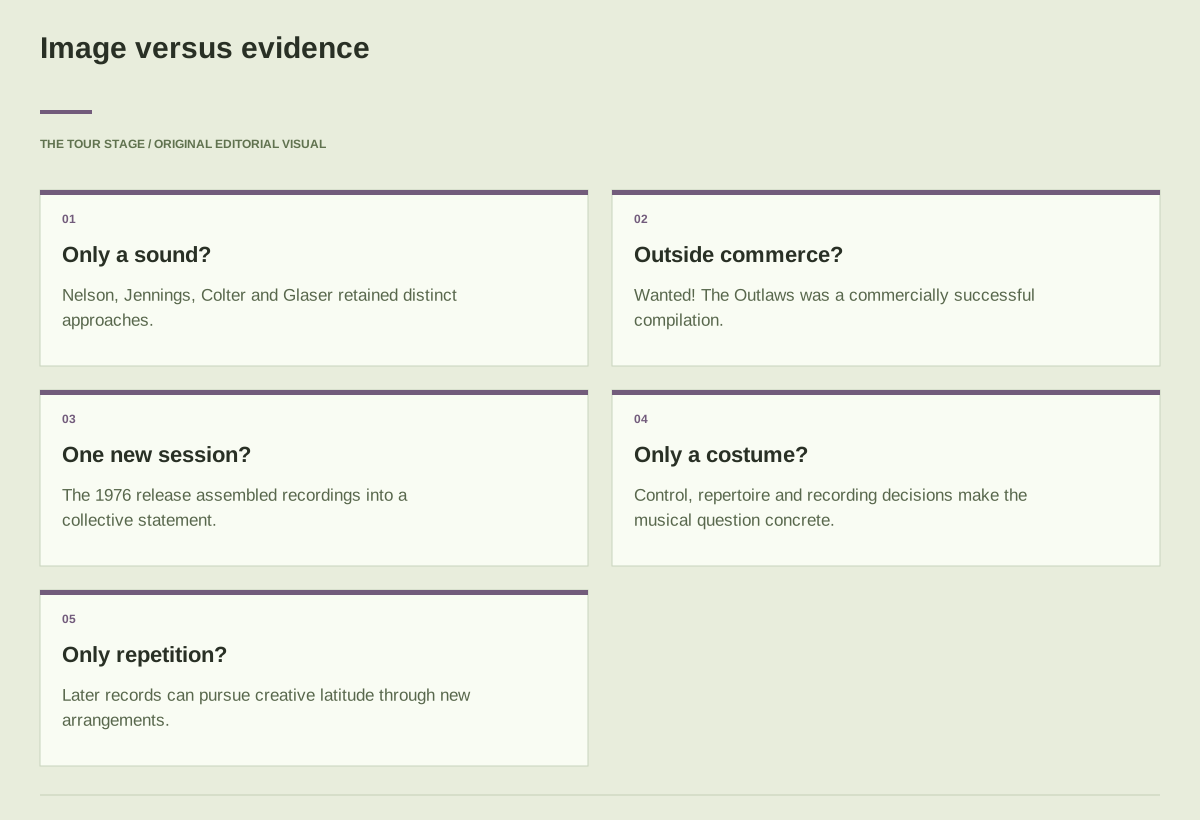
Image versus evidence
- Only a sound?Nelson, Jennings, Colter and Glaser retained distinct approaches.
- Outside commerce?Wanted! The Outlaws was a commercially successful compilation.
- One new session?The 1976 release assembled recordings into a collective statement.
- Only a costume?Control, repertoire and recording decisions make the musical question concrete.
- Only repetition?Later records can pursue creative latitude through new arrangements.
Read the visual as text
- Only a sound?Nelson, Jennings, Colter and Glaser retained distinct approaches.
- Outside commerce?Wanted! The Outlaws was a commercially successful compilation.
- One new session?The 1976 release assembled recordings into a collective statement.
- Only a costume?Control, repertoire and recording decisions make the musical question concrete.
- Only repetition?Later records can pursue creative latitude through new arrangements.
Wanted! The Outlaws was a compilation
The 1976 Wanted! The Outlaws project brought together recordings associated with Jennings, Nelson, Jessi Colter and Tompall Glaser. The museum’s filmed conversation with Colter explicitly identifies it as a compilation and documents its significance as country’s first certified-platinum album. That distinction matters: the release was not simply four artists arriving together to invent a sound in one new studio session. Curation and marketing helped turn separate careers into a collective public statement.2
Colter also belongs in the story as an artist, not a footnote attached to Jennings. Naming all four participants changes the picture from two rebellious men to a broader set of voices and recordings. Listen to the contrasting deliveries rather than expecting uniformity. The compilation’s impact is evidence that a public could recognise a shared proposition across differences. It is not evidence that every participant pursued the same musical approach or had the same experience of the industry.
Test the familiar myths
The first myth is that outlaw means aggressive music. A restrained performance can be artistically uncompromising; volume does not measure control. The second is that an outlaw artist must write every song. Selecting and interpreting someone else’s writing can be a deliberate artistic act. The third is that the movement sat entirely outside commerce. Major labels and successful packaging were part of the documented history, so popularity cannot logically disqualify every record from it.
A fourth myth treats personal danger as a credential. That approach distracts from the musical work and turns complicated lives into a costume. When listening, replace the image test with practical questions: whose songs were selected, what does the band sound like, what shape does the album take, and what decisions are supported by interviews or credits? Keep the difference between a documented production choice and an inference you make from the recording.
Jamey Johnson: weight without constant force
Jamey Johnson’s official catalogue dates That Lonesome Song to 2008 and The Guitar Song to 2010. These records offer a later listening route into country that can feel substantial without a constant rush of activity. Start with a vocal line and the space around it. A low voice, deliberate pacing and an instrumental response can create pressure more effectively than an uninterrupted display of power.3
Later artists are often described as outlaw because of audible tradition, public independence or an unwillingness to fit a narrow format. Those are different claims and should be separated. Johnson’s recordings are useful here as music to compare, not as proof that a seventies movement simply restarted intact. Ask which habits seem connected and which are specific to his performance. Our ballad feature examines the expressive possibilities of such restraint.
Shooter Jennings and Sturgill Simpson complicate inheritance
Shooter Jennings’ official release list includes Put the O Back in Country, while the MCA store dates that debut to March 2005. Listen to “4th of July” as a record with its own construction rather than a surname made audible. The label notes that the album version includes a George Jones cameo omitted from the radio edit, a useful reminder to identify the actual version under discussion.4
Sturgill Simpson’s official Bandcamp catalogue locates Metamodern Sounds in Country Music in 2014. Its title alone signals a conversation between an established musical vocabulary and a different conceptual frame. Listen for the point at which a recognisable country voice meets an unexpected texture or turn in the arrangement. A later artist can inherit the freedom to change, rather than an obligation to repeat an earlier sound.5
Use history to sharpen the listening
Build a session around one Nelson or Jennings recording from the era, one Colter selection, then Johnson, Shooter Jennings and Simpson. For each, distinguish the historical fact you know from the musical impression you hear. “This was included on a compilation” is a release fact; “the vocal sounds unhurried” is a listening judgment. Both are useful, but they should not silently substitute for one another.
The visual below pairs popular shortcuts with more precise evidence. Continue to independent country for modern release structures and country rock for the interaction of songs and electric bands. Outlaw country becomes richer when the marketing image remains only one part of the explanation. The lasting question is how artists found the conditions to make distinctive records, and how listeners learned to recognise the resulting differences as something worth following.
Sources & further reading
- Country Music Hall of Fame: Willie Nelson1970 Texas return, Austin, 1973 Atlantic projects and picnic.
- Jessi Colter museum interview1976 compilation, four participants and platinum milestone.
- Jamey Johnson official catalogue2008 and 2010 album chronology.
- MCA: Shooter Jennings debut2005 release and album/radio version distinction.
- Sturgill Simpson official Bandcamp2014 album catalogue.